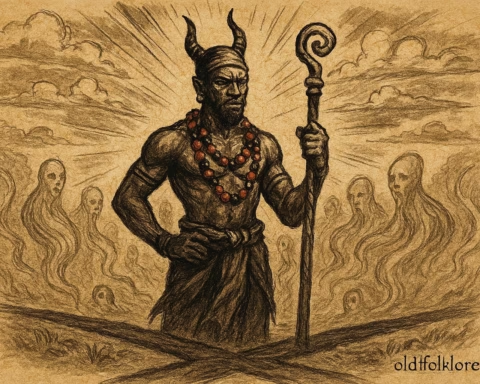
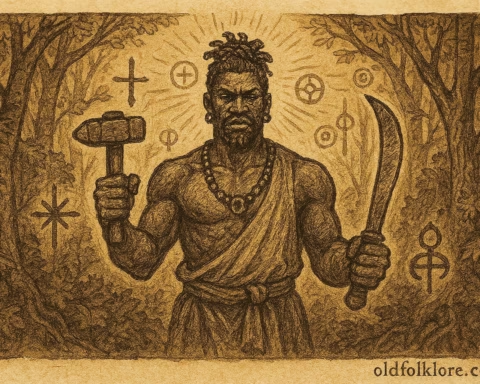
Ṣàngó (also spelled Shango, Sango, or Xangô in the diaspora) is one of the most revered and fearsome Orishas of Yoruba religion. He governs thunder, lightning, fire, drumming, power, and the very force of kingship. His presence crackles like a storm: sudden, bright, unpredictable, yet bound to divine order and morality.
He carries the oshe, a double-headed axe symbolizing balanced justice, and his sacred colors are red and white. As a historical king of Oyo later deified, Ṣàngó embodies authority, charisma, and the burdens of leadership.
Lightning stones, called edun àrá, are believed to mark where Ṣàngó’s power has struck. His worship involves vigorous drumming, bata rhythms, spirit possession, and offerings of ram, kola nut, and palm oil. Across the Afro-diasporic world, from Brazil’s Candomblé to Cuba’s Santería, Ṣàngó remains a central figure of strength, righteous fury, and protection.
MYTHIC STORY: The Judgment of Thunder
In the old days, when the Oyo kingdom was young and the forests still whispered with spirits, there lived a chief named Ajékanje, whose authority stretched across several villages. His people once honored him, for he came from a lineage of warriors. But power, when left unchecked, can turn from stewardship into hunger. Ajékanje’s heart grew dark with arrogance. He seized farmland, demanded impossible tributes, and punished dissent with cruelty. His people trembled beneath him, their prayers rising in secret so the chief’s spies would not hear.
The elders watched the growing suffering with pain. They poured libations at the shrine of Ṣàngó and asked, “Lord of Thunder, will you allow injustice to rule the land?”
For Ṣàngó is no indifferent deity. He listens to the cries of the oppressed, and the fire in his heart burns whenever the scales of justice tilt too far. Though unpredictable, his fury has purpose: to restore cosmic order.
Weeks passed in tense silence, as if the sky itself were waiting.
Then, on a moonless night, a strange wind swept through the village, hot, electric, humming with pressure. Animals grew restless, children clung to their mothers, and the seasoned elders whispered, “Ṣàngó is awake.”
Clouds gathered without rain, thick and heavy. Thunder rolled like footsteps approaching from afar. Ajékanje stood outside his compound, dismissing the villagers’ fear. “It is only weather,” he scoffed, unaware his arrogance echoed into the heavens.
The storm broke suddenly.
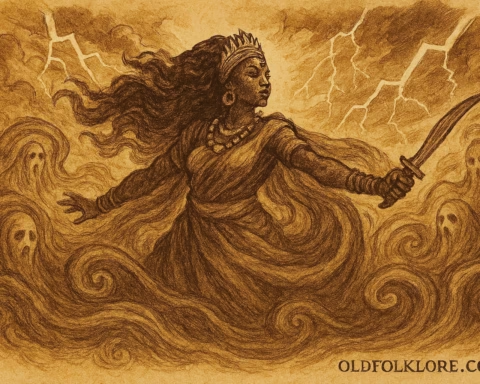
Lightning split the sky into a hundred white veins. The earth shook. Thunder roared like a war drum. From the swirling clouds descended a blaze of crimson light. Though no mortal saw his full form, all felt him, Ṣàngó, clad in fire, crowned in lightning, the ground trembling beneath the weight of his presence.
A bolt struck the chief’s roof, splitting the pillars with explosive force. Flames surged upward as if eager to reveal corruption. A second thunderbolt shattered the granaries where Ajékanje had hoarded food during famine. A third struck the earth before him, blinding him with the brilliance of divine judgment.
Ajékanje fell to his knees, trembling. “Mercy, Ṣàngó! Do not take my life!”
But the storm did not answer. Instead, the thunder rolled with the heavy finality of truth exposed.
Villagers poured into the compound, witnessing the destruction. They saw their chief reduced to a broken, humbled man, not slain, but stripped of the illusions that shielded his cruelty. When lightning struck again, it scorched symbols of his authority: the staff he used to intimidate his subjects and the drum he beat to summon forced labor.
The people realized then that this was no senseless punishment but a divine warning.
As the flames died down, the storm softened. The air cooled. A gentle rumble, less a threat, more a reminder, passed overhead, and the sky slowly cleared. Only smoke curled into the moonlight, carrying the scent of thunder.
The elders gathered the villagers and spoke:
“Ṣàngó has acted. Let us restore order.”
Under their watch, Ajékanje stepped down. The people rebuilt what had been destroyed; the fields were redistributed, the hoarded grain returned to the families who had suffered. At the shrine of Ṣàngó, they offered kola nut, ram’s blood, and praise-songs of gratitude.
From that day onward, no one in the region doubted the authority of the Thunder Lord. Stories of the night Ṣàngó shattered tyranny spread across Yoruba lands and later crossed the Atlantic with enslaved peoples, surviving in diaspora traditions. Wherever his name is spoken, the memory remains: Ṣàngó punishes injustice not from cruelty, but from the cosmic duty to set the world right.
Discover the gods, goddesses, and divine spirits who ruled the heavens and shaped human fate
Author’s Note
Ṣàngó’s myth teaches that power without conscience collapses under its own weight. His thunder is not merely destruction but illumination, exposing lies, restoring balance, and reminding humanity that justice is woven into the fabric of the universe. Through him, the Yoruba tradition affirms that moral order is sacred and that no ruler stands above the laws of the cosmos.
Knowledge Check
Q1: What domain does Ṣàngó govern?
A: Thunder, lightning, fire, justice, and kingship.
Q2: What symbol is Ṣàngó most associated with?
A: The oshe, a double-headed axe representing divine justice.
Q3: How did Ṣàngó punish Chief Ajékanje in the myth?
A: By striking his compound with thunder and lightning to expose his wrongdoing.
Q4: What objects are believed to mark Ṣàngó’s lightning strikes?
A: Edun àrá (lightning stones).
Q5: In which culture and region does Ṣàngó originate?
A: Yoruba culture, Southwestern Nigeria.
Q6: How is Ṣàngó honored in worship?
A: Through drumming, offerings, spirit possession, and rituals of praise.
Source: Yoruba Oral Tradition, Nigeria.
Source Origin: Yoruba, Nigeria