Loundja, Daughter of Tseriel, is a Kabyle folktale from Algeria recorded in Taos Amrouche’s collection Le grain magique. It tells the story of a young hunter who searches for Loundja, the beautiful daughter of an ogress. After finding her in a secluded house, he persuades her to escape with him. Their journey brings further danger when an eagle carries the young man away, forcing Loundja to find a way to reunite with him. The tale combines magical encounters, disguise, danger and an unexpected ending.
The Young Hunter Searches for Loundja
Once upon a time, during winter, two young men went hunting in the mountains. They killed a partridge, and as its blood stained the white snow, one of them remarked that he would be fortunate to marry a woman whose complexion was as white as snow and as red as blood.
His companion told him that such a woman existed. Her name was Loundja, and she was the daughter of Tseriel, a fearsome ogress.
Eager to find her, the young man asked where she lived. His companion pointed towards a distant place in the mountains.
The hunter left his companion behind and set off with his gun over his shoulder. He walked throughout the day and night until he entered a forest and noticed smoke rising above the trees.
Following the smoke, he discovered a small house surrounded by a hedge of thorns.
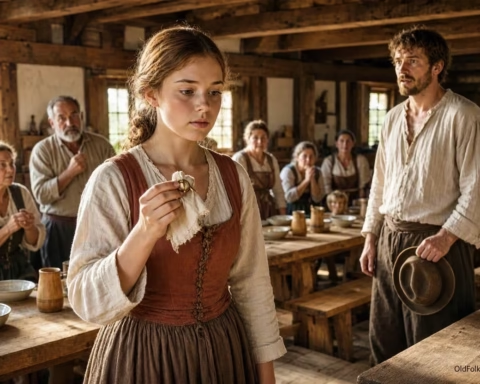
He called out, and a beautiful young woman appeared. Her complexion matched the description he had heard, white as snow and red as blood.
The young man explained that he had lost his way and asked for shelter for the night. Loundja welcomed him inside and told him that she was the daughter of Tseriel, an ogress whose return was expected at sunset.
She gave him food and drink. As night approached, she hid him in an underground space and covered its entrance with a large wooden dish.
Tseriel Returns Home
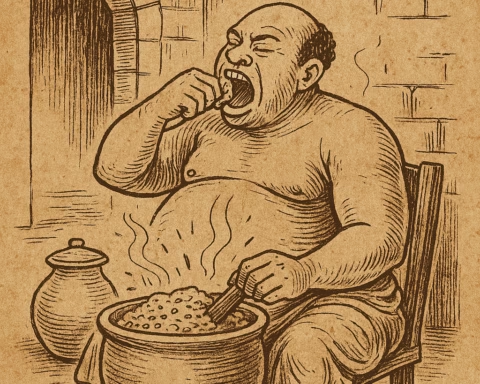
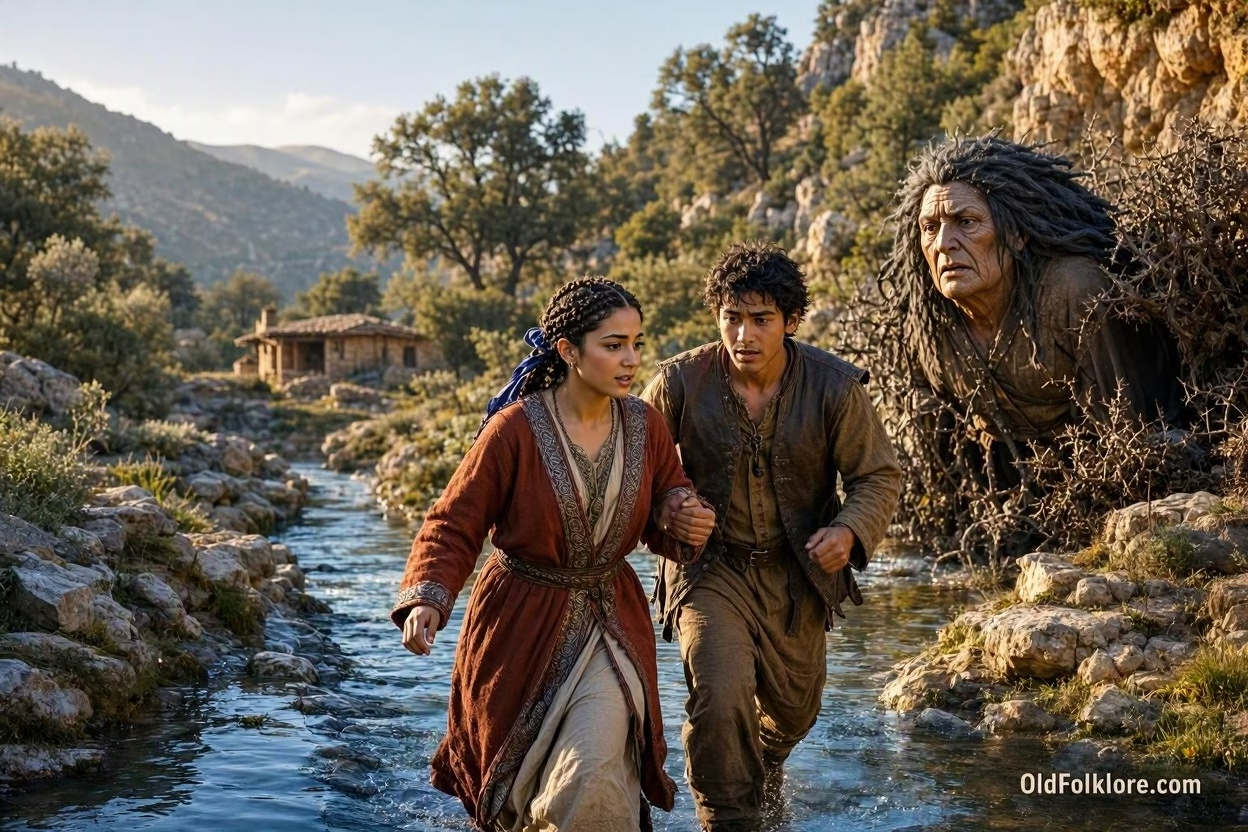
Before long, Tseriel returned from the hunt. She was enormous, and her head resembled a thick bush of thorns.
As soon as she entered the house, she sniffed the air and declared that she could smell a human being.
Loundja explained that a beggar had visited earlier and that she had given him food in charity. Tseriel accepted the explanation and asked for her evening meal.
After eating, the ogress announced that she intended to apply henna to her wooden dishes and bowls. She called each one by name, and they came to her in turn.
However, the dish covering the underground hiding place remained where it was.Explore more stories from our West African Folk-Tales collection.
Tseriel called it again, but Loundja asked her mother to leave it until the following day because she was comfortable sitting on it. Since the ogress loved her daughter, she did not insist.
Eventually, Tseriel fell asleep.
Loundja pretended to sleep too, but she remained alert. She waited until she heard the sounds of the animals her mother had swallowed during the day. When the cattle, sheep, goats, donkey and chickens began making noises inside the ogress, Loundja knew that her mother was sleeping deeply.
She uncovered the hiding place and told the young man to escape quickly.
He refused to leave without her, explaining that he had come in search of her. Loundja agreed to accompany him, and together they slipped out of the house.
The Escape Through the Thorn Hedge
Outside, a thick hedge of thorns blocked their way.
Loundja addressed it with a magical plea: she asked the hedge to become a hedge of honey and butter and let them pass.
The hedge opened, allowing them through, and closed behind them.
They hurried onward until they reached a turbulent river. Loundja again used her words, asking the river of honey and butter to let them cross.
The waters parted, and the young woman and the hunter reached the opposite bank safely.
When Tseriel awoke, she discovered that her daughter had escaped. Realising that Loundja had deceived her, she rushed out in pursuit.
At the thorn hedge, the ogress demanded passage, but the thorns grew sharper and larger. Although she managed to force her way through, they tore at her feet and clothes.
She continued chasing the fugitives until she reached the river.
Tseriel ordered the river to open for her, but it refused. She threw herself into the water, and a huge wave swept her away. Before disappearing beneath the water, she cursed her daughter for abandoning her.
By then, Loundja and the young hunter had travelled far from the ogress’s home.
The Eagle Carries the Young Man Away
As the couple crossed the mountains towards the young man’s village, they came upon two eagles fighting.
The young man used a stick to separate the birds. However, the larger eagle retaliated by catching him beneath its wing and carrying him into the sky.
Loundja cried out in despair, believing that after betraying her mother, she had now been betrayed herself.
Before disappearing, the young man managed to give her instructions. He told her to continue towards his village, where she would meet a female servant arriving with donkeys and water containers.
He instructed Loundja to disguise herself using the servant’s skin and follow the donkeys to his father’s house. There, she was to explain that an eagle had carried the young man away.
Loundja followed the instructions and eventually reached the servant at a fountain. After the encounter described in the source, she assumed the disguise and followed the donkeys to the young man’s home.
When she arrived, she told his father that his son had been carried away by an eagle.
The Father’s Plan to Rescue His Son
The young man’s father waited several days, hoping the eagle would release his son. When nothing changed, he sought the advice of a wise old man.
The wise man reassured him that the young man was probably still alive. He explained that the eagle carrying him would become too heavy to fly easily after feeding.
He advised the father to climb the highest mountain and sacrifice a fine, well-fed heifer. When the eagles descended to feed, the father should identify the largest bird and strike its wing with a reed.
The father followed this advice.
He climbed the mountain, sacrificed the heifer and waited for the eagles to arrive. As they fed, he watched the largest bird become too heavy to take flight easily.
When the eagle attempted to fly away, the father struck its wing with a reed. The young man fell into the grass below.
He was weak and thin from hunger, but his father rescued him and carried him home.
Loundja cared for the young man, feeding him grilled meat, eggs, honey, butter and fruit until he regained his strength.
An Unexpected Marriage
After recovering, the young man approached his father with an unexpected request. He announced that he wanted to marry the woman who appeared to be a dark-skinned servant.
His father objected, fearing that the marriage would bring shame upon their family. However, the young man insisted that he would marry her or die.
Eventually, the marriage took place. Loundja received rich gifts, and another servant was employed in the household.
That night, the young man removed the disguise concealing Loundja’s appearance.
The following morning, the new servant entered the couple’s room with their breakfast. She was astonished to discover Loundja’s beauty and hurried to tell the household that the bride was not what everyone had believed.
The family gathered to witness the surprising revelation.
The Younger Brother’s Foolish Decision
The young man’s younger brother wanted to know how the transformation had occurred.
His elder brother explained that he had simply commanded the disguised woman to remove her borrowed skin.
The younger brother foolishly assumed that the same approach would work with an animal. Reasoning that a dog might reveal an even more extraordinary beauty, he decided to marry a female dog.
When he was alone with the animal in the marriage chamber, he ordered it to remove its skin.
The dog answered with an angry bark.
He repeated his command, but instead of transforming, the animal attacked and devoured him.
The following morning, a servant entered the room and discovered the terrible scene. She fled in horror, announcing that the young man had been killed and that the dog was crouched over his remains.
The tale ends with this shocking incident, bringing Loundja’s extraordinary journey to a grim conclusion.Explore our complete Algerian Folktales archive.
Moral Lesson
The tale shows the danger of making foolish assumptions and blindly imitating another person’s experiences. It also highlights courage and resourcefulness in the face of unexpected challenges. Its dark ending is characteristic of the story’s unusual and sometimes brutal style.
Knowledge Check
1. Who is Loundja?
Loundja is the beautiful daughter of Tseriel, an ogress in a Kabyle folktale.
2. Why does the young hunter search for Loundja?
He hears about her extraordinary beauty and decides to find her.
3. How does Loundja help the young man escape from Tseriel?
She hides him from her mother and uses magical words to open a path through the thorn hedge and across a river.
4. What happens when the young man separates the fighting eagles?
The larger eagle retaliates by carrying him away beneath its wing.
5. How does the young man’s father rescue him?
Following the wise man’s advice, he attracts the eagles with a sacrificed heifer and strikes the largest eagle’s wing with a reed, causing it to release his son.
6. Why does the younger brother meet a tragic end?
He foolishly believes that marrying a dog and ordering it to remove its skin will reveal a beautiful woman. Instead, the dog attacks and kills him.
Source
Amrouche, Taos. Le grain magique: Contes, poèmes et proverbes berbères de Kabylie. Paris: François Maspero, 1966. “Loundja, fille de Tseriel,” p. 21 onwards.Explore More Algerian Folktales