Once upon a time, in a quiet corner of the countryside, there lived an elderly farmer and his wife in a humble farmhouse. Their home had a thatched roof, crooked walls, a small pond where ducks paddled, and an old tree that offered shade beside the fence. They possessed very little, but their modest life was filled with affection and contentment.
Among their few possessions was a horse. It grazed by the roadside and occasionally helped the couple earn favours from neighbours who borrowed it. Yet the old farmer and his wife began to wonder whether they might be better off exchanging it for something more useful.
One morning, his wife prepared him for the journey to the market.
“It is market day,” she said, straightening his neckerchief and brushing his hat. “Go and sell the horse, or exchange it for something you think we need. Whatever you decide will be right by me.”
Love this story? Discover our full Southern African folktales collection
She kissed him affectionately, and the old man mounted his horse and set off towards town.
The day was hot, and the road was crowded with people travelling to the market. As the farmer rode along, he met a man leading a fine cow.
“That looks like a useful animal,” he thought. “A cow would give us milk, and we could make butter and cheese. She would serve us better than the horse.”
He approached the stranger and proposed an exchange. The man agreed, and the farmer traded his horse for the cow.
He could have returned home immediately, having completed the task his wife had given him. However, he had already decided to visit the market, so he continued along the road, leading his new possession.
Before long, he encountered another man with a healthy sheep covered in thick wool.
“A sheep might suit us even better,” the farmer considered. “We have enough grass beside our fence to feed it, and in winter, we could keep it warm indoors. Its wool would also be useful.”
He offered the cow for the sheep. Once again, the other man readily agreed, and the farmer continued his journey with his new animal.
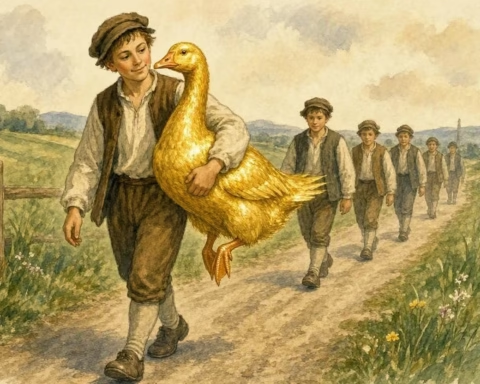
Further along the road, he met a man carrying a large goose beneath his arm. The bird was plump, with plenty of feathers and fat.
The farmer immediately thought of his wife.
“She has often wished for a goose,” he said to himself. “It could wander about our pond, and we might fatten it for a good meal. Perhaps she would prefer it to the sheep.”
He proposed another exchange, offering his sheep for the goose and thanking the stranger for the bargain. The man accepted, and the farmer happily continued towards the market.
As he approached the town, the road became increasingly crowded. People and animals pressed together near the entrance, and the confusion extended into the tollkeeper’s potato field. There, the tollkeeper had tied his only hen by the leg to prevent it from wandering away in the commotion.
The farmer noticed the little bird and stopped to admire it.
“What a fine hen!” he thought. “A hen can find much of its own food, and it will lay eggs. Before long, we might have a whole yard full of chickens!”
He approached the tollkeeper and offered his goose in exchange for the hen. The tollkeeper saw no reason to refuse. The deal was made, and the farmer continued towards the inn, carrying his modest prize.
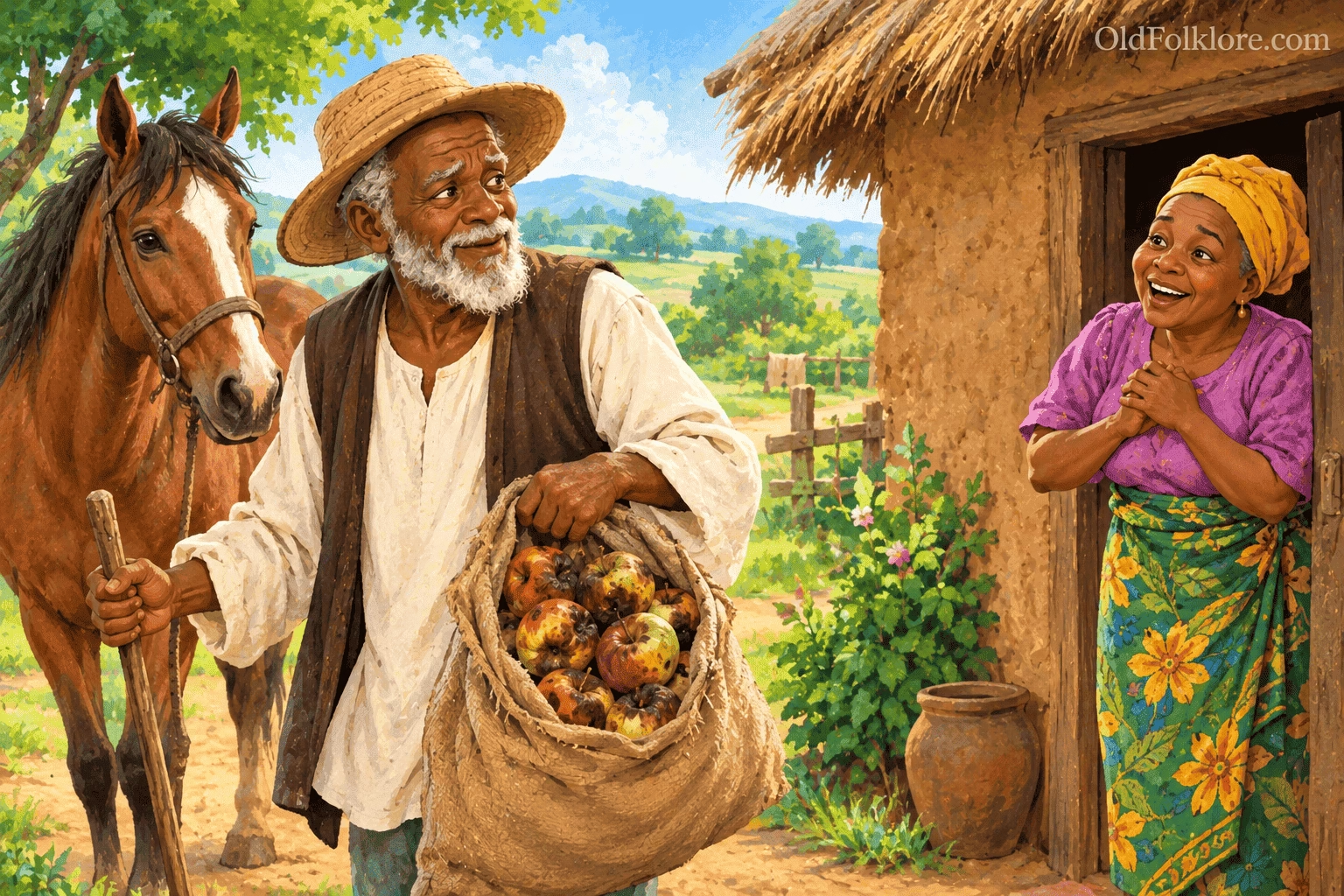
By now, the heat had exhausted him. He wanted something to eat and a small glass of brandy, so he stopped at an inn. At the entrance, he met a stable hand carrying a sack.
“What have you got there?” the farmer asked.
“Rotten apples,” the man replied. “A whole sack of them. They are fit for nothing but feeding pigs.”
The farmer was astonished. At home, their old apple tree had produced only a single apple the previous year, and his wife had treasured it even after it became spoiled. Here was an entire sack of apples that someone considered worthless!
“My wife would be delighted with those,” he said. “Would you exchange them for my hen?”
The stable hand agreed, and the farmer handed over the bird in return for the sack. He carried the apples inside and placed them beside the stove, then sat down to rest.
Unfortunately, the stove was hot. Before long, the rotten apples began to sizzle.
Several people were gathered in the inn, including two wealthy Englishmen whose pockets bulged with gold coins. Curious about the noise, they asked what was happening. The farmer explained how he had traded his horse for a cow, his cow for a sheep, his sheep for a goose, his goose for a hen, and finally his hen for the sack of apples.
One of the Englishmen laughed.
“Your wife will certainly be angry when you arrive home with nothing but rotten apples!”
“Angry?” the farmer replied in surprise. “Not at all! She will kiss me and say, ‘What the old man does is always right.’”
The Englishman found this so amusing that he proposed a wager. He would bet a hundredweight of gold against the farmer’s sack of apples that the farmer’s wife would scold her husband rather than praise him.
The farmer accepted. He even offered himself and his wife as part of the wager, confident that her response would prove him right.
The Englishmen, eager to witness the outcome, accompanied him home.
When the old couple met again, the farmer greeted his wife warmly.
“Good evening, my dear.”
“Good evening, my old man,” she replied, embracing him.
“I have made some exchanges today,” he announced.
“I am sure you have done what is best,” she said affectionately.
“I exchanged the horse for a cow,” he began.
“Wonderful!” his wife exclaimed. “Now we shall have fresh milk, butter and cheese. That was an excellent bargain!”
“But I exchanged the cow for a sheep.”
“Even better! We have enough grass for a sheep, and its wool will provide us with warm clothing. You always think of everything!”
“Then I exchanged the sheep for a goose.”
The woman clapped her hands with delight. “A goose! Just imagine the lovely roast goose we could enjoy. We can let it grow fatter before we prepare it.”
“But I exchanged the goose for a hen,” the farmer continued.
“A hen!” she cried. “That is splendid. It will lay eggs, hatch chicks, and soon we may have a whole poultry yard. You know exactly what we need!”
The farmer paused before revealing his final bargain.
“I exchanged the hen for a sack of rotten apples.”
His wife stared at him for a moment, then burst into delighted laughter.
“Oh, my dear husband! Come here and let me kiss you!”
The two Englishmen looked at each other in disbelief. The woman explained that, earlier that morning, she had wanted to make pancakes with savoury herbs for her husband’s supper. She had eggs and bacon, but no herbs. When she asked the schoolmistress for some, the woman had refused, claiming that nothing useful grew in her garden, not even a single rotten apple.
“Now I can give her ten rotten apples, or even the whole sack!” the farmer’s wife declared. “Just think how pleased she will be when I can help her after she refused to help me!”
She embraced her husband again, entirely satisfied with his day’s work.
The Englishmen could hardly believe what they had witnessed. The farmer had exchanged a valuable horse for a cow, a sheep, a goose, a hen and, finally, a sack of spoiled apples. Yet his wife had found something to appreciate in every decision.
They paid the farmer the gold they had wagered, acknowledging that his wife had not scolded him as they expected. Instead, she had welcomed him with affection and gratitude.
And so the old farmer returned home not with the riches of the market, but with something more precious to him: the happiness of a wife who trusted him and always found a reason to see the good in what he did.
That is why the story is called What the Old Man Does Is Always Right.
If you enjoyed this story, explore our full West African folktales collection
Moral
A loving relationship is strengthened by trust, kindness and the willingness to appreciate one another. The story reminds us that happiness does not depend entirely on wealth or possessions, and that a person who can find good in difficult circumstances may discover unexpected reasons to be grateful.
Knowledge Check
1. Why did the farmer decide to exchange his horse?
He and his wife believed that another animal or possession might be more useful to their household.
2. What did the farmer receive in exchange for his horse?
He received a cow, which he later exchanged for a sheep, then a goose, a hen and finally a sack of rotten apples.
3. Why did the farmer’s wife approve of the sack of rotten apples?
She wanted to give apples to the schoolmistress, who had refused to lend her herbs because she claimed that she had nothing useful to offer.
4. Why did the Englishmen wager against the farmer?
They expected his wife to become angry when she discovered that he had exchanged the horse for something apparently worthless.
5. What makes the ending humorous?
Instead of scolding her husband, the farmer’s wife celebrates every exchange. Her response surprises the Englishmen and wins her husband the wager.
6. What is the central theme of the story?
The story explores marital trust, contentment, optimism and the humorous difference between material value and personal happiness.
Source
Adapted from Hans Christian Andersen, What the Moon Saw: and Other Tales, translated by H. W. Dulcken, “What the Old Man Does Is Always Right,” pp. 114–119, George Routledge and Sons, 1866.
Explore More African Folktales
- Bluebeard: The Forbidden Room That Revealed a Terrible Secret
- The Bremen Town Musicians: The Grimm Brothers’ Tale of Four Animals Who Found a New Home
- The Secret of the Little Iron House
- Gendefli and the Mountain
- The Children Lost Beyond the Village
- The Cost of Selfishness in Marriage
- The Hunter’s Twins and the Mystery Behind Their Family
- Biti Mupalume: The Schoolboy Who Became a Football Legend