What could a poor young man possibly achieve with nothing but a cat as his inheritance? When a miller dies and divides his modest possessions among his three sons, the youngest receives what appears to be the least valuable share. His older brothers inherit the mill and the donkey, while he is left with a cat. Disappointed and worried about his future, he cannot imagine how the animal could help him escape poverty.
The cat, however, has a plan of his own. Asking only for a bag and a pair of boots, he begins a remarkable campaign to improve his master’s fortunes. Through clever tricks, carefully arranged encounters, and a bold confrontation with a powerful ogre, the cat sets out to make his master appear wealthy and important.
Puss in Boots is a celebrated literary fairy tale by the French writer Charles Perrault. Its central character succeeds through intelligence, confidence, and resourcefulness rather than physical strength. Yet the story also raises questions about appearances, honesty, social status, and the lengths to which someone might go to achieve success.
The Story of Puss in Boots
The Youngest Son’s Inheritance
Once, a miller died and left behind three sons. His possessions were limited to a mill, a donkey, and a cat. The brothers divided the inheritance without needing lawyers or other officials to help them.
The eldest son received the mill. The second inherited the donkey. The youngest was left with nothing but the cat.
The youngest son was deeply disappointed. His brothers could use their inheritances to earn a living, but he could see little value in his own share. He feared that once he had eaten what he could afford and used the cat’s skin to make himself a muff, he would have nothing left and would starve.
The cat had heard his master’s complaints. Instead of remaining silent, he addressed the young man seriously and told him not to despair. All he needed, he explained, was a bag and a pair of boots. With these, he promised to show that his master had received a better inheritance than he imagined.
Although the young man was not entirely convinced, he remembered the clever tricks the cat had used to catch rats and mice. He decided to give the animal what he requested.
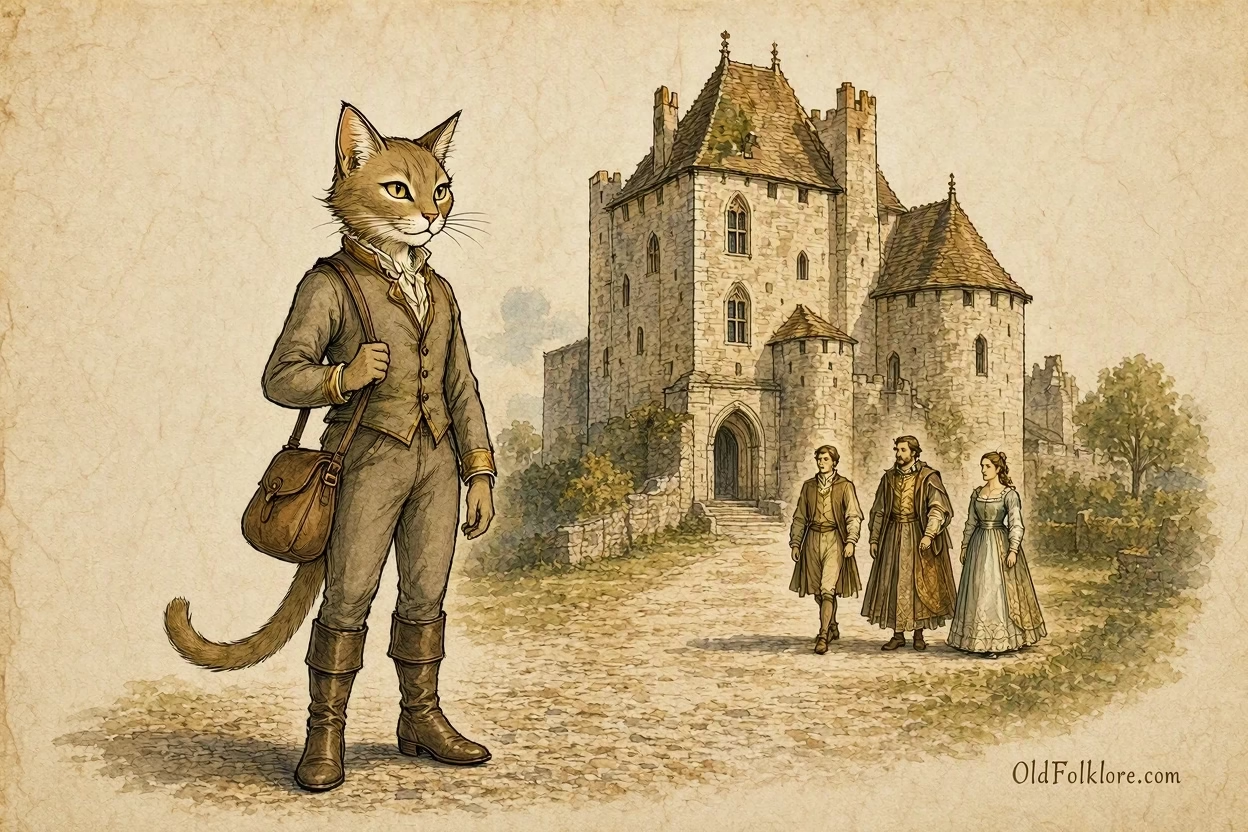
The cat received his bag and boots, dressed himself in them, and set out to put his plan into action.
The Cat Begins His Plan
The cat went to a place where rabbits were plentiful. He filled his bag with bran and sow thistle, then lay down as though he were dead. He waited patiently for a young rabbit to approach the food inside his bag.
Before long, one of the unsuspecting rabbits entered. The cat pulled the strings closed, caught the animal, and killed it.
Pleased with his success, he carried the rabbit to the royal palace and asked to see the King. When he was admitted, he bowed respectfully and presented the rabbit as a gift from his master, whom he introduced as the Marquis of Carabas.
The title was one the cat had invented for the young man. Nevertheless, he presented it confidently, as though his master were already a nobleman of considerable importance.
The King accepted the gift with pleasure and sent his thanks to the supposed Marquis.
On another occasion, the cat hid among standing corn with his bag open. When two partridges entered, he caught them in the same way. He then took the birds to the palace and presented them to the King on his master’s behalf.
The King welcomed the gifts and rewarded the cat.
For two or three months, the cat continued bringing game to the royal household. Each visit strengthened the King’s familiarity with the mysterious Marquis of Carabas, even though the young man had done nothing to earn the title the cat had given him.
Fascinated by this tale? Discover more North African folktales
The Meeting Beside the River
One day, the cat learned that the King would travel along the riverside with his daughter, who was described in the tale as exceptionally beautiful.
Seeing an opportunity to advance his master’s position, the cat told the young man that his fortune could be made if he followed his instructions. He asked him to bathe in the river at a particular place and leave the rest to him.
The young man obeyed, although he did not understand what the cat intended to accomplish.
When the King approached in his carriage, the cat began shouting for help. He cried that the Marquis of Carabas was drowning and urgently needed assistance.
The King recognised the cat who had brought him gifts on several occasions. He immediately ordered his attendants to rescue the supposed nobleman.
As the young man was brought out of the water, the cat approached the royal carriage and explained that thieves had stolen his master’s clothes while he was bathing. In reality, the cat had hidden the clothes himself beneath a large stone.
The King ordered his wardrobe attendants to bring one of his finest suits for the young man.
Dressed in the King’s clothes, the young man looked handsome and respectable. The Princess took an immediate interest in him, and the two exchanged several polite, affectionate glances. Before long, she had fallen deeply in love with the supposed Marquis.
The King invited him into the carriage, and the royal party continued its journey with the young man among them.
The Fields of the Marquis of Carabas
While the King traveled with the young man, the cat hurried ahead to prepare the next part of his scheme.
He encountered some countrymen mowing a meadow. The cat ordered them to tell the King that the meadow belonged to the Marquis of Carabas. He threatened them with terrible consequences if they refused.
When the royal party arrived, the King asked the workers who owned the meadow. Frightened by the cat’s threat, they all answered that it belonged to the Marquis.
The King admired the property and remarked that his companion possessed a valuable estate. The young man followed the cat’s lead and spoke as though the meadow were genuinely his.
The cat continued ahead and found workers harvesting corn. He gave them the same warning, demanding that they identify the cornfields as the property of the Marquis.
When the King asked who owned the fields, the workers gave the answer the cat had instructed them to provide.
The King was increasingly impressed by the supposed nobleman’s wealth. Everywhere he traveled, the cat made sure that the people he encountered appeared to confirm the same story.
The young man continued to benefit from the deception, while the King remained unaware that the fields and meadow had not been established as his property through any genuine transfer of ownership.
The Ogre and His Castle
Eventually, the cat reached a magnificent castle belonging to an extremely wealthy ogre. The surrounding lands belonged to the ogre, whose riches and powers had made him a figure of considerable importance.
Before approaching the castle, the cat had made inquiries about its owner and learned that the ogre could transform himself into different creatures.
The ogre received the cat politely and invited him to sit down.
The cat began by saying that he had heard the ogre possessed the extraordinary ability to change his shape. He mentioned that the ogre could supposedly become creatures as large as a lion or an elephant.
The ogre confirmed that the report was true. To demonstrate his power, he transformed himself into a lion.
The sight frightened the cat so badly that he scrambled towards the roof gutter. His boots made the climb difficult, but he managed to escape the lion’s immediate reach. Once the ogre had returned to his usual form, the cat climbed down.
He admitted that the transformation had frightened him. Then he continued his questioning.
The cat said he had also heard that the ogre could become very small creatures, such as a rat or a mouse. He pretended to doubt this claim, suggesting that such a transformation would be almost impossible.
The ogre took the challenge. Determined to prove his abilities, he transformed himself into a mouse and began running across the floor.
This was precisely the opportunity the cat had been waiting for.
He immediately pounced on the mouse and ate it.
With the ogre gone, the cat had removed the obstacle standing between his master and the magnificent castle.
The Marquis Enters the Castle
While the cat was completing his plan, the King approached the castle with his daughter and the young man.
The cat hurried out to welcome them. He announced that the King had arrived at the castle of the Marquis of Carabas, presenting the property as though it had always belonged to his master.
The King was astonished. He had already seen what he believed were the Marquis’s extensive fields and meadows, and now he stood before a grand castle with impressive buildings and a spacious courtyard.
He asked whether the castle also belonged to the Marquis.
The cat assured him that it did and invited the royal party inside.
The young man offered his hand to the Princess, and they followed the King into the castle. Inside the great hall, they discovered a magnificent meal that the ogre had prepared for guests who were expected to visit that day. Those guests did not dare enter while the King was present.
The King was impressed by the young man’s apparent wealth and by the qualities he believed the Marquis possessed. His daughter was equally pleased with the man she had come to admire.
Seeing the magnificent estate and believing its owner to be a suitable match for his daughter, the King declared that it was now up to the Marquis himself to become his son in law.
The young man accepted the honor.
That very day, he married the Princess, and his fortunes changed completely.
The Cat’s Reward
The young man who had once feared that he would starve with nothing but a cat for an inheritance had become a royal son in law and the owner, as the story presents it, of a magnificent castle.
His success had depended largely on the intelligence and boldness of the cat. The animal had understood how to gain the King’s attention, create an impression of wealth, and turn a dangerous encounter with an ogre to his master’s advantage.
The cat was rewarded for his efforts. He became a great lord himself and no longer needed to hunt mice for survival, except when he chose to do so for amusement.
Thus ends Charles Perrault’s version of Puss in Boots, a tale in which a clever animal transforms his master’s life through a series of calculated schemes.
Looking for more? Explore the magic of East African folktales here
Moral Lesson
Intelligence, courage, and resourcefulness can help someone overcome difficult circumstances. Puss in Boots demonstrates the power of quick thinking and determination, but his methods also remind readers that appearances can be misleading. Success achieved through deception is not the same as success earned through honest work, and the story invites readers to think carefully about the difference between cleverness and integrity.
Knowledge Check
1. Who wrote Puss in Boots?
Charles Perrault wrote the literary fairy tale known as Puss in Boots, also titled The Master Cat, or Puss in Boots.
2. What did the youngest son inherit from his father?
He inherited a cat, while his elder brothers received a mill and a donkey.
3. What two things did the cat request from his master?
He asked for a bag and a pair of boots so that he could carry out his plans.
4. Why did the cat call his master the Marquis of Carabas?
The cat invented the title to make his master appear wealthy and important to the King and the royal household.
5. How did the cat defeat the ogre?
He challenged the ogre to demonstrate his ability to transform into a small animal. When the ogre became a mouse, the cat caught and ate him.
6. What is one important lesson readers can learn from Puss in Boots?
The story shows how intelligence and resourcefulness can change a person’s circumstances, while also encouraging readers to question success built on deception.
Source
Charles Perrault, The Tales of Mother Goose, translated by Charles Welsh, D. C. Heath & Co., 1901. Tale: “The Master Cat, or Puss in Boots.”
Explore More African
- The Golden Goose: A Brothers Grimm Fairy Tale
- The Enchanted Doe: A Tale of Friendship, Loyalty, and Courage
- Prince Hyacinth and the Dear Little Princess: A Fairy Tale About Pride and Self-Knowledge
- East of the Sun and West of the Moon: The Search for a Lost Prince
- The Horned Women: An Irish Folktale of Twelve Witches
- The Hunter’s Twins and the Mystery Behind Their Family
- Biti Mupalume: The Schoolboy Who Became a Football Legend