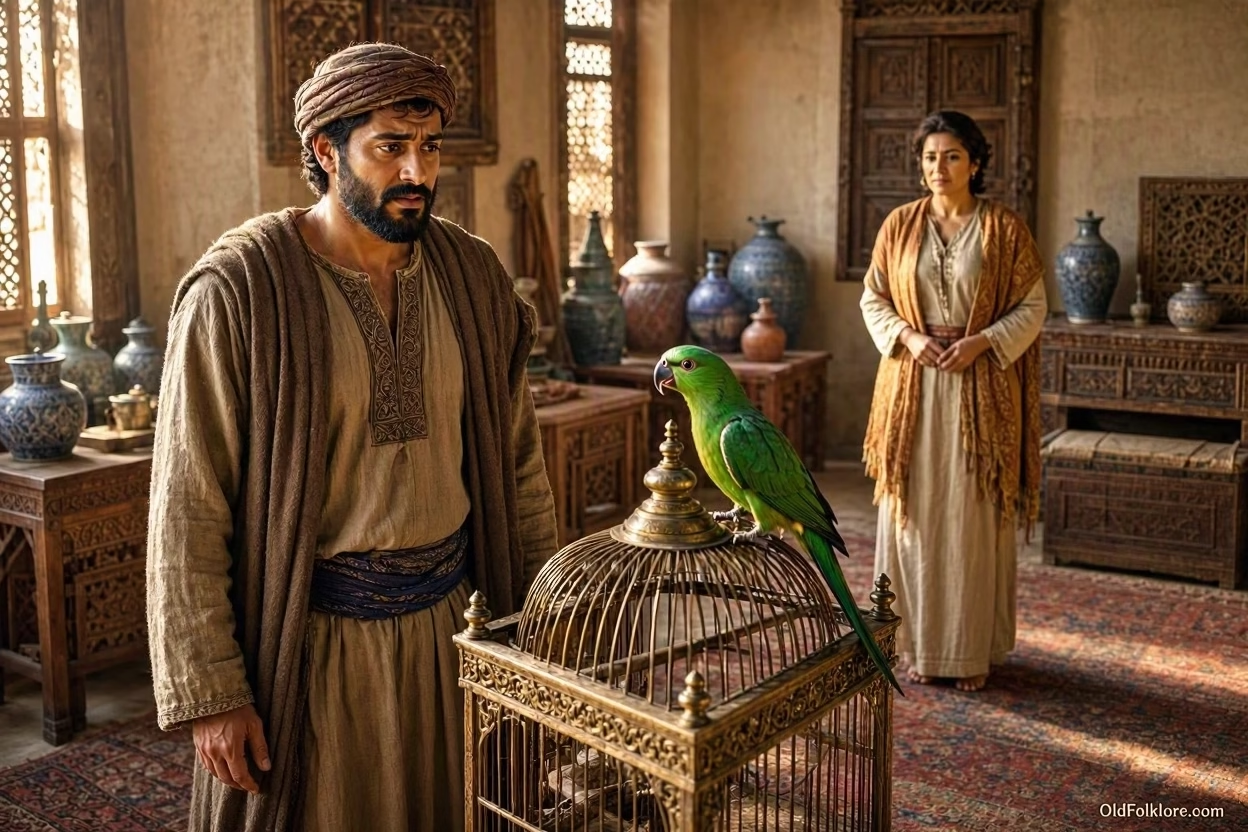
Within The Tale of the Wazir and the Sage Duban, a king hears a story about a husband who entrusts a talking parrot with watching his wife while he is away. When the husband returns, the bird reports what it claims to have witnessed during the night. The wife denies the account, and the disagreement exposes how jealousy can turn uncertain evidence into a destructive conviction. The episode forms part of a larger argument about trust, testimony and the dangers of believing a single account without examining the circumstances behind it.
The Wazir’s Argument
The story of the husband and the parrot appears within the larger tale of the Wazir and the Sage Duban. In that frame narrative, the characters debate whether a ruler should trust the advice of someone whose intentions may be uncertain.
The Wazir seeks to influence the king’s judgement by telling stories that warn against misplaced trust. One of these concerns a husband who believes that a talking parrot can report on his wife’s conduct while he is absent.
The tale turns on the husband’s confidence in the bird’s testimony. Because the parrot can speak, he assumes that it can provide a reliable account of what happens in his household. He fails to consider how appearances, misunderstandings and personal suspicion might affect what he hears.
The Husband and His Talking Parrot
A man possessed a talking parrot that could repeat what it heard and describe events in its surroundings. The bird was sufficiently accomplished that its owner treated it as a trustworthy witness.
Before leaving home, the husband arranged for the parrot to observe his wife. He expected the bird to tell him what she did during his absence. In placing such responsibility upon it, he treated the parrot’s ability to speak as proof that its reports would be accurate.
The husband’s confidence reflected his suspicion of his wife. Instead of relying on open conversation or mutual trust, he preferred to monitor her secretly. The parrot became an instrument of that mistrust.
Explore more stories from our The Arabian Nights collection.
When the husband returned, he asked the bird what had happened while he was away. The parrot gave an account of the night, describing what it claimed to have witnessed. Its report included unusual activity that the husband interpreted as evidence against his wife.
The bird’s words unsettled him. He had expected an answer that would satisfy his doubts, but the report raised further questions about what had occurred and whether his wife had been faithful.
The Wife Challenges the Report
When confronted with the parrot’s account, the wife denied the allegations. She disputed the bird’s description of events and maintained that its report did not accurately represent what had happened.
The husband faced a choice. He could investigate the matter and consider his wife’s explanation, or he could treat the parrot’s testimony as conclusive simply because the bird could speak.
His suspicion made the second course tempting. He had arranged for the parrot to watch his wife precisely because he wanted an outside witness. Now that the bird had supplied an accusation, he was inclined to accept it as proof.
Yet the parrot’s ability to repeat sounds and describe what it perceived did not establish that it understood every event correctly. A witness can report appearances without knowing their meaning, and a report can be misleading even when the speaker believes it to be true.
The dispute therefore became a test of judgement as much as a question of the wife’s conduct. The husband had to decide whether his trust in the bird was justified or whether his own jealousy had shaped the way he interpreted its words.
Jealousy and the Danger of Unquestioned Evidence
The episode illustrates how suspicion can influence the way a person receives information. The husband sought evidence because he already feared betrayal. Once the parrot made its report, he risked treating it as confirmation of what he had suspected from the beginning.
The story also distinguishes speech from understanding. The parrot can talk, but its ability to describe events does not necessarily make it a reliable judge of human motives. Its owner places too much confidence in a creature whose observations may not tell the whole story.
The wife’s denial creates uncertainty that the husband must confront. Rather than treating the bird’s words as an unquestionable verdict, he should consider the limits of its knowledge and the possibility that events have been misunderstood.
Within the wider frame of the Wazir and the Sage Duban, the episode contributes to the debate about trust and judgement. Stories can persuade listeners, but the lesson a person draws from them depends on how carefully the evidence is examined. A compelling account is not automatically a truthful one.
The Story’s Place in The Arabian Nights
The husband and the parrot episode should be understood as a story embedded within a larger narrative, not as an independent account of all The Arabian Nights. Its immediate purpose is connected to the argument between the Wazir and the king.
The Wazir uses examples to influence the ruler’s decisions. By introducing a tale about a husband who depends on an animal’s testimony, the narrative raises questions about the reliability of witnesses and the consequences of acting without sufficient judgement.
This framing matters because the meaning of the episode extends beyond the household dispute. The parrot’s report becomes part of a broader discussion about whom to trust, how to assess advice and whether a person should act on accusations before considering their reliability.
The episode also shows how storytelling operates within the collection. One character tells a story to persuade another, and the story itself becomes evidence in a larger debate. The listener must decide not only whether the tale is convincing but also whether it supports the conclusion being advanced.
Explore our complete Historic Folklore & Fairy-Tale Collections archive.
Moral Lesson
The tale warns against allowing jealousy to replace careful judgement. A person who expects betrayal may interpret uncertain information as proof, especially when it appears to confirm an existing fear.
It also reminds readers that the ability to speak does not guarantee complete understanding. A witness may describe what appears to have happened without knowing the full circumstances or motives involved.
Trust requires more than accepting the first report that supports a suspicion. Fair judgement means considering the evidence, listening to explanations and recognising the limits of what a witness can know.
Knowledge Check
1. Within which larger tale does the husband and the parrot episode appear?
It appears within The Tale of the Wazir and the Sage Duban.
2. Why did the husband rely on the parrot?
He believed the talking bird could observe his wife and report what happened while he was away.
3. What did the husband ask the parrot to do?
He expected it to watch his wife and tell him about her conduct during his absence.
4. How did the wife respond to the parrot’s report?
She disputed the account and denied that it accurately described what had happened.
5. What weakness does the husband’s reliance on the parrot reveal?
He treats the bird’s ability to speak as proof that its account is complete and reliable, without adequately considering the limits of its understanding.
6. What is one central lesson of the episode?
Jealousy and unquestioned testimony can lead to unjust conclusions; evidence should be assessed carefully before action is taken.
Source
This article is intended to draw on the episode commonly known as “Tale of the Husband and the Parrot,” embedded in “The Tale of the Wazir and the Sage Duban,” in The Book of the Thousand Nights and a Night, Volume I, translated by Richard F. Burton and published in 1885.
Explore More The Arabian Nights Tales