In the beginning, before time learned to measure itself, before space knew direction, before light understood what it meant to shine, there existed only Amma the Supreme Creator, the Eternal One, the god who floated in absolute nothingness like a thought waiting to be thought. Amma was silent and potential, consciousness without object, being without form. He existed in perfect solitude, complete unto himself, yet within his divine mind rested something of infinite significance: the Cosmic Egg.
This was no ordinary egg, not something that could be held in mortal hands or seen with earthly eyes. The Cosmic Egg existed within Amma’s contemplation, containing within its uncracked shell the seeds of absolutely everything that would ever be the blazing stars that would illuminate the void, the solid earth that would provide foundation for life, the flowing waters that would nourish and sustain, the invisible spirits that would move between worlds, and the life force itself that would animate all creation.
Click to read all Myths & Legends – timeless stories of creation, fate, and the divine across every culture and continent
For an eternity that cannot be measured for measurement itself did not yet exist, Amma contemplated the Egg. He considered what it contained, what it might become, and what consequences would flow from the simple act of cracking its shell and releasing the compressed potential within. Creation is not a simple thing, not even for a god. Once begun, it cannot be undone. Once released, the forces within cannot be recalled.
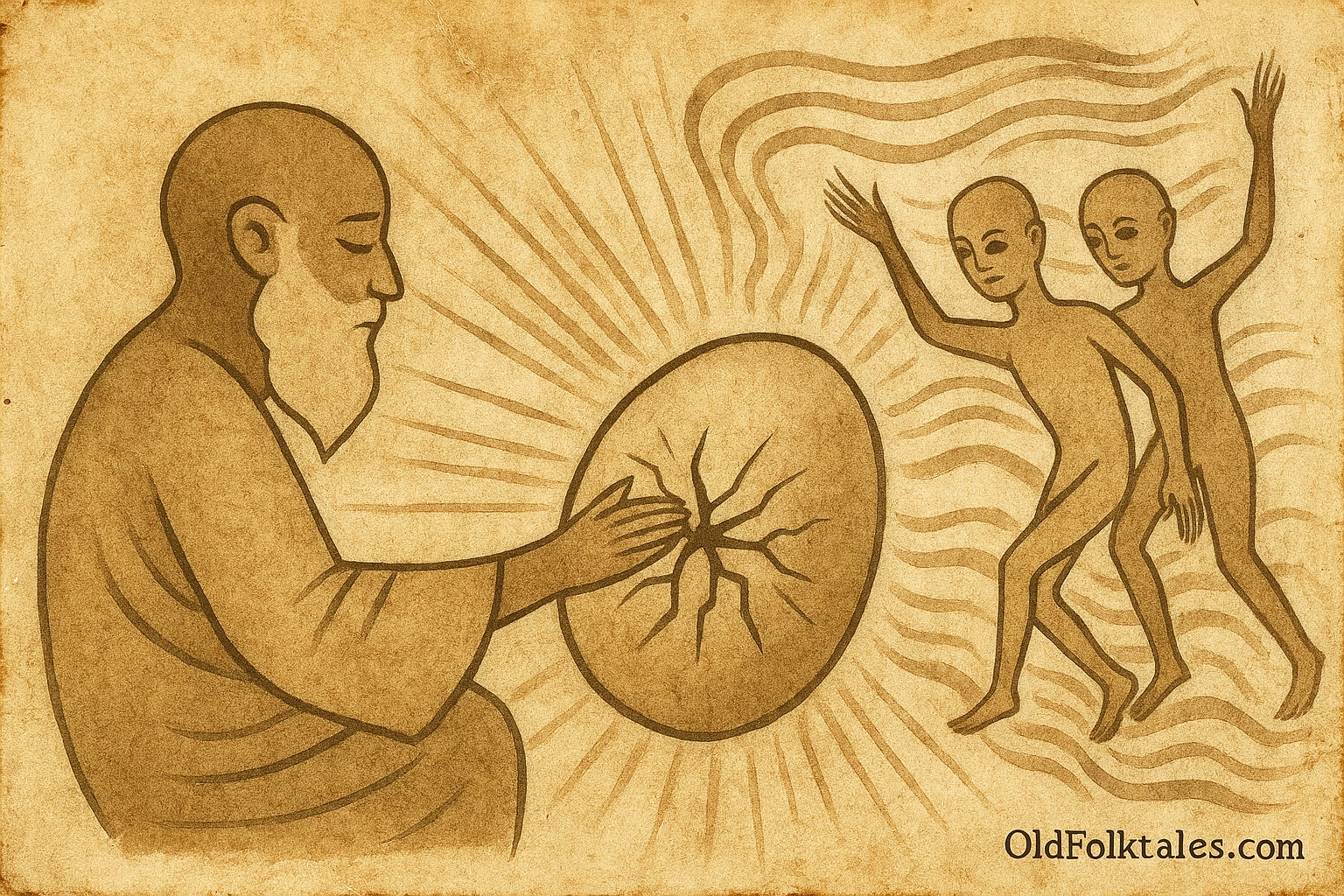
But the time came, as it always must, when contemplation gave way to action. Amma reached out, though he had no hands, for his being transcended physical form and touched the Cosmic Egg. At that touch, fractures appeared across its surface, thin lines of light spreading like lightning through dark clouds. The shell vibrated with the power of what it contained, humming with a frequency that would eventually become the fundamental vibration of all matter.
Then, with a sound that was the first sound ever to disturb the eternal silence a sound that contained within it every note that would ever be sung, every word that would ever be spoken, every cry and whisper and shout that would echo through the ages, the Cosmic Egg cracked open.
From its fragments, tumbling forth into the newly born space, came the twin beings known as Nommo. They were neither entirely male nor entirely female, neither wholly physical nor completely spiritual, but something that transcended and included all such distinctions. The Nommo were dual aspects of a single cosmic principle, mirrors of each other, complements destined to work in harmony to shape the emerging universe.
The Nommo possessed voices, and these voices were not merely sound but creative power itself. When they sang, reality responded. Their harmonies became the mathematical principles that would govern the movements of celestial bodies. Their rhythms established the cycles that would mark time, the rotation of worlds, the progression of seasons, the beating of hearts yet to be formed. Together, their voices wove the fabric of existence, singing the universe into ordered harmony.
One twin understood instinctively the sacred duty with which they had been entrusted. This Nommo sang with reverence and precision, carefully crafting each element of creation according to the divine blueprint that Amma had implanted within them both. When this obedient twin sang, stars took their appointed places in the heavens, arranging themselves in patterns that would guide travelers and mark the passage of years. Mountains rose from formless matter, their peaks reaching toward the sky in gestures of aspiration and strength. Rivers found their courses, flowing from high places to low, carrying life-giving water to places that would otherwise remain barren.
But the other twin, whether from pride, or curiosity, or some impulse toward independence that even the gods cannot fully explain, began to sing different notes, to introduce variations into the cosmic harmony. This rebellious Nommo desired not to follow the established plan but to improvise, to create freely without constraint, to express individuality rather than unity.
At first, the variations seemed merely interesting, adding unexpected beauty to creation like improvisations in music that enhance rather than detract from the original melody. But as the rebellious Nommo grew bolder, the deviations became more extreme. The careful order that the obedient twin was establishing began to show cracks and irregularities. Chaos seeped into creation like water finding its way through stone.
Where the obedient Nommo sang forth fertile plains perfect for cultivation, the rebellious twin’s counter-song created deserts and wastelands. Where harmony decreed gentle rains to nourish the earth, rebellion brought storms that tore and destroyed. The very fabric of reality began to tear under the strain of these opposing forces, harmony and discord fighting for dominance, order and chaos locked in a struggle that threatened to unravel everything that had been so carefully constructed.
Amma watched this cosmic conflict with the sorrow that only a creator can feel when witnessing the corruption of a perfect vision. The universe he had intended balanced, harmonious, functioning according to divine law was becoming something else, something unstable and dangerous. The rebellious Nommo’s actions had introduced an element that Amma had not planned for: the possibility of destruction, of entropy, of things falling apart rather than coming together.
The Supreme Creator faced a terrible choice. He could unmake all creation, returning everything to the void, preserving the purity of his original vision by preventing its corruption. Or he could intervene in a way that would establish a new kind of balance, not the perfect, unmarred harmony he had originally intended, but something more complex, a dynamic equilibrium between opposing forces.
Amma chose the second path, though it cost him dearly. To restore balance to the fractured creation, he would need to make a sacrifice of profound significance. The obedient Nommo faithful, harmonious, perfect in its dedication to divine order, would have to give up its existence as a separate being.
The sacrifice was not forced. The obedient Nommo understood what was necessary and accepted its fate with the same perfect compliance it had shown in all things. In an act of cosmic self-offering, this faithful twin allowed its form to be dispersed, its essence scattered throughout the entire universe, its singular existence transformed into multiplicity.
Where the Nommo’s blood fell, rivers formed not just water flowing over stone, but life-giving arteries carrying vitality and nourishment to every part of creation. These rivers would sustain all living things, their currents a reminder of the sacrifice that made continued existence possible. The Nommo’s blood became the water that quenches thirst, irrigates crops, and cleanses and renews.
Where the Nommo’s flesh scattered, it transformed into fertile soil, dark, rich earth capable of bringing forth plants and sustaining animals. This was not dead matter but living substance, infused with the very essence of the sacrificed twin, containing within it the generative power that would make growth and transformation possible. Every seed that sprouted would draw on this gift, every harvest would be a testament to the Nommo’s willing sacrifice.
Where the Nommo’s bones fell, they became the minerals and metals hidden in the earth’s depths iron for tools, copper for ornaments, gold and silver for sacred objects. Even in becoming scattered, even in losing its unified form, the obedient Nommo continued to serve creation, providing resources that future beings would need for their survival and flourishing.
And where the Nommo’s spirit dispersed, it became the invisible forces that move through all things the wind that stirs the grass, the warmth of the sun, the mysterious vitality that distinguishes the living from the dead. This spirit-essence permeated everything, making the entire universe a kind of living organism, interconnected and interdependent, every part containing a trace of the sacrificed divine being.
But what of the rebellious twin? Amma did not destroy this Nommo, for to do so would be to eliminate the very principle of freedom and variation that makes genuine existence possible. Instead, the rebellious twin was transformed, its chaotic power not eliminated but contained, channeled, made part of a larger system. This Nommo became the force of change, challenge, and transformation necessary for growth but dangerous when unbalanced, creative in some contexts but destructive in others.
Thus was established the fundamental structure of reality as the Dogon understand it: a universe built not on simple perfection but on dynamic tension, where order and disorder, harmony and chaos, cooperation and rebellion exist in constant interplay. Life and death, creation and destruction, growth and decay all these opposing principles were woven together from the very beginning, each necessary for the existence of the other, neither able to claim absolute dominion.
The stars that had been scattered across the heavens by the Nommo’s songs began their eternal dance, moving in patterns that reflected both the original harmony and the variations introduced by rebellion. Day and night alternated in cycles that honored both twins, the light of order and the darkness of mystery. Seasons changed in rhythms that showed the influence of both creative forces, the abundance of growth and the necessity of dormancy.
And when, much later, human beings emerged in this complexly ordered universe, they carried within themselves the legacy of both Nommo twins. The capacity for harmony, cooperation, and constructive action came from the obedient twin whose sacrifice had made their existence possible. But the capacity for individuality, innovation, and sometimes destructive rebellion came from the other twin, whose challenge to divine authority had introduced freedom dangerous, necessary freedom into the cosmic order.
The Dogon elders teach that every person contains both principles, must navigate between both impulses, must learn to honor the sacrifice that created harmony while also acknowledging the creative power of challenge and change. To live only by order is to be rigid and lifeless. To live only by chaos is to be destructive and purposeless. The wise path lies in understanding how these opposing forces can be balanced, how the tension between them generates the energy that drives life forward.
This is why the Dogon cosmology sees the universe not as a static creation but as a living being, constantly growing and changing, breathing with the rhythm of opposing forces, sustained by the blood and flesh and spirit of the sacrificed Nommo, challenged and enlivened by the rebellious energy of its twin. Creation was not a single event completed in the distant past but an ongoing process, a conversation between order and disorder that will continue as long as existence itself continues.
Author’s Note
The Dogon creation myth presents a deeply philosophical view of the universe as a balance between order and chaos, rather than a battle of good versus evil. It teaches that both harmony and disruption are essential for creation and growth. The obedient Nommo’s sacrifice symbolizes transformation and unity with the cosmos, while the rebellious Nommo represents change and creativity. Together, they show that wisdom lies in understanding how chaos and order work together to sustain life. This ancient African worldview emphasizes that balance is a dynamic process, one that remains profoundly relevant to ecological, social, and personal harmony today.
Knowledge Check
Q1: Who was Amma and what did he contain within his consciousness before creation?
A: Amma was the Supreme Creator god who existed alone in the primordial void before creation. Within his divine mind rested the Cosmic Egg, which contained the seeds of everything that would ever exist stars, earth, water, spirits, and all forms of life compressed into pure potential.
Q2: What were the Nommo and what special power did they possess?
A: The Nommo were twin beings who emerged when Amma cracked the Cosmic Egg. They possessed voices that had creative power when they sang, reality responded and took shape. Their voices established the mathematical principles, cycles, and harmonies that would govern the universe.
Q3: How did the rebellious Nommo’s actions threaten creation?
A: The rebellious Nommo refused to follow the divine blueprint and began singing different notes, introducing chaos and disorder into creation. Where the obedient twin created fertile plains, the rebel created deserts; where harmony decreed gentle rains, rebellion brought destructive storms, threatening to unravel the fabric of reality itself.
Q4: What sacrifice did Amma require to restore balance to the fractured creation?
A: Amma required the obedient Nommo to sacrifice its existence as a unified being. The faithful twin willingly allowed its form to be dispersed throughout the universe its blood becoming rivers, its flesh becoming fertile soil, its bones becoming minerals and metals, and its spirit becoming the invisible life force permeating all things.
Q5: What happened to the rebellious Nommo after the sacrifice?
A: The rebellious Nommo was not destroyed but transformed and contained. It became the force of change, challenge, and transformation in the universe necessary for growth and creativity but dangerous when unbalanced, representing the principle of freedom and variation that makes genuine existence possible.
Q6: What fundamental principle about reality does this Dogon myth establish?
A: The myth establishes that the universe is built on dynamic tension between opposing forces order and disorder, harmony and chaos, cooperation and rebellion, all woven together from the beginning. Life, death, creation, and destruction exist in constant interplay, with neither force able to claim absolute dominion, creating a living, breathing cosmos sustained by balanced opposition.
Source: Adapted from Marcel Griaule and Germaine Dieterlen, Le Renard Pâle (The Pale Fox) (1965)
Cultural Origin: Dogon People, Bandiagara Escarpment region, Mali, West African.