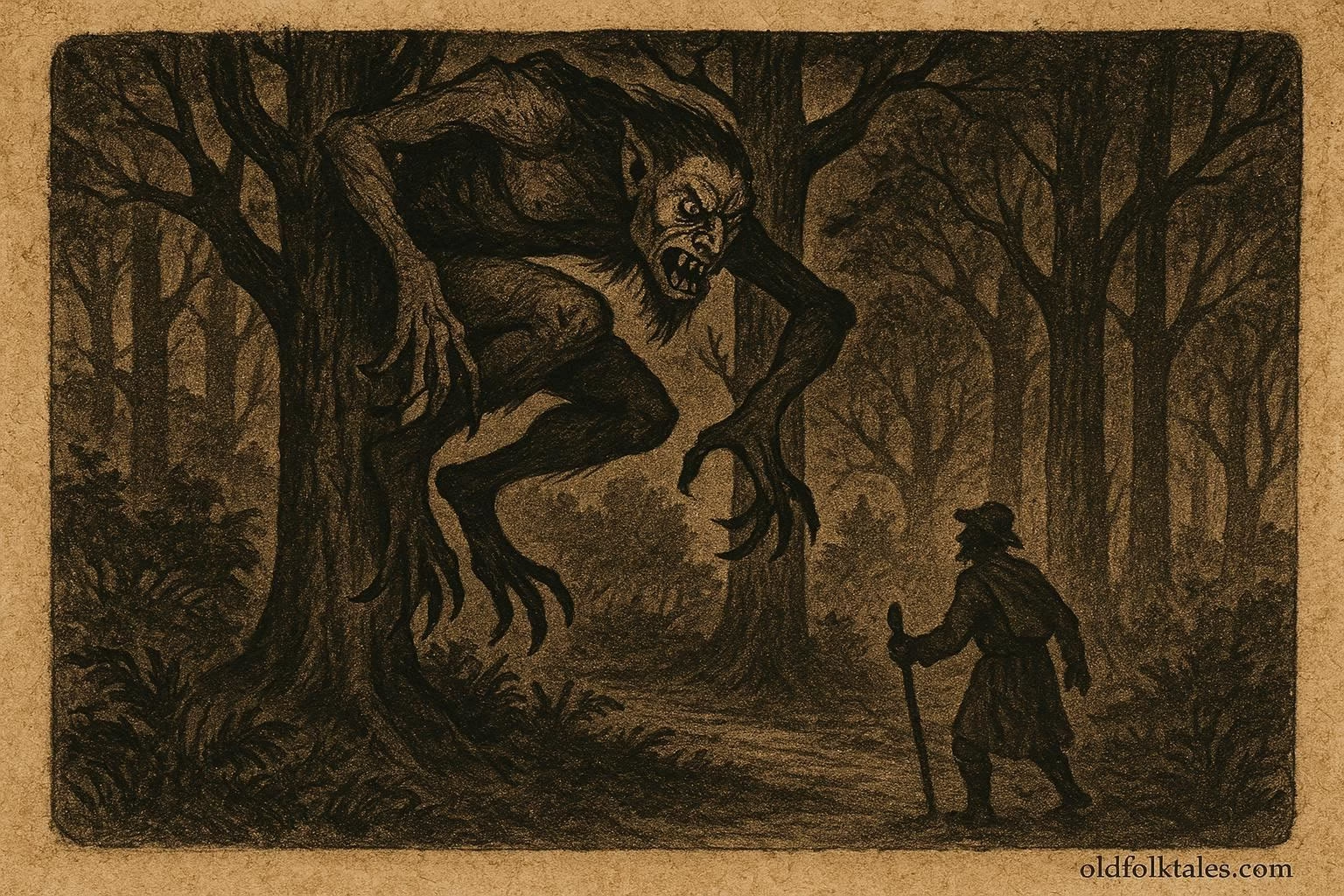
The Sasabonsam (also called Asanbosam) is a fearsome humanoid creature whose legend dominates Akan forest lore. Its most striking characteristics are its iron-like teeth and hooked feet, which allow it to prey upon unwary travelers, hunters, and forest intruders. Its body is large, muscular, and adapted for arboreal movement, with long limbs that enable it to swing from branches or descend silently onto its victims.
The Sasabonsam is usually imagined as a forest-dwelling predator, blending humanoid and monstrous traits. Its face may appear partially human in some retellings, lending it an uncanny familiarity, but its ferocity is emphasized by its massive, iron-hardened teeth and claws. Its hooked feet are not just physical tools but carry symbolic meaning: they represent its grip on those who disrespect forest boundaries, the inevitability of consequences, and the natural power of the wilderness.
Journey through the world’s most powerful legends, where gods, mortals, and destiny intertwine
The creature often lurks high in the trees, using its vantage point to ambush victims who stray from marked paths or venture too deep into dense forest. The Sasabonsam is typically nocturnal, preferring twilight or nightfall to assert its dominance over the forest canopy. When it strikes, it may drop from above, grab, immobilize, or even maul its victims, a direct reflection of the danger and unpredictability of forest life.
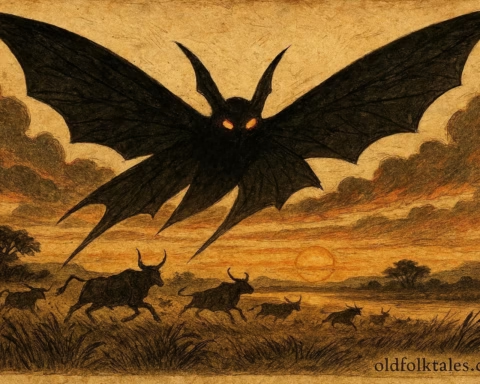
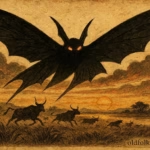
Some modern retellings depict it with bat-like wings or ogre-like proportions, likely influenced by European vampire imagery, but traditional Akan narratives focus on the tree-dwelling, hook-footed predator motif. Its power lies less in supernatural flight and more in stealth, strength, and cunning, making it a forest-enforced moral guardian.
Cultural and Symbolic Role
The Sasabonsam plays a critical role in Akan moral and ecological imagination. Its functions extend beyond mere fright; it enforces ethical, social, and environmental boundaries:
- Forest as moral and physical boundary:Forests were often seen as sacred spaces or places of danger. The Sasabonsam teaches humans to respect natural limits, stay on established paths, and avoid greedy or reckless behavior.
- Enforcer of communal norms:Hunters, travelers, or children who ignore societal rules risk encountering the creature, reinforcing social discipline.
- Personification of natural hazards:Its iron teeth and hooked feet metaphorically amplify the dangers of forest life: venomous snakes, falling branches, treacherous terrain, and wild predators.
- Moral lesson through fear:The creature’s stories were told as cautionary tales, emphasizing vigilance, preparation, and respect for the unknown. By embedding ethical instruction in the frightening figure of the Sasabonsam, the Akan transmitted cultural wisdom across generations.
- Symbol of justice and balance:Beyond punishment, the Sasabonsam represents ecological equilibrium. The forest is a living entity with rules, and the creature acts as a guardian, ensuring humans interact with the environment responsibly.
- Connection to spiritual beliefs:While not always framed as a divine spirit, the Sasabonsam aligns with broader Akan cosmology, in which forests and natural sites are inhabited by entities that mediate between humans and nature.
Comparative Mythology
Interestingly, the Sasabonsam shares similarities with other African forest-dwelling beings, such as:
- The Kishi of Ambundu (Angola), a two-faced predator combining beauty and danger, teaching caution against deception.
- The Tokoloshe in Zulu folklore, a small, malevolent spirit that can harm or manipulate humans, often in domestic or forest settings.
These comparative examples illustrate a pan-African pattern of mythic beings functioning as moral enforcers and ecological guardians, using fearsome features to teach survival, ethics, and respect for supernatural boundaries.
Folkloric Context
The Sasabonsam’s stories have traditionally been oral, passed down through generations, often recounted around evening fires or during forest excursions. While 19th- and 20th-century European collectors like Héli Chatelain documented related African forest creatures, direct colonial-era printed Akan sources remain scarce. Missionary journals and anthropological field notes from the Gold Coast (modern Ghana) contain descriptions of forest spirits with similar ambush behaviors and iron teeth motifs.
This scarcity highlights the importance of oral tradition in preserving forest-creature myths. By combining ecological observation, social norms, and moral storytelling, the Sasabonsam exemplifies how folklore served as a practical guide to forest survival while embedding spiritual and ethical meaning.
Explore the mysterious creatures of legend, from guardians of the sacred to bringers of chaos
Author’s Note
The Sasabonsam is a striking example of how African oral traditions intertwine ecology, morality, and imagination. Its iron teeth and hooked feet may appear fantastical, yet they metaphorically dramatize real dangers in forested environments. Stories of the Sasabonsam continue to remind modern audiences that folklore is not merely entertainment, it encodes lessons about safety, respect for nature, and social responsibility. By focusing on archival references and older oral motifs, this entry avoids modern reinterpretations that exaggerate wings or bat-like qualities.
Knowledge Check
- What are the most distinctive physical features of the Sasabonsam?
Iron-like teeth and hooked feet. - Where does the Sasabonsam typically dwell?
In the tall trees of deep forests. - What type of people does it primarily target?
Hunters, travelers, or anyone straying into dangerous forest zones. - What moral or natural lesson does the Sasabonsam symbolize?
Respect for forest boundaries, caution, and consequences for recklessness. - How does it differ from European vampire myths?
Its predation is metaphorical, emphasizing morality and forest boundaries rather than drinking blood. - Why are hooked feet significant in Akan tradition?
They allow it to ambush victims from trees, symbolizing hidden forest dangers and moral enforcement.
Source:
Biggs, Tristan. Mythical Creatures of Sub-Saharan Africa (online article)
Reference / motif: Chatelain, Héli. Folk-tales of Angola: Fifty Tales, with Ki-Mbundu Text, Literal English Translation, Introduction, and Notes. American Folk-Lore Society, 1894. (Public domain)
Origin:
Akan ethnic area of southern Ghana & Côte d’Ivoire; oral tradition predating colonial contact; recorded in 19th–20th-century European-missionary and anthropological sources.