
Long before the creation of humankind, the world was said to have been inhabited by the Djinn beings of smokeless fire who roamed the desert winds and ancient ruins. They were free spirits, neither angels nor demons, capable of both good and evil. Some lived peacefully, while others rebelled, and their power often rivaled that of the elements themselves. Over time, they became unseen dwellers of the earth, hidden from mortal sight yet always near.
Among the countless tales of these fiery beings, one story stands above the rest, the legend of the fisherman and the Djinn.
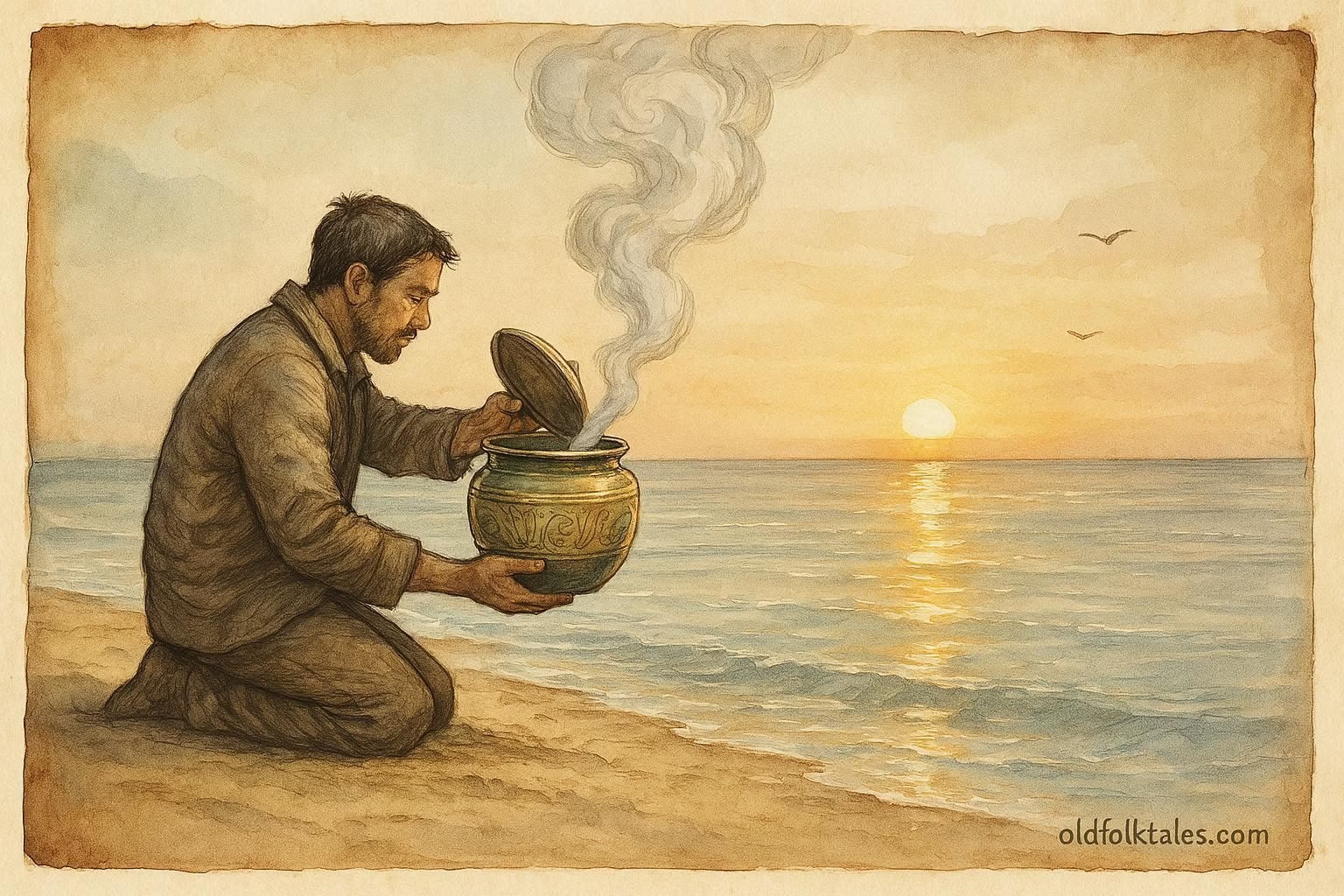
In a small coastal town along the Arabian Sea, there lived a poor fisherman who cast his net every morning in hopes of catching enough fish to feed his family. For three days, he caught nothing but weeds and broken shells. On the fourth morning, as the sun rose over the golden waves, he prayed for mercy and threw his net once more into the sea. When he pulled it in, it was heavier than ever before. His heart filled with hope, thinking he had finally caught a bounty of fish.
But as he dragged it to shore, he found instead a strange brass jar, sealed tightly with a lid engraved in old Arabic script. The writing shimmered faintly under the morning light. Curious, he turned it over and saw that it bore the seal of the great King Solomon, who in ancient times commanded both men and spirits.
Discover the gods, goddesses, and divine spirits who ruled the heavens and shaped human fate
The fisherman hesitated, wondering if it was cursed. Yet his curiosity was stronger than his fear. He pried open the seal with his knife. At once, smoke poured out of the jar, rising in thick coils that filled the air and darkened the sky. The fisherman stumbled back in terror as the smoke twisted into the shape of a towering figure a Djinn, fierce and radiant like fire given form.
“Praise be to Allah who has freed me,” the Djinn thundered, his voice echoing across the waves. “For centuries I have been imprisoned in this vessel by Solomon’s command.”
The fisherman trembled but bowed respectfully. “Peace be upon you, O mighty spirit. I am but a poor fisherman and meant you no harm.”
The Djinn’s eyes blazed like embers. “Know, mortal, that once I was proud among my kind. When Solomon offered me mercy, I mocked him, and for that I was bound within this jar. At first, I swore that whoever released me would be richly rewarded. But as centuries passed and no one came, rage filled my heart. Now I vow that whoever frees me shall die at once.”
The fisherman’s hope turned to fear. “Surely you would not destroy the one who gave you freedom,” he pleaded.
The Djinn laughed. “I am bound by my own word, not by mercy.” He raised his hand, and sparks flared around his palm.
Thinking quickly, the fisherman said, “If you are truly as great as you claim, prove it to me. How can such a mighty being fit into so small a jar? Surely you speak falsely.”
The Djinn roared in anger. “You doubt my power, mortal? Behold.”
In an instant, his fiery form dissolved into smoke once more, streaming back into the brass jar until it was completely full. With great speed, the fisherman seized the lid and clamped it shut, sealing the spirit inside once again.
He fell to the sand, panting, the jar trembling in his hands. From within came the muffled voice of the Djinn, now pleading. “Release me, fisherman, and I shall reward you beyond imagining.”
But the man shook his head. “You promised death before mercy. I will not risk my life again.”
The Djinn begged and promised gold, jewels, and hidden knowledge. Yet the fisherman remembered his poverty and how arrogance had trapped the spirit in the first place.
Finally, the fisherman cast the jar far into the depths of the sea, saying, “Stay there, proud spirit, until one wiser than I dares to free you.”
He returned to his home that night, his heart lightened by survival and wisdom. And though he remained poor in wealth, he was rich in spirit, for he had learned that cleverness and humility can conquer even the fiercest powers of the unseen.
The tale spread across the desert caravans and ports of Arabia, told by travelers and poets alike. Some said the Djinn still whispers from the ocean floor, waiting for another soul to break the seal. Others said the spirit was at last freed when the time for mercy arrived.
Whatever the truth, the story of the fisherman and the Djinn endures as a timeless lesson that power without humility leads to ruin, and that wisdom born of patience is stronger than the fire of pride.
Author’s Note
The legend of the Djinn reflects the ancient Arabian understanding of balance between strength and restraint. The fisherman represents humility and intelligence, while the Djinn embodies arrogance and rebellion. Their meeting is not merely a contest of power but a moral trial about wisdom, faith, and respect for unseen forces. In Islamic and pre-Islamic tradition, the Djinn are neither wholly evil nor wholly good, they mirror the human soul’s struggle between pride and submission to divine order.
Knowledge Check
1. What are the Djinn made of according to Arabian lore?
They are beings of smokeless fire, created before humankind.
2. How did the fisherman first encounter the Djinn?
He found a sealed brass jar in his fishing net while casting into the sea.
3. Why was the Djinn imprisoned in the jar?
He defied King Solomon and was sealed as punishment for his pride.
4. How did the fisherman trick the Djinn?
He challenged the Djinn to prove he could fit into the jar, then sealed it once the spirit entered.
5. What moral lesson does the story teach?
That wisdom and humility overcome arrogance and power.
6. What does the fisherman do with the jar at the end?
He throws it back into the sea to prevent the Djinn from harming others.
Source:
Adapted from “The Fisherman and the Djinn” in One Thousand and One Nights, translated by Sir Richard F. Burton (1885), London: The Burton Club.
Cultural Origin:
Arabian Peninsula, Middle Eastern Islamic Tradition






