
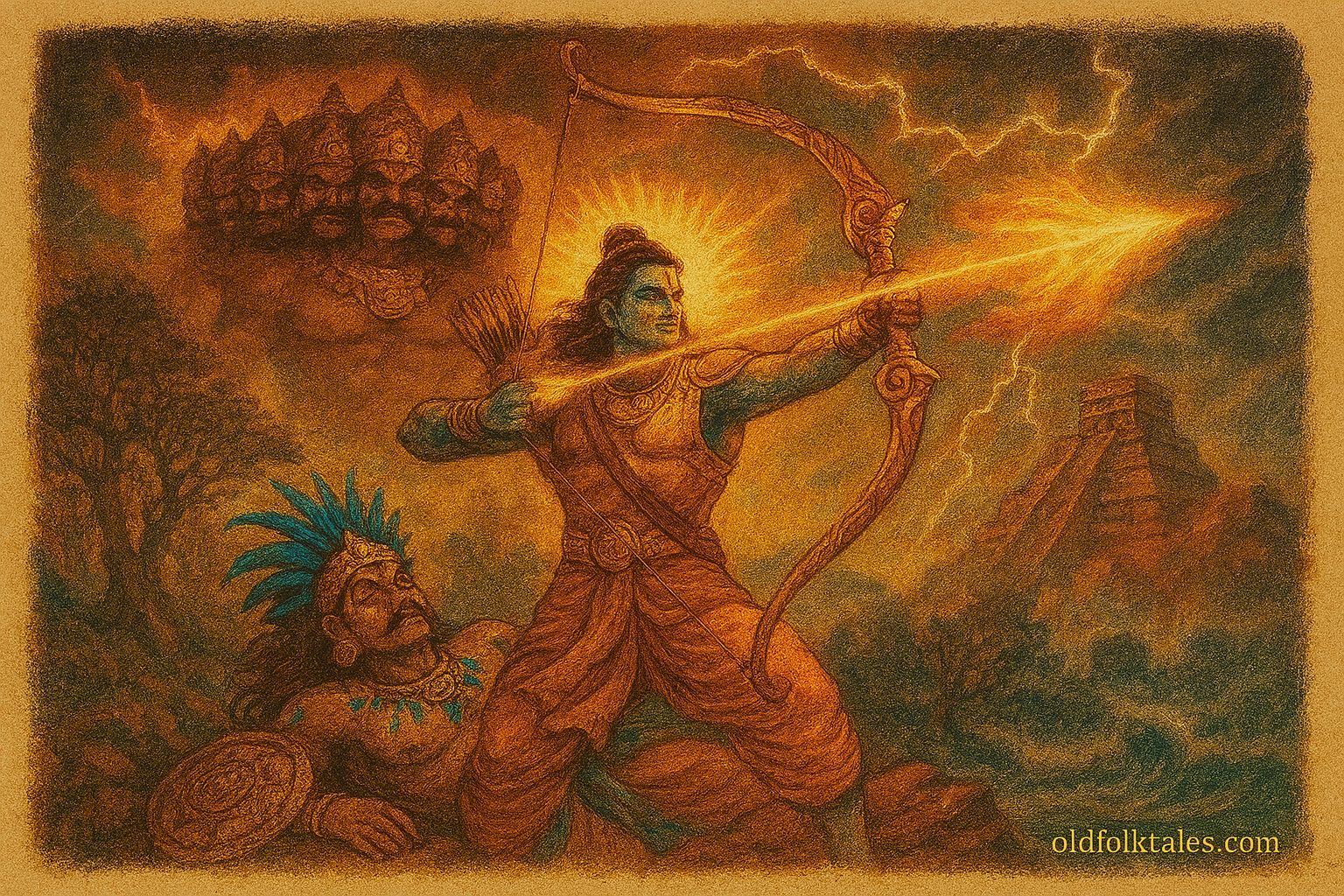
In the ancient land of Ayodhya, where rivers shimmered like molten silver and forests whispered the secrets of the gods, a child was born to King Dasharatha and Queen Kaushalya. This child was Rama, an incarnation of the god Vishnu, destined to uphold dharma, divine law and cosmic balance. From his earliest days, Rama’s presence radiated calm authority and unwavering virtue. The sages spoke of him in hushed reverence, proclaiming that the world’s order rested upon his mortal shoulders.
Rama’s youth was marked by prodigious skill in warfare, archery, and the sacred arts of righteousness. Yet, he remained humble, gentle to the weak, steadfast to the just. His devotion to dharma was mirrored in his love for his younger brother Lakshmana, whose loyalty was as deep as the ocean, and in his bond with Sita, a princess of unmatched beauty and wisdom, who would become his eternal companion. Their union was blessed by the gods, a marriage that would intertwine love with the sacred purpose of maintaining order in the world.
But destiny, as it often does, demanded a test of the heart and spirit. The scheming Queen Kaikeyi, mother of Bharata, invoked a boon long promised by King Dasharatha. With cunning and pride, she demanded that Rama be exiled to the forest for fourteen years, and that her son Bharata ascend the throne. The king’s heart shattered, but Rama, ever the embodiment of dharma, bowed without hesitation. His smile, serene and resolute, carried no hint of bitterness; only the quiet light of moral courage. With Lakshmana at his side, he journeyed into the wild forests, leaving behind the golden palace and the world’s comforts. Sita, bound by love and loyalty, accompanied him, her presence a flame of hope amid shadow.
The forest was no idle refuge; it was a crucible of trial. Rama faced rakshasas, demonic beings of immense power, and witnessed the suffering and fear that imbalance could sow among mortals. His bow sang death to the wicked, yet mercy tempered every stroke. When Ravana, the ten-headed demon-king of Lanka, abducted Sita, it was not just an affront to Rama’s family but a challenge to dharma itself. Sita’s plight reflected the cosmic struggle: desire and tyranny against righteousness and order.
Rama’s quest to rescue Sita was epic in scale and moral significance. He formed alliances with vanaras, the mighty monkey warriors led by Hanuman, whose devotion mirrored Rama’s own, and Sugriva, who had been wronged by betrayal. The armies of forest and mountain converged upon Lanka, a realm of infernal splendor, where Ravana’s arrogance was as immense as his power. The ensuing battle was cataclysmic, as arrows blazed like shooting stars and the ground trembled beneath the clash of divine and demonic forces.
In the heart of the battle, Rama faced Ravana directly. Ten heads, each a symbol of pride, greed, lust, and unchecked ambition, towered before him. Yet Rama’s focus never wavered; he invoked the divine energies granted to him by Vishnu. With a single, fateful arrow, he struck Ravana’s heart, ending the tyrant’s reign. Sita was freed, yet Rama’s trials were not complete. He tested her purity and resolve, for dharma demanded that even love be tempered by righteousness. Sita’s unwavering fidelity illuminated the path of moral clarity, a beacon of virtue that reaffirmed the triumph of cosmic order over chaos.
Rama’s return to Ayodhya was a spectacle of divine joy and human relief. The city, once steeped in sorrow, resonated with celebration. Rama ascended the throne, not merely as king, but as dharmaraja, the ruler whose every decision reflected justice, morality, and balance. His story was remembered not simply for battles won or enemies vanquished, but for the example of selflessness, courage, and adherence to the sacred law of existence. Through trials, exile, love, and war, Rama embodied the eternal principle that the righteous path, though arduous, leads to harmony, peace, and the ultimate triumph of order over chaos.
Author’s Note:
Rama’s legend transcends time and culture, embodying the ideal of dharma in human form. He is not merely a prince or a warrior; he is a symbol of moral rectitude, devotion, and the righteous execution of duty. Across centuries, his story has inspired countless generations, teaching that virtue is a living force that must be exercised in action, choice, and leadership. The Ramayana’s enduring power lies in its portrayal of the human struggle with ethical complexity, divine purpose, and the courage required to uphold cosmic order.
Knowledge Check:
-
Who were Rama’s parents, and which kingdom did he belong to?
-
What is dharma, and how does Rama exemplify it in his life?
-
Why was Rama exiled, and who demanded his exile?
-
Who assisted Rama in the battle against Ravana, and what qualities did they embody?
-
What does Ravana’s ten heads symbolize, and how does Rama overcome them?
-
How does the story of Rama illustrate the balance between human struggle and divine purpose?
Source: The Ramayana of Valmiki (Penguin Classics edition), India, c. 500–100 BCE









