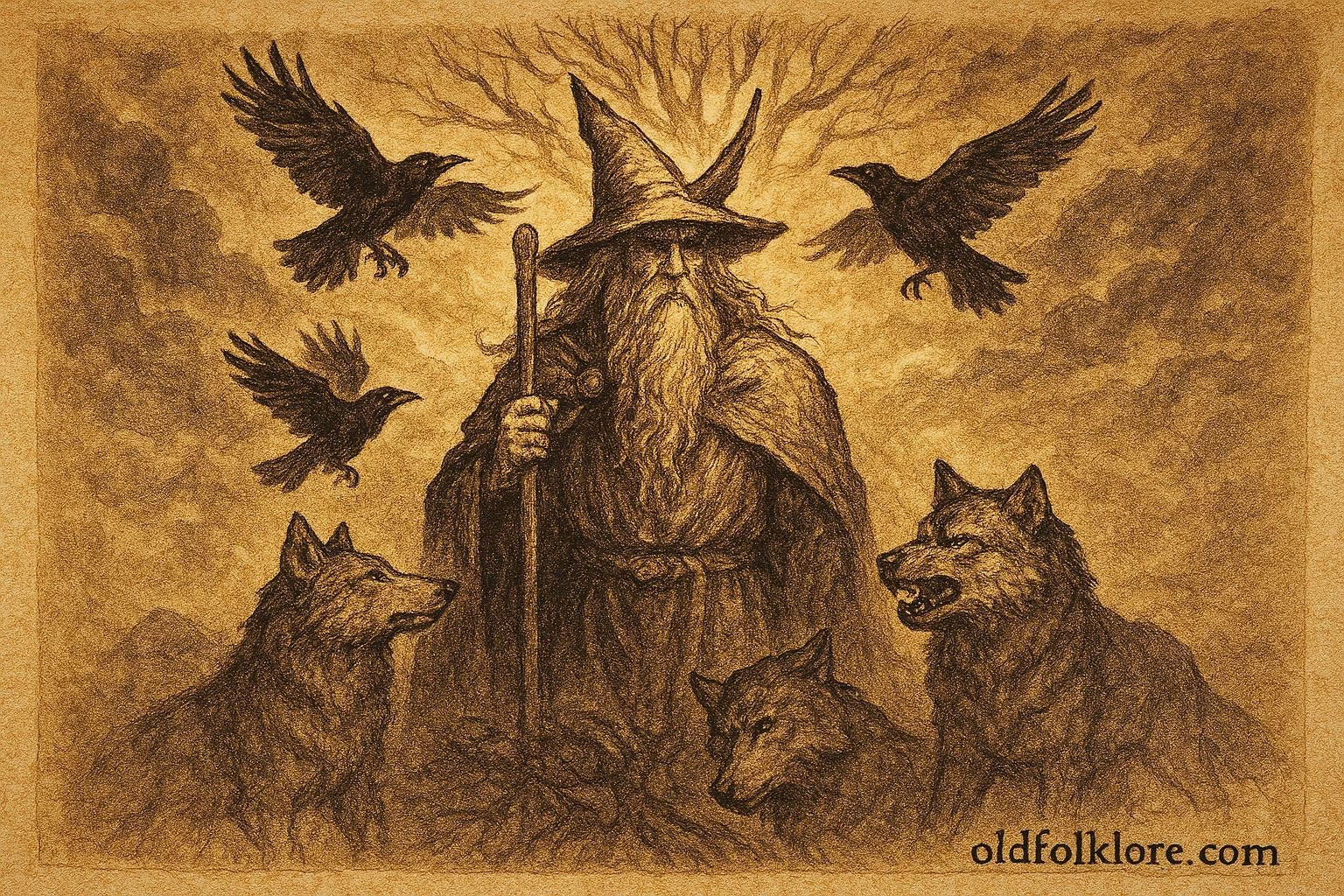
Odin (Old Norse: Óðinn) stands as the supreme god of the Norse pantheon, ruler of the Æsir and father of many divine lineages. Known as the All-Father (Alföðr), he governs wisdom, poetry, war, and death, moving between realms as both king and wanderer. He is depicted with one eye, the other sacrificed at Mímir’s Well for knowledge, and a long gray beard beneath a wide-brimmed hat, cloaked in shadow and mystery. Two ravens, Huginn (Thought) and Muninn (Memory), fly across the worlds each day, whispering all they see into his ears. Two wolves, Geri and Freki, sit by his throne, where he drinks only mead, for he has no need of mortal food.
Odin rides Sleipnir, his eight-legged steed, faster than any wind, and wields Gungnir, the spear that never misses its mark. His hall, Valhalla, stands in Asgard, where the bravest warriors, those slain in battle, are brought by the Valkyries to prepare for Ragnarök, the doom of gods and men. Odin’s wisdom is vast, but it was earned through suffering, sacrifice, and relentless pursuit of hidden truths. Above all, he is a god who gives of himself to gain knowledge for the world.
Mythic Story: The Sacrifice on the World Tree
In the dawn of ages, before men carved runes upon stone or whispered prayers into the wind, Odin sought the knowledge that lay beyond the reach of gods. The runes, symbols of power, fate, and creation—were hidden deep within Yggdrasil, the World Tree, whose branches stretched above the heavens and whose roots coiled through the dark wells of existence.
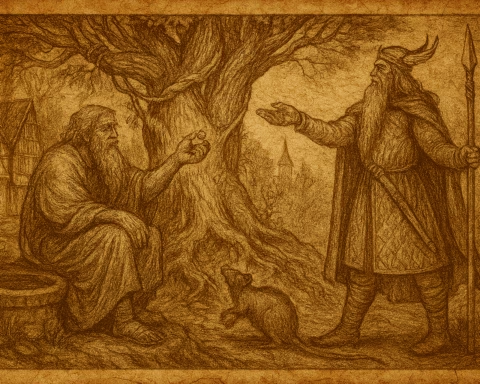
Odin knew that wisdom could not be given, it must be earned. So, he turned his gaze inward, into the heart of mystery. He approached Mímir’s Well, where the water held the memory of all things. There, the guardian Mímir warned him:
“To drink from this well, All-Father, you must pay with that which sees.”
Without hesitation, Odin plucked out his own eye and cast it into the shimmering depths. The water rippled with his sacrifice, and from its surface, truth rose like mist. He drank, and visions flooded his mind: the birth of worlds, the weaving of fate by the Norns, and the final fire that would consume all.
Yet even that was not enough. The runes still eluded him, their shapes buried in the Tree of Life itself. Thus, Odin resolved to give more, his very being. He went to Yggdrasil, the mighty ash that binds all realms, and hung himself upon its wind-swept branches. No one offered him aid, no bread nor mead; he was pierced by his own spear, Gungnir, and the world turned beneath him.
For nine nights he hung there, between life and death. The winds screamed through the branches; the roots whispered secrets of earth and underworld. He gazed downward into the abyss, into the well of Urd, where fate itself was carved. In his agony, his spirit wandered through shadow and void, seeking the symbols that shaped destiny.
On the ninth night, as the stars dimmed, the runes rose from the deep, glowing, living signs of power. With trembling hands he seized them, crying out a terrible and holy cry. The Tree shuddered, and Odin fell, reborn, holding the wisdom of the runes. From that day forth, he was the master of secret knowledge: of spells, poetry, warcraft, and prophecy.
He taught the runes to gods and men alike, so they might shape fate through understanding. Yet his gift was double-edged, for those who wield wisdom must also bear its burden. He foresaw the coming of Ragnarök: the death of gods, his own slaying by the wolf Fenrir, and the rebirth of the world beyond the flames. Still, Odin did not despair. Knowledge, even of doom, was better than blindness.
So he walks the earth disguised as a wanderer, gray-cloaked, one-eyed, bearing the name Grímnir, or Bölverkr, or a hundred others. He visits kings and peasants, poets and prophets, testing hearts and rewarding courage. For Odin is not only the father of gods but the teacher of humankind, who reminds mortals that sacrifice, not comfort, is the price of truth.
“I know that I hung on the windy tree, nine long nights,
Wounded with a spear, offered to Odin, myself to myself,
Upon that tree which no man knows from what root it rises.”
– Hávamál, Poetic Edda
Author’s Note
Odin’s tale is one of the oldest meditations on the cost of wisdom. His self-sacrifice mirrors the human struggle to understand existence: that knowledge comes through loss, endurance, and humility before the unknown. In giving his eye and hanging upon Yggdrasil, Odin embodies the eternal truth that enlightenment demands surrender. The myth reminds us that wisdom is not the absence of suffering, it is the transformation of it into vision.
Knowledge Check
Q1. Title: What does Odin’s name mean in Old Norse?
A: “Óðinn” derives from óðr, meaning “fury,” “inspiration,” or “mind,” reflecting his ecstatic and poetic nature.
Q2. Title: What is the significance of Odin’s eye sacrifice?
A: He gave one eye to drink from Mímir’s Well, gaining profound knowledge of the cosmos and fate.
Q3. Title: Why did Odin hang on Yggdrasil for nine nights?
A: To obtain the runes, cosmic symbols of wisdom and power, through self-sacrifice and suffering.
Q4. Title: What animals accompany Odin?
A: Two ravens, Huginn and Muninn, who bring him knowledge, and two wolves, Geri and Freki.
Q5. Title: What does Odin’s hall, Valhalla, represent?
A: It is the hall of the slain, where chosen warriors train for Ragnarök, the final battle of gods and giants.
Q6. Title: What is the central moral of Odin’s myth?
A: True wisdom requires sacrifice; enlightenment is earned through the courage to confront suffering and fate.
Source: Poetic Edda & Prose Edda, Iceland (13th century).
Cultural Origin: Norse Mythology, Scandinavia.