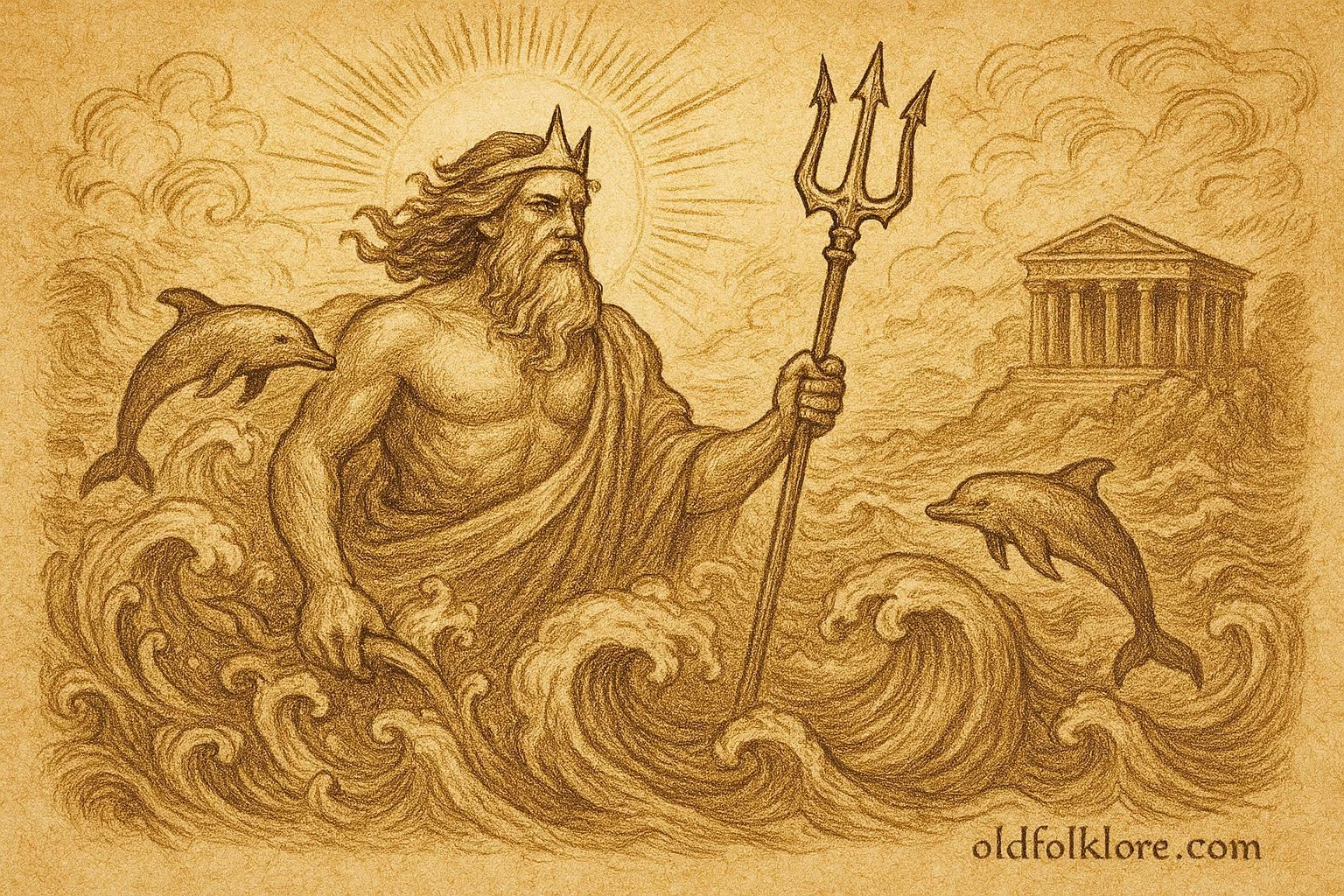
Poseidon (Ποσειδῶν), one of the Olympian Twelve, is the god of the sea, earthquakes, storms, and horses. Brother to Zeus and Hades, he rules the waters as Zeus rules the skies and Hades the underworld. Born of the Titans Cronus and Rhea, Poseidon escaped his father’s devouring after Zeus freed their siblings from Cronus’s belly.
His realm spans all oceans, rivers, and coastal tides. Mariners, fishermen, and voyagers prayed to him for calm seas, or feared his wrath when storms broke. He wields the trident, a three-pronged spear forged by the Cyclopes, capable of shaking both sea and land. His sacred animals include the horse, which he is said to have created, and the dolphin, symbol of his gentler nature.
Temples dedicated to Poseidon once rose on coastal cliffs and promontories across Greece, notably the Temple of Poseidon at Cape Sounion, overlooking the Aegean. Offerings of bulls, horses, or polished shells were made to appease him before voyages, for Poseidon’s moods were unpredictable, calm one moment, vengeful the next. He was both a protector and destroyer: the embodiment of the ocean’s dual nature.
Mythic Story: Poseidon’s Wrath Against Odysseus
When Troy fell, the Greek heroes sailed homeward, their ships scattered across the wine-dark sea. Among them was Odysseus, king of Ithaca, whose cunning had ensured victory through the Trojan Horse. Yet as he set sail for home, his fate was bound to the wrath of Poseidon.
On his voyage, Odysseus and his men landed upon the island of the Cyclopes, savage one-eyed giants who herded flocks upon stony hills. Seeking food, Odysseus entered a great cave, the dwelling of Polyphemus, son of Poseidon. When Polyphemus returned and found strangers feasting on his stores, he sealed the cave with a boulder and devoured two men in rage. Odysseus, ever clever, devised an escape.
He offered the giant potent wine, declaring his name was “Nobody.” When Polyphemus, drunk and reeling, fell into sleep, Odysseus drove a sharpened stake into his single eye. The blinded Cyclops screamed to his kin that “Nobody” had hurt him, and thus none came to his aid. Odysseus and his men slipped away beneath the bellies of the sheep as dawn broke, escaping to their ship.
But Odysseus could not resist pride. As the ship pulled away, he called out to the shore, revealing his true name and boasting of his deed. Polyphemus, bleeding and blind, lifted his hands to the heavens and cried to his father:
“Hear me, Poseidon, Earth-shaker! Grant that Odysseus, son of Laertes, may never reach his home. But if fate decrees he return, let it be long delayed, through suffering, loss, and storm!”
Poseidon heard. From that moment, the sea became Odysseus’s enemy. His ships were tossed upon monstrous waves; tempests shattered masts and scattered his fleet. Each time Odysseus neared home, Poseidon’s hand rose to strike him back.
When Odysseus reached the island of the Phaeacians, the god’s fury was still unspent. The Phaeacians, blessed with swift ships, aided all sailors lost at sea. They ferried Odysseus home at last, but as their ship returned, Poseidon turned it to stone in the harbor and ringed their city with mountains, punishment for helping his foe.
At last, only after years of wandering, shipwreck, and sorrow, did Poseidon’s anger subside. The god had shown that none may mock the divine without consequence. His power was not mere vengeance but a reminder of the humility mortals owed to the sea, that vast, untamable force through which all life flowed.
Author’s Note
Poseidon’s myth reveals more than tempest and punishment; it mirrors the sea itself, beautiful yet perilous, calm yet capable of ruin. His story teaches reverence for nature’s power and the folly of pride. To ancient Greeks, Poseidon was not merely a god but a truth: that the forces sustaining life are the same that can destroy it if disrespected.
Knowledge Check
Q1. What is Poseidon’s primary domain?
A: He rules the sea, storms, horses, and earthquakes as one of the Olympian gods.
Q2. What is Poseidon’s most famous weapon?
A: His trident, a three-pronged spear that can shake both sea and earth.
Q3. Who was Poseidon’s son in the Odyssey?
A: Polyphemus, the Cyclops blinded by Odysseus.
Q4. Why did Poseidon punish Odysseus?
A: Because Odysseus blinded his son Polyphemus and boasted about it.
Q5. What are Poseidon’s sacred symbols or animals?
A: The horse and the dolphin, both linked to his power over waves and creation.
Q6. What does Poseidon’s story teach about human nature?
A: It warns against arrogance and underscores respect for nature’s might and divinity.
Source: Greek Mythology, Greece.
Source Origin: Greece