Huitzilopochtli, meaning “Hummingbird of the Left (South)” in Nahuatl, is the radiant warrior deity of the Mexica, better known as the Aztecs. He embodies the sun’s relentless journey through the heavens and the unending struggle against cosmic darkness. Patron of warfare, sacrifice, and the Mexica nation itself, Huitzilopochtli stands as both protector and punisher, a god of light who demands blood to sustain the dawn.
His sacred symbols include the hummingbird, emblem of the soul of fallen warriors reborn in battle; the serpent scepter (Xiuhcoatl), symbolizing the burning weapon of the sun; and blue war paint, marking his dominion over the southern sky. His temples, most famously the Templo Mayor in Tenochtitlan, were aligned to greet his first light each morning, their steps stained by ritual offerings that nourished his solar path.
Among the Mexica pantheon, Huitzilopochtli shares the celestial order with Tlaloc, god of rain, and Quetzalcoatl, the wind-serpent. Yet unlike his brothers, his power is rooted in struggle: each day’s sunrise is a victory over death. To the Aztecs, war and sacrifice were sacred acts, sustaining both cosmos and civilization through the heart of their Sun.
Mythic Story: The Birth of Huitzilopochtli
Before the Mexica built their island capital, before their sun had risen, there was Coatlicue, the mother of gods, “She of the Serpent Skirt.” Upon the sacred mountain Coatepec, she tended the temple of the heavens, sweeping its stones as an act of devotion. One day, as she swept, a ball of shimmering feathers descended from the sky and touched her. When she placed them within her breast, they vanished, and Coatlicue felt life stir inside her womb.
When her many children, the Centzon Huitznahua (the Four Hundred of the South, gods of the stars) and her daughter Coyolxauhqui, goddess of the Moon, learned of this mysterious pregnancy, they were enraged. “Who has dishonored our mother?” cried Coyolxauhqui, rallying her siblings to vengeance. They conspired to kill Coatlicue and her unborn child before dawn, fearing the power of this new god.
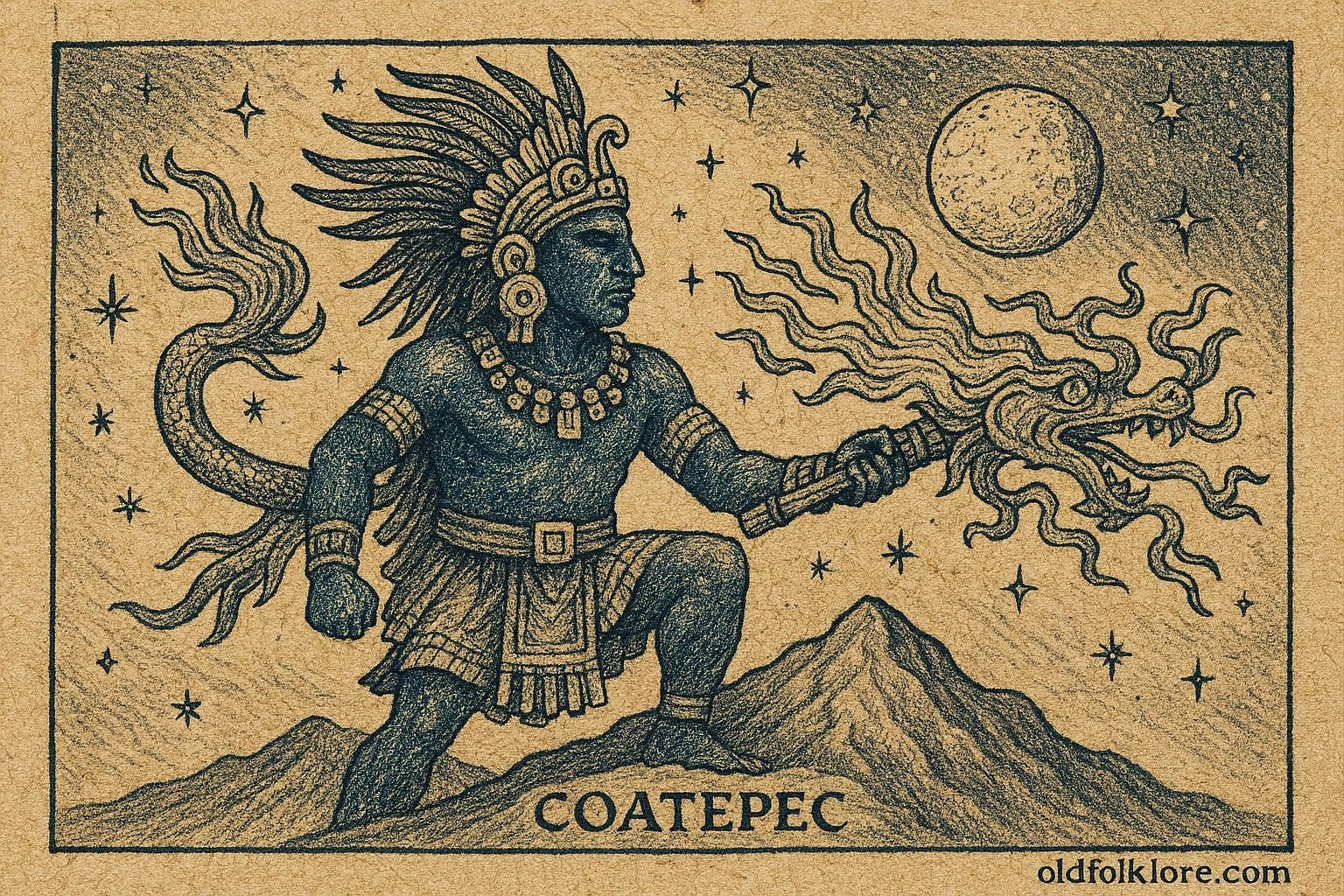
But inside the womb, Huitzilopochtli heard everything. “Do not fear, my mother,” he whispered from within, “for I am ready.” As the stars marched toward Coatepec with Coyolxauhqui at their head, lightning began to stir in the womb of Coatlicue. The mountain trembled. Then, with a cry that split the heavens, Huitzilopochtli was born, fully armed and shining like the sun.
In his right hand burned the Xiuhcoatl, the serpent of fire. With its searing strike he cut down Coyolxauhqui, casting her body down the mountainside, her head torn away and flung into the sky, where it became the Moon, eternally fleeing the Sun’s pursuit. Then he turned upon the four hundred brothers, scattering them in all directions. They became the stars, forever retreating before the dawn.
Thus, the sky found its order: the Sun triumphing over the Moon and stars each day, only to fall and rise again. This celestial battle became the rhythm of existence itself, a cycle that required the lifeblood of humanity to continue. Through sacrifice, the Mexica repaid their debt to Huitzilopochtli, ensuring that the sun would not die, that the heavens would not collapse into night eternal.
From that first victory at Coatepec, Huitzilopochtli became the heart of the Mexica people. Guided by his divine voice, they migrated across valleys and lakes, seeking the place where an eagle would perch on a cactus devouring a serpent, the promised sign of their new empire. When they found it upon an island in Lake Texcoco, they built Tenochtitlan, “the place of the prickly pear cactus,” and raised his temple as its radiant center.
Every year, festivals honored his birth and triumph. Warriors captured in battle were sacrificed upon the pyramid, their hearts lifted to the sun, gifts of life to sustain his eternal struggle. In their eyes, the victims became stars ascending to join the cosmic order. To die for Huitzilopochtli was not death, but transformation, the promise that one’s soul would rise as a hummingbird, drinking from the flowers of the afterlife and returning each dawn with the light of the sun.
Author’s Note
The myth of Huitzilopochtli reveals the Mexica’s profound philosophy of cosmic balance, life born from death, creation sustained by sacrifice. In their world, divinity was not distant but woven into every heartbeat, every sunrise. Huitzilopochtli teaches that existence itself demands struggle and offering, that even the sun must fight each day to rise again.
Knowledge Check
Q1. What does Huitzilopochtli’s name mean in Nahuatl?
A: “Hummingbird of the Left” or “Hummingbird of the South,” referring to his solar and warrior aspects.
Q2. Who were Huitzilopochtli’s mother and siblings?
A: His mother was Coatlicue; his siblings were Coyolxauhqui (the Moon) and the Centzon Huitznahua (the stars).
Q3. What weapon did Huitzilopochtli wield at birth?
A: The Xiuhcoatl, a serpent of fire symbolizing solar power and divine wrath.
Q4. What celestial order did his myth explain?
A: The daily battle of the Sun (Huitzilopochtli) overcoming the Moon and stars.
Q5. Why were human sacrifices made to Huitzilopochtli?
A: To nourish the Sun’s strength and ensure the continuation of cosmic balance.
Q6. What sacred symbol guided the Mexica to found Tenochtitlan?
A: An eagle perched on a cactus devouring a serpent, Huitzilopochtli’s sign.
Source: Aztec (Mexica) Mythology, Florentine Codex, Valley of Mexico.
Origin: Aztec (Mexica), Valley of Mexico