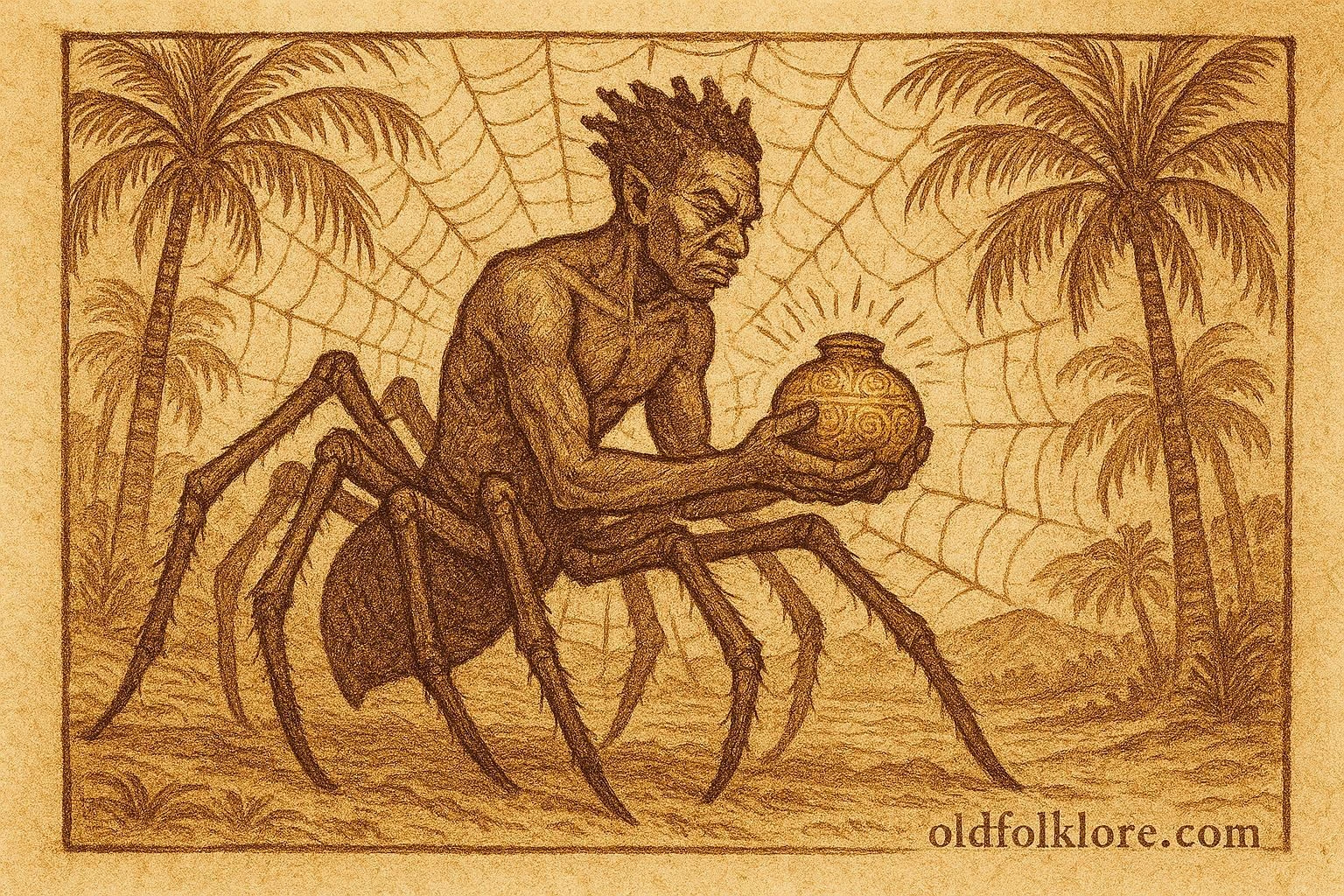
Anansi, known among the Akan as Kwaku Ananse, meaning “Ananse born on Wednesday”, is the most famous trickster spirit of West Africa. Often appearing as both man and spider, he is a weaver of webs and of words, a symbol of cleverness, survival, and the eternal power of storytelling.
In Akan belief, Anansi stands between the worlds of gods and humans. Though not a creator god, his wit and daring earn him sacred status as a culture-bringer, the one who secured the world’s stories for humankind. To the Ashanti, he is both a divine messenger and a mischievous spirit who exposes the folly of pride and greed through laughter.
Anansi’s symbols include the spider’s web, representing interconnectedness and intelligence; the calabash, vessel of stories and wisdom; and the palm tree, beneath which many of his tales begin. His wife Aso, often the true mind behind his triumphs, appears in several stories as the voice of quiet wisdom. In the Akan worldview, Anansi embodies the wisdom of the small triumphing over the mighty, the enduring truth that intellect outlasts power.
Through the transatlantic slave trade, his tales crossed oceans and survived in the Caribbean and the Americas, reborn as Anancy or Aunt Nancy tales in Jamaica, Suriname, and the Gullah South. Across continents, his laughter carried the memory of home.
Mythic Story: How Anansi Won the Stories of the Sky-God
In the beginning, the world had no stories. All wisdom, all tales of gods, heroes, and animals were owned by Nyame, the Sky-God. He kept them locked in a golden chest in the heavens, far from mortal hands. On earth, people lived without songs or myths to explain their world.
But Anansi, the spider-man, gazed up at the endless sky and decided that such treasures should belong to everyone. He climbed the tallest silk-cotton tree and called to Nyame, “Great Sky-God! I wish to buy your stories, so that all people may share them!”
Nyame laughed thunderously. “My stories? They are precious. Even if you offered your mother, your children, and your wife, it would not be enough!”
But Anansi persisted. “Tell me your price,” he said.
Nyame, amused by this tiny creature’s courage, declared, “Bring me Onini the Python, Osebo the Leopard, Mmoboro the Hornets, and Mmoatia, the invisible fairy whom no one has ever caught. Only then shall I give you my stories.”
The other gods watching from the clouds laughed, for who could imagine a spider capturing such fearsome beings?
Yet Anansi smiled. “It shall be done.”
The Python and the Web of Wit
Anansi went first to the river where Onini the great python slept. “My wife and I have a dispute,” he said aloud. “She claims you are shorter than a palm branch, but I say you are longer!”
The curious python raised his head. “Measure me and see,” he hissed.
So Anansi stretched a long palm branch beside the serpent and tied its tail to one end “so it won’t move.” Then, as he “measured,” he bound Onini’s middle, then his neck. “Ah,” Anansi said, smiling, “I think we have proved it well.” The python wriggled, but the web held firm. Into a basket he went.
The Leopard, the Hornets, and the Invisible Fairy
Next, Anansi dug a deep pit along Osebo the leopard’s path and covered it with leaves. When Osebo fell in, roaring, Anansi offered help. “Tie your tail to my rope and I will pull you out!”
But when the leopard was tied, Anansi pulled the rope tight instead, trapping him fast.
He then went to Mmoboro, the hornets, standing by a tree. “Look how the rains are coming!” he shouted, pouring water over them from his calabash. “Fly into this gourd to stay dry!” The hornets swarmed inside, and Anansi sealed the top.
Last came Mmoatia, the invisible fairy. For her, Anansi carved a small doll of wood, coated it with sticky gum, and placed it under a palm tree with a bowl of mashed yam. “Eat, little one,” he called.
When the fairy thanked the doll but got no answer, she struck it and stuck fast! She struck again and again until she was trapped. Laughing, Anansi carried her away.
Anansi’s Triumph
At last, Anansi climbed once more to the sky, carrying his prizes. Nyame stared in astonishment. “You have captured them all! Even the invisible one. No one has ever done this.”
“Then your stories belong to the people,” Anansi said.
Nyame nodded solemnly. “From this day forth, all stories shall be called Anansesem, the tales of Anansi. Go, and let them be told among mortals forever.”
And so Anansi descended to earth, his web shimmering between heaven and soil, carrying with him the first stories of the world. From his cleverness, humanity inherited not only myth but the art of storytelling itself, the weaving of words into webs that catch the light of truth.
Learn the ancient stories behind deities of light, storm, and shadow from cultures across the world
Author’s Note
Anansi’s triumph is more than a trick; it is a sacred allegory. His tale honors intellect as divine power, a lesson that wit, patience, and creativity can achieve what brute force cannot. For the Akan, storytelling is a spiritual inheritance: each word a thread linking ancestors to descendants. Through Anansi, we learn that the smallest voice may yet hold the greatest wisdom.
Knowledge Check
Q1. What does “Anansi” mean in Akan?
A: It means “spider,” often paired with “Kwaku” (born on Wednesday).
Q2. Who owned the world’s stories before Anansi?
A: Nyame, the Sky-God, who kept them hidden in the heavens.
Q3. What creatures did Anansi have to capture to earn the stories?
A: The python Onini, the leopard Osebo, the hornets Mmoboro, and the invisible fairy Mmoatia.
Q4. How did Anansi trap the fairy Mmoatia?
A: He used a sticky gum doll that caught her when she struck it.
Q5. What name did stories receive after Anansi’s victory?
A: Anansesem, meaning “Anansi stories.”
Q6. What moral lesson does Anansi’s tale teach?
A: That wisdom and creativity can overcome strength and authority.
Source: Akan Oral Tradition, Akan-Ashanti Folk-Tales (R. S. Rattray), Ghana.
Source Origin: Akan (Ashanti), Ghana