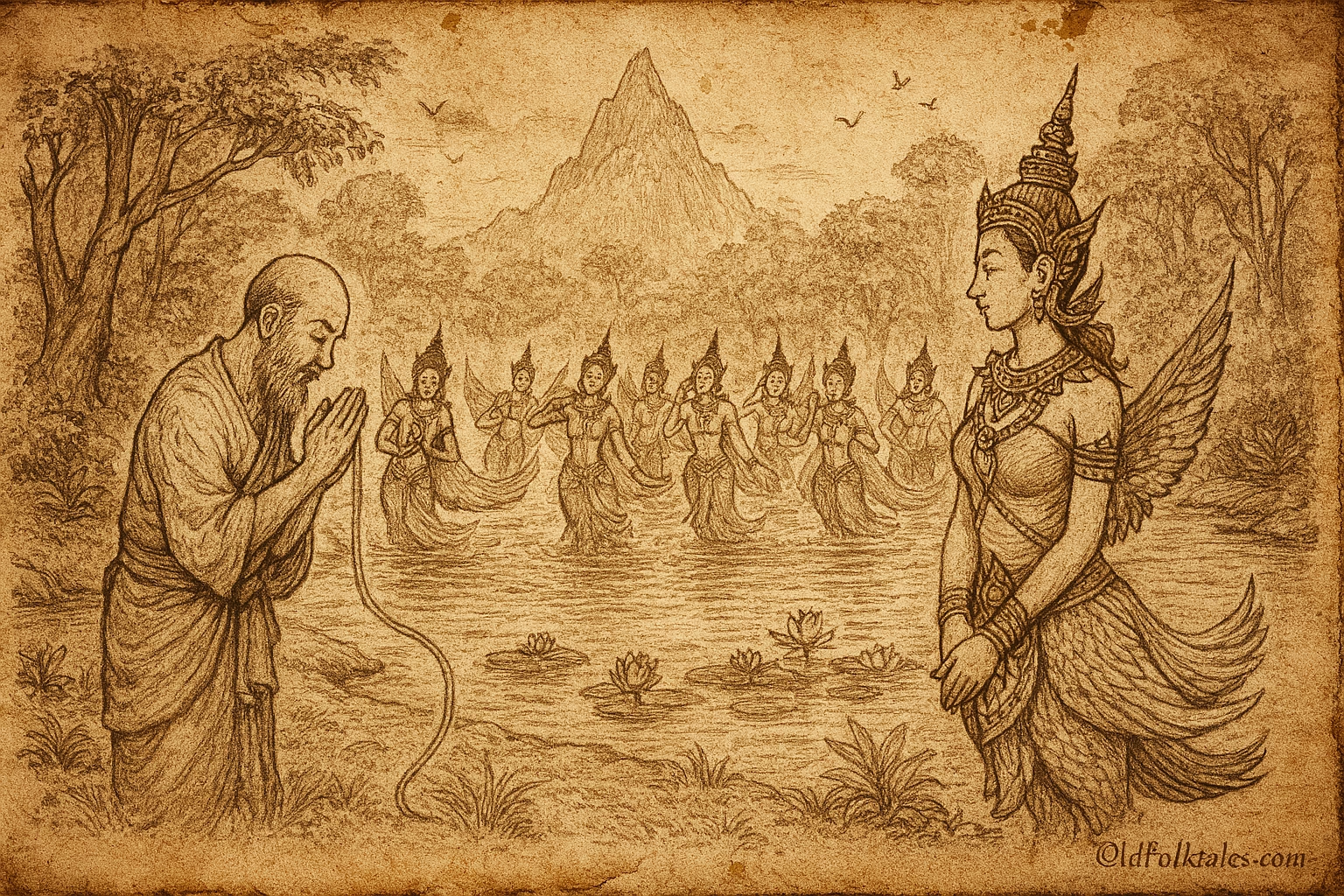
In the golden age of the Ayutthaya Kingdom, when magic still wove through the fabric of the world, there stood the mystical Mount Grairat, a mountain that pierced the clouds and touched the realm of the divine. Upon this sacred peak lived King Prathum and Queen Jantakinnaree, rulers of a kingdom where wonder was woven into everyday life. The royal couple had been blessed with seven daughters, each more enchanting than the last the Kinnaree princesses, beings of extraordinary grace who possessed bodies that were half-woman, half-swan.
These princesses were no ordinary maidens. Delicate white wings sprouted from their backs, and they could soar through the heavens with the freedom of birds or shed their wings at will to walk upon the earth as humans. Their voices rang like crystal bells, their movements flowed like water over smooth stones, and their beauty was spoken of in whispered reverence throughout the lands.
Click to read all Myths & Legends – timeless stories of creation, fate, and the divine across every culture and continent
The youngest of these seven sisters was Princess Manorah, and she shone brightest among them all. Her eyes sparkled with curiosity and kindness, her laughter echoed like wind chimes in a gentle breeze, and her spirit possessed a lightness that even her wings could not match. Of all her sisters, Manorah loved the mortal world most dearly, finding wonder in every flower, every stream, every living creature that crossed her path.
On days when the moon swelled full and round in the night sky the auspicious occasions known as Panarasi the seven Kinnaree princesses would fly down from Mount Grairat to visit their favorite place in all the world: a crystalline lake nestled deep within the Himmapan forest. This was no ordinary woodland but a realm where magic breathed in the mist, where ancient trees whispered secrets, and where creatures of myth and legend made their homes. The lake’s waters gleamed like liquid silver, reflecting the sky so perfectly that heaven and earth seemed to merge at its surface.
Not far from this enchanted lake lived an old hermit, a wise man who had long ago withdrawn from the world of men to dwell in solitude among the forest’s mysteries. He had witnessed countless marvels during his years in the Himmapan, and little could surprise him anymore.
One morning, as golden sunlight filtered through the dense canopy, a young man named Prahnbun wandered through the forest paths. He was an adventurer by nature, always seeking new experiences and undiscovered wonders. As he moved quietly between the ancient trees, a sound reached his ears melodious laughter, light as birdsong, drifting through the green shadows.
Drawn by curiosity, Prahnbun crept closer until he reached the lake’s edge. There, his breath caught in his throat. Seven magnificent beings played in and around the crystalline waters the Kinnaree princesses in all their glory. They had shed their wings temporarily and splashed in the shallows, their joy infectious, their beauty otherworldly. But among the seven, one captured Prahnbun’s attention completely. Princess Manorah moved with such grace, smiled with such radiance, that she seemed to illuminate the very air around her.
Prahnbun’s mind began to race. He knew of Prince Suton, the noble ruler of Udon Panjah, a prince renowned for his wisdom and virtue but who remained unmarried, searching for a bride worthy of his heart. What greater gift could Prahnbun offer than the most beautiful princess ever to grace the earth?
Quietly, Prahnbun withdrew from the lake and sought out the old hermit’s dwelling. He found the wise man sitting in meditation beneath a banyan tree, its roots spreading like ancient fingers across the forest floor.
“Venerable hermit,” Prahnbun began, bowing respectfully, “I have seen the Kinnaree princesses at the lake. I wish to capture one Princess Manorah to bring her to Prince Suton. Can you help me?”
The hermit opened his eyes slowly, studying the young man before him. “Capturing a Kinnaree is no simple task,” he said, his voice like dry leaves rustling. “Their magic is powerful, their wings swift. You would need something equally magical a rope enchanted with binding power. And such a rope can only be obtained from the great dragon who dwells in the deepest, darkest part of this forest.”
Prahnbun’s determination did not waver. He thanked the hermit and set off into the forest’s heart, where shadows grew thick and ancient trees stood like sentinels guarding forgotten secrets. After a perilous journey, he found the great dragon a magnificent serpent with scales that shimmered like precious gems, coiled in a cavern where underground rivers sang their eternal songs.
The dragon was neither cruel nor kind, simply indifferent to the affairs of mortals. But Prahnbun spoke with eloquence and persistence, explaining his purpose and the worthiness of Prince Suton. Whether moved by Prahnbun’s words or simply weary of his presence, the dragon finally uncoiled one of its own scales, which transformed into a magical rope that glowed with a faint golden light.
“This rope will bind even a Kinnaree’s magic,” the dragon rumbled. “Use it wisely.”
Prahnbun returned to the lake on the next Panarasi, when the full moon rose and the seven sisters descended once more to play in the silver waters. He concealed himself among the reeds at the water’s edge, the magical rope coiled in his hands, his heart pounding with anticipation and nervousness.
As the princesses laughed and danced, Manorah wandered closer to the shore, bending to admire a lotus flower that had just opened its petals. In that moment, Prahnbun acted. He threw the magical rope with perfect aim, and it looped around Manorah’s slender neck, tightening gently but firmly.
Manorah gasped, her hands flying to the rope as its magic pulsed through her. Her six sisters, realizing the danger, snatched up their wings and took flight in a flurry of white feathers, their frightened cries echoing across the water as they disappeared into the sky, racing back to Mount Grairat to tell their parents of their sister’s capture.
Prahnbun emerged from his hiding place, speaking softly to calm the frightened princess. “Please, do not be afraid. I mean you no harm. I am taking you to Prince Suton of Udon Panjah, a noble and worthy man. You will be treated with honor and respect.”
Manorah’s eyes flashed with defiance and fear, but the magical rope held her power in check. Prahnbun carefully secured her wings to prevent her escape, binding them with silk that would not harm her delicate feathers. Then, with gentle but firm guidance, he led her through the winding forest paths toward Udon Panjah.
The journey took several days, and as they traveled, Prahnbun treated Manorah with kindness, offering her food and water, ensuring her comfort despite her captivity. Gradually, Manorah’s terror eased, though confusion and sadness still clouded her bright eyes. She said little, gazing longingly at the sky where she could no longer fly.
As fate would have it, on the final day of their journey, they encountered Prince Suton himself. The prince was riding through the forest on his magnificent horse, accompanied by a small retinue of guards, inspecting the borderlands of his kingdom. When his eyes fell upon Manorah, time seemed to stop.
The prince had seen many beautiful women in his life, but never had he witnessed such ethereal grace, such luminous beauty. Her Kinnaree nature was evident even with her wings bound—there was something not quite of this earth about her, a radiance that spoke of sky and cloud and distant mountains touching heaven.
“Who is this?” Prince Suton asked, dismounting quickly, unable to tear his gaze away.
Prahnbun bowed deeply, a smile spreading across his face. “Your Highness, this is Princess Manorah, youngest daughter of King Prathum of Mount Grairat. I have captured her especially for you, believing that no other woman in all the kingdoms could be worthy to stand as your bride.”
Prince Suton’s heart, which had remained untouched by romance for so long, suddenly blazed with feeling. But he was also a man of honor and wisdom. He approached Manorah gently, bowing to her with the respect due to royalty.
“Princess,” he said softly, “I am humbled by your presence. Though the circumstances of our meeting are unusual, I promise you will be treated with every courtesy and honor in my palace. I hope that in time, you might choose to see me not as your captor, but as someone worthy of your affection.”
Something in Prince Suton’s voice, in the genuine kindness of his eyes, touched Manorah’s frightened heart. She saw before her not a brutal lord but a noble soul someone who spoke to her with respect despite having the power to command her.
Prince Suton rewarded Prahnbun handsomely with gold, jewels, and lands, thanking him for his bravery and dedication. Then the prince personally escorted Manorah to his palace in Udon Panjah, where she was given the finest chambers, silk robes, and servants to attend her every need. But more importantly, she was given freedom to roam the palace gardens, to speak her mind, and to be treated as an honored guest rather than a prisoner.
Days turned to weeks, and weeks to months. Prince Suton courted Manorah with patience and genuine affection, never forcing his attentions upon her. He learned of her love for music and brought the finest musicians to play for her. He discovered her fascination with the natural world and created gardens filled with rare flowers and singing birds. He listened when she spoke of her home on Mount Grairat, of her sisters and parents, and he could see the homesickness in her eyes.
“If you wish to return home,” he told her one evening as they walked beneath the stars, “I will not stop you. Your happiness matters more to me than my own desires.”
It was this selflessness that finally unlocked Manorah’s heart. She realized that Prince Suton’s love was not possessive but liberating, not demanding but giving. She saw in him a partner who valued her spirit as much as her beauty, who respected her nature even when it meant potentially losing her.
“I do not wish to leave,” Manorah said softly, placing her hand in his. “My heart has found its home here, with you.”
The kingdom of Udon Panjah erupted in celebration when Prince Suton and Princess Manorah announced their engagement. The wedding was a spectacle of unmatched splendor. Even King Prathum and Queen Jantakinnaree, along with Manorah’s six sisters, flew down from Mount Grairat to attend, their initial anger at their daughter’s capture softened by seeing the genuine love between the couple.
Prince Suton and Princess Manorah were married under a canopy woven with flowers from both earth and heaven, blessed by monks and witnessed by nobles and commoners alike. From that day forward, they ruled Udon Panjah together with wisdom and compassion, their love story becoming legend a tale of how beauty and nobility can meet across worlds, and how true love transforms capture into choice, fear into trust, and strangers into soulmates.
The Moral Lesson
The legend of Princess Manorah teaches that genuine love cannot be forced but must be freely given. While Manorah was initially captured against her will, Prince Suton’s respect, patience, and willingness to release her if she wished transformed their relationship from captivity to genuine partnership. The story reminds us that true nobility lies in how we treat others, especially those who are vulnerable or in our power. Prince Suton won Manorah’s heart not through force but through demonstrating that he valued her happiness above his own desires, showing that love built on respect and freedom creates the strongest bonds.
Knowledge Check
Q1: Who was Princess Manorah in Thai mythology?
A: Princess Manorah was the youngest of seven Kinnaree daughters of King Prathum and Queen Jantakinnaree who lived on Mount Grairat. She possessed a half-woman, half-swan body with wings she could wear or shed at will. She became famous for her exceptional beauty and grace, and her story of love with Prince Suton became one of Thailand’s most beloved legends from the Ayutthaya period.
Q2: What is a Kinnaree and what powers did they possess?
A: A Kinnaree is a mythical being from Thai and Southeast Asian mythology with a half-human, half-bird form typically depicted as having a woman’s upper body and a swan’s lower body with wings. The seven Kinnaree sisters could fly through the heavens or shed their wings to walk on earth as humans, allowing them to move freely between the celestial and mortal realms.
Q3: How did Prahnbun capture Princess Manorah?
A: Prahnbun sought advice from an old hermit in the Himmapan forest, who told him he needed a magical rope that only the great dragon dwelling deep in the forest could provide. After persuading the dragon to give him the enchanted rope, Prahnbun waited at the lake during Panarasi (full moon) when the princesses came to play. He threw the magical rope around Manorah’s neck, which bound her powers and prevented her escape.
Q4: What is the significance of the Himmapan forest in the legend?
A: The Himmapan forest is a mythical, magical woodland in Thai mythology where supernatural beings and legendary creatures dwell. In this story, it serves as the liminal space between the celestial realm of Mount Grairat and the mortal kingdom of Udon Panjah. The forest contains the enchanted lake where the Kinnaree princesses played, and it was home to both the wise hermit and the great dragon, making it a place where magic and reality intersect.
Q5: How did Prince Suton win Princess Manorah’s love?
A: Despite Manorah being captured for him, Prince Suton won her love through respect, patience, and genuine kindness. He treated her as an honored guest rather than a prisoner, gave her freedom within his palace, courted her gently without force, and ultimately told her she could return home if she wished that her happiness mattered more than his desires. This selfless nobility transformed Manorah’s fear into trust and eventually into true love.
Q6: What is the cultural significance of the Manorah legend in Thailand?
A: The legend of Princess Manorah has been told since the Ayutthaya period and remains one of Thailand’s most cherished folktales. It represents important Thai values including respect in relationships, the nobility of character over force, and the possibility of love transcending different worlds. The story is celebrated in traditional Thai dance-drama (Manorah dance) and remains a cultural symbol of beauty, grace, and the transformative power of genuine love and respect.
Source: Adapted from traditional Thai folklore passed down through generations since the Ayutthaya period (1351-1767 CE).
Cultural Origin: Thai people, Kingdom of Thailand, Southeast Asia