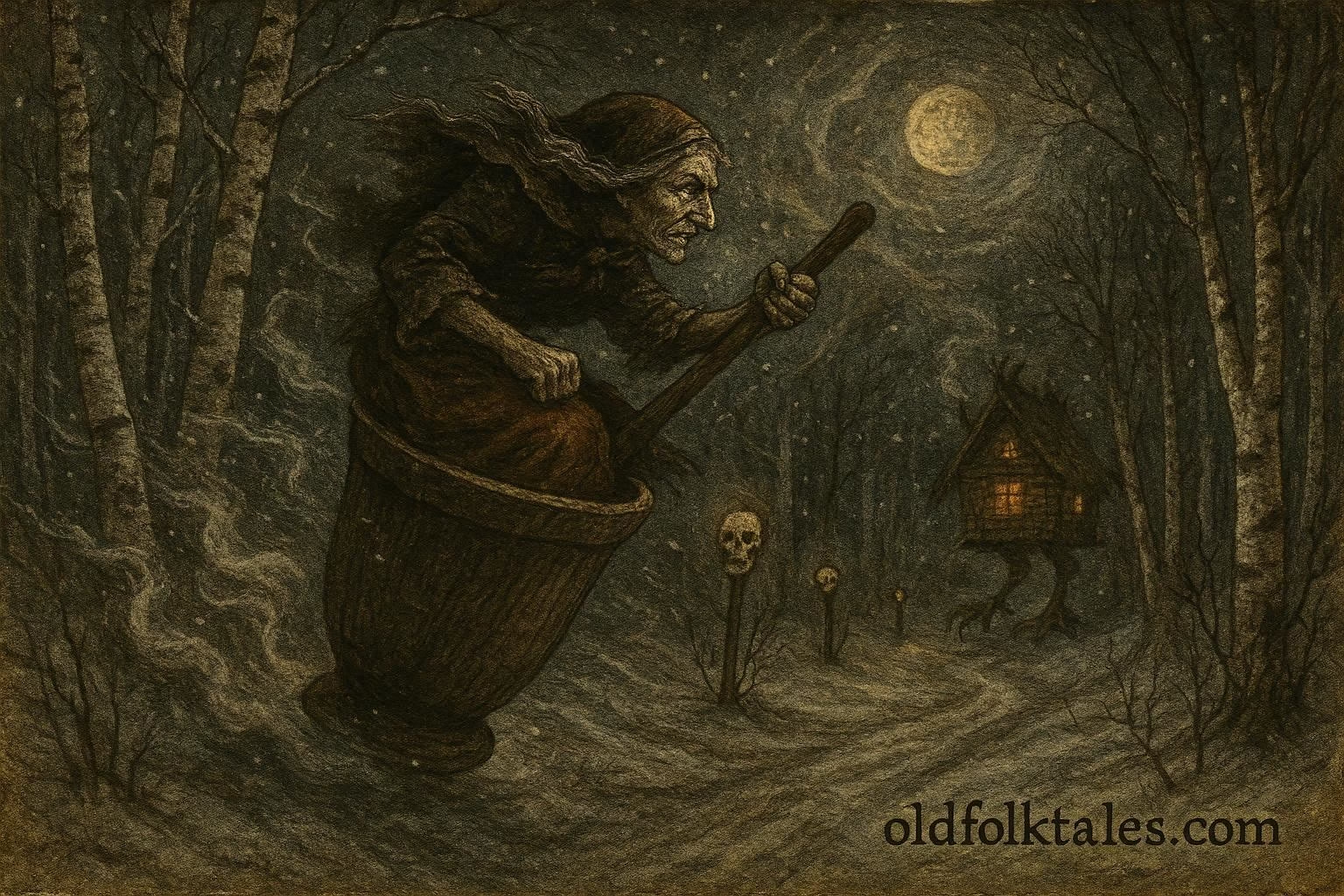
Deep within the birch-dark forests of old Russia stands a hut unlike any other, perched upon chicken legs, spinning slowly, creaking to the rhythm of the wind. Its fence is woven from human bones; its gateposts are crowned with skulls that glow by night. Inside lives Baba Yaga, the old witch of the wilderness: part grandmother, part storm, part judge of human worth.
In Afanasyev’s Russian Folk-Tales (public domain), she is introduced simply: “in a hut that stood on hen’s-legs.” Yet from that modest phrase has grown one of world folklore’s most enduring archetypes. Baba Yaga is no ordinary witch. She flies through the air in a mortar, steering with a pestle and sweeping away her tracks with a broom of silver birch. Her nose is long enough to scrape the ceiling, her teeth of iron, her appetite vast, but her wisdom greater still.
Sometimes she is the hero’s devourer, ready to roast the unwary in her oven; at other times she becomes a reluctant helper, offering enchanted gifts or counsel once the hero proves courtesy and courage. Her speech is as sharp as frost, her laughter the crackle of wood in firelight.
Myths, Powers, and Behavior
In most traditional tellings, Baba Yaga dwells at the threshold of worlds, where the human and supernatural meet. Heroes seeking truth, brides escaping curses, or children lost in the forest must confront her. To enter her hut, one must utter the charm:
“Turn your back to the forest,
your front to me.”
Only then does the chicken-legged hut twist about and settle, creaking, to admit the visitor.
Baba Yaga’s powers are elemental. She commands winds, spirits, and beasts of the forest. In many variants she has three horsemen who serve her, the white (dawn), the red (noon), and the black (night), symbolizing the cycles of time. She can smell human presence “as a Russian spirit smells” and rides the air like a tempest. Her broom sweeps away traces of passage, a metaphor for death’s erasure or the hidden paths between realms.
In Afanasyev’s corpus, Baba Yaga tests the manners and bravery of those who seek her. A polite or courageous child may earn her favor: magical water, a glowing skull-lantern, or advice leading to the Firebird’s realm. A rude or cowardly one may meet her oven. Thus, she is both nurturer and destroyer, a paradox echoing ancient Slavic mother-goddess imagery.
Cultural Role and Symbolism
Scholars such as Marina Warner and Russian folklorists view Baba Yaga as a liminal figure, inheritor of pre-Christian female divinities, part earth mother, part death-keeper. The forest, in Slavic cosmology, represents chaos and the otherworld; her hut is the boundary between life and death, civilization and wilderness. The spinning hut may symbolize the cosmic spindle, rotating the world’s fate.
Baba Yaga’s cannibalistic appetite, especially for children, intertwines fear and fertility: she consumes the unready and releases the reborn. Like the initiation crone of myth, she strips away innocence so that renewal can occur. Many folktales end with the hero leaving her domain transformed, wiser, braver, now fit for the adult world.
At the same time, Baba Yaga embodies the ambivalence toward old women in patriarchal societies. To children, she is terror; to peasants, she may be the solitary herbalist, healer, or widow living beyond the village’s moral fences. Her knowledge of herbs, charms, and animals links her to shamanic and agrarian roots of the Slavic countryside.
Baba Yaga’s hut itself functions as a ritual gateway. Its skull fence echoes ancient funerary motifs; its spinning evokes the circle of seasons. Some ethnographers interpret her domain as an initiation chamber, the oven a symbolic womb of rebirth. Passing her tests means surviving symbolic death and emerging renewed.
The ambiguous morality of Baba Yaga teaches a nuanced lesson: not all darkness is evil. The forest’s peril conceals wisdom; fear, when faced with respect, yields strength. Thus she endures as a teacher in monstrous form, reminding listeners that growth requires confronting the unknown.
Variants and Regional Differences
Afanasyev’s 19th-century collections recorded dozens of Baba Yaga tales, each varying slightly.
- In “Vasilisa the Beautiful,” she guards the flame of life; the heroine’s courtesy earns her aid.
- In others, three Baba Yaga appear as sisters, three phases of one being (maiden, mother, crone).
- Some Ukrainian versions portray her as keeper of a magical herd or the guardian of the water of life.
- Belarusian tellings make her more overtly demonic, allied with forest devils.
Across all, the core traits persist: the chicken-leg hut, the mortar flight, and her shifting role as both devourer and donor.
Modern Reinterpretations
From the 20th century onward, Baba Yaga migrated into literature, ballet, animation, and gaming. Yet serious folklorists caution that modern portrayals, grandmotherly guide or cartoon villain, simplify a complex figure born of oral tradition. In her authentic form, she resists neat moral labeling. She is the wild feminine, neither saint nor fiend.
Contemporary Russian feminist writers reclaim her as a symbol of independent womanhood, self-sufficient and feared only because she owes no obedience. Environmental readings see her as guardian of the forest, punishing human greed. In both views, she endures as the embodiment of nature’s untamed wisdom.
Author’s Note
When reading Afanasyev’s rough, rhythmic translations, one senses how naturally Baba Yaga fits the Russian landscape, an echo of birch forests, hearth smoke, and winter storms. She is not evil but necessary: the question the traveler must answer, the cold that teaches endurance.
Her legend reminds us that culture’s borders are guarded not by heroes but by questions. To approach the unknown, politely, bravely, and without presumption, is the oldest Slavic moral lesson. Baba Yaga may threaten to eat you, but what she truly consumes is arrogance.
Knowledge Check
- What does “Baba Yaga” literally mean?
→ “Baba” = old woman or grandmother; “Yaga” is an archaic, possibly Proto-Slavic term for a supernatural being or illness spirit. - How does Baba Yaga travel?
→ She flies in a mortar, steers with a pestle, and sweeps away her traces with a broom. - What structure does she live in?
→ A hut standing on chicken legs, surrounded by a fence of human bones and skulls. - What moral lesson do Baba Yaga stories teach?
→ Courtesy, courage, and respect for the unknown lead to wisdom; rudeness or fear invites destruction. - Who collected the most famous Baba Yaga tales?
→ Aleksandr Nikolayevich Afanasyev, 19th-century Russian folklorist. - What natural or spiritual concept does she symbolize?
→ The cyclical power of nature and transformation, death, renewal, and the boundary between worlds.
Source: A. N. Afanasyev, Russian Folk-Tales (19th-century field collection; Project Gutenberg / Sacred-Texts)
Origin: Russia, Ukraine, and Belarus, oral tales collected mid-19th century with roots in pre-Christian Slavic cosmology