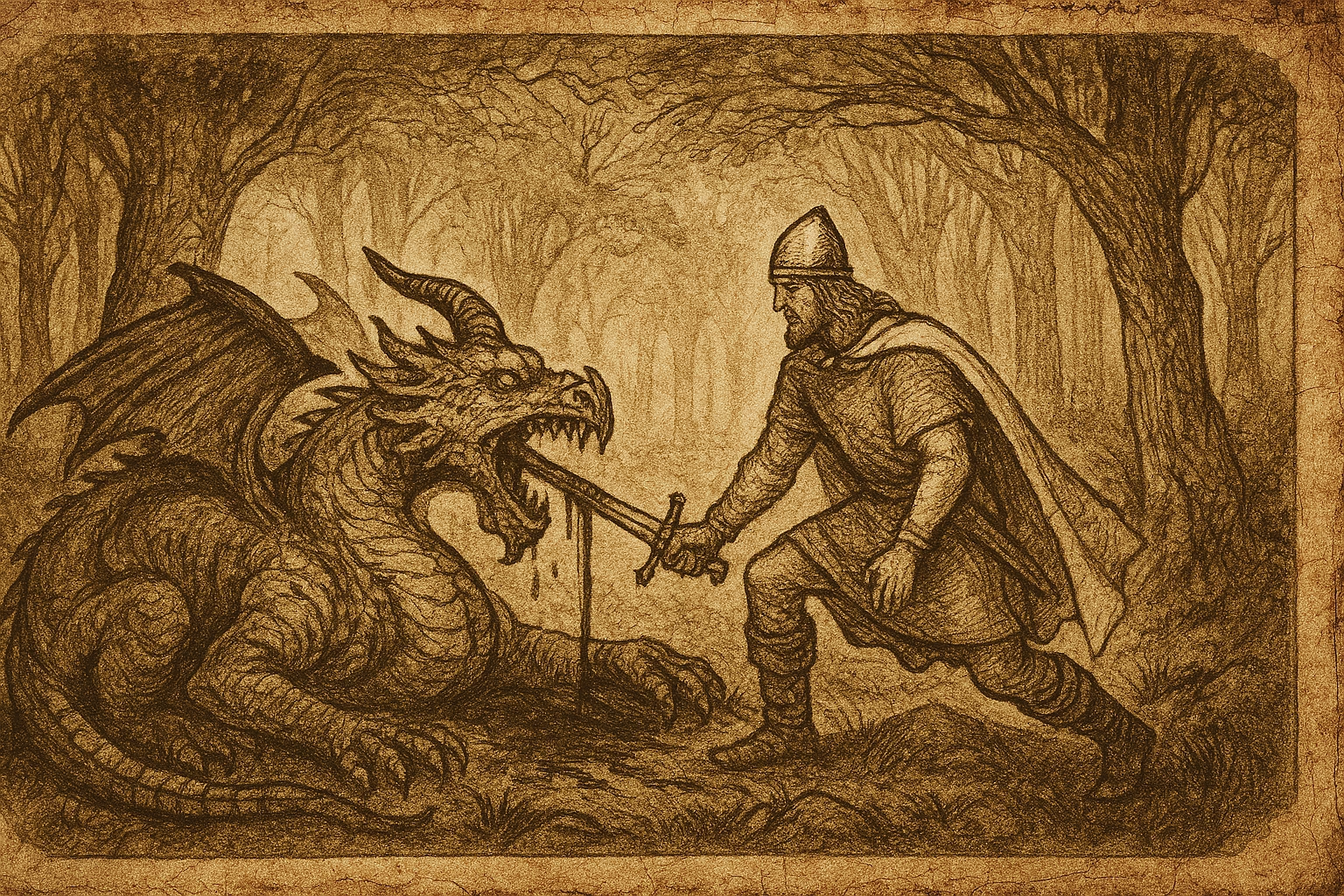
In the deep, ancient forests of medieval Germany, where oak trees stood like cathedral pillars and morning mist clung to the earth like ghostly shrouds, there lived a hero whose name would echo through the ages. Siegfried of the Netherlands was no ordinary nobleman; he was a warrior of such prowess and courage that even hardened knights spoke his name with reverence. Tales of his strength traveled from the Rhine to the Danube, carried on the lips of merchants and minstrels alike.
The young prince’s greatest feat came when he ventured into the shadowed realm where the monstrous dragon Fafnir coiled upon a hoard of cursed gold. The beast’s scales were like iron shields, its breath hot enough to melt armor, its roar sufficient to turn brave men’s hearts to water. But Siegfried did not falter. With cunning and valor, he drove his sword deep into the dragon’s heart, and as Fafnir’s lifeblood poured forth like a dark river, Siegfried bathed in it, knowing the legend that dragon’s blood made flesh impervious to any weapon.
As the hot blood washed over him, transforming his mortal skin into armor no blade could pierce, Siegfried did not notice the small linden leaf that fluttered down from the canopy above and adhered to his back, between his shoulder blades. That tiny spot remained untouched by the dragon’s blood a hidden vulnerability, a fatal flaw that destiny would one day exploit.
With Fafnir’s death came possession of the Nibelung treasure mountains of gold, jewels that captured starlight, and a helm of terrible power that could make its wearer invisible. Siegfried also claimed a legendary sword and the cursed ring of the Nibelungs. He was now among the mightiest heroes in all of Germany, invincible and wealthy beyond measure.
His heart, however, yearned for something more precious than gold. When Siegfried arrived at the magnificent court of Worms on the Rhine, he beheld the Princess Kriemhild, and in that moment, his fate was sealed by love rather than prophecy. She was breathtaking her beauty celebrated in song throughout the Burgundian lands, her grace and nobility evident in every gesture. Kriemhild, too, found herself drawn to this golden hero, and their love blossomed like spring roses along the Rhine’s banks.
But Siegfried’s path to marriage required him to aid Kriemhild’s brother, King Gunther, in his own romantic pursuit. Gunther desired Brunhild, the warrior-queen of Iceland, whose strength was legendary and whose hand could only be won by defeating her in contests of combat and skill. No ordinary man could accomplish such a feat Brunhild could hurl spears farther than any knight and possessed the strength of many men.
Here, the seeds of doom were planted in fertile soil. Siegfried, wearing the Tarnhelm the helm of invisibility secretly aided Gunther in the contests, making it appear that the Burgundian king possessed superhuman strength. Through this deception, Gunther won Brunhild’s hand, but the proud queen’s suspicions festered like an untended wound. She sensed the trickery, felt the humiliation burning in her breast, though she could not yet prove what her heart knew to be true.
The revelation came through a tragic quarrel between queens. Kriemhild, in a moment of pride and anger, revealed the truth of how Gunther had won Brunhild through Siegfried’s hidden aid and trickery. The humiliation was complete. Brunhild, her honor shattered before the court, her marriage revealed as a sham built on deceit, turned to the darkest knight in Gunther’s service: Hagen of Tronje.
Hagen was a man of shadows and cruel cunning, his loyalty to the Burgundian crown absolute, his methods merciless. He saw in Siegfried not a brother-in-arms but a threat too powerful, too beloved, too likely to overshadow his own king. Brunhild’s wounded pride gave Hagen the excuse he needed. Together, they plotted murder.
With serpent’s guile, Hagen approached Kriemhild under the pretense of protecting her beloved husband. He convinced her to mark Siegfried’s vulnerable spot that small place between his shoulders where the linden leaf had fallen so that Hagen might better shield him in battle. Trusting and unsuspecting, Kriemhild sewed a small cross upon her husband’s tunic, marking the very place death could enter.
On a hunt in the forest, far from the protective walls of Worms, Hagen struck. As Siegfried bent to drink from a cool spring, Hagen drove his spear through the marked spot with brutal precision. The invincible hero fell, his blood darkening the grass and flowers, his eyes searching for understanding in his final moments. With his dying breath, Siegfried cursed his murderers, and his blood cried out for vengeance.
Kriemhild’s grief was a terrible thing to behold it transformed her from a gentle princess into an avatar of vengeance. Her heart, once full of love and light, became a fortress of cold fury. She mourned for years, nursing her hatred, planning her revenge with infinite patience. When Etzel, the mighty king of the Huns, sought her hand in marriage, she accepted not for love, but for the army and power he could provide.
Thirteen years passed before Kriemhild’s trap was ready. She invited her brothers and their retinue, including Hagen, to Etzel’s court for a grand festival. They came, despite warnings and dark omens, bound by honor and kinship. When Hagen refused to return the Nibelung treasure he had stolen after Siegfried’s death, Kriemhild unleashed her long-prepared vengeance.
The great hall became a slaughterhouse. Fire and steel claimed hundreds of lives as Burgundians and Huns clashed in savage combat. Brothers died defending their honor; kingdoms fell in a single night of bloodshed. In the end, Kriemhild herself took up Siegfried’s sword and struck down Hagen, finally avenging her beloved husband. But vengeance brought no peace moments later, an old warrior, horrified by her actions, cut down Kriemhild herself.
The great hall fell silent, choked with smoke and corpses. The Nibelung treasure remained lost, the Burgundian kingdom destroyed, and all the heroes dead. Pride, betrayal, and the thirst for revenge had consumed them all.
Click to read all Myths & Legends – timeless stories of creation, fate, and the divine across every culture and continent
The Moral Lesson
The Nibelungenlied teaches us that deception, no matter how small or well-intentioned, plants seed that grow into tragedy. Pride and the inability to forgive transform victims into villains, and vengeance, even when justified, destroys the avenger along with the guilty. The epic reminds us that true strength lies not in invincibility or the power to destroy, but in the courage to choose mercy over revenge and truth over expedient lies.
Knowledge Check
Q1: How did Siegfried become invincible and what was his fatal weakness? A: Siegfried became invincible by bathing in the blood of the dragon Fafnir after slaying it in the forests of medieval Germany. However, a linden leaf fell on his back between his shoulder blades during the blood bath, leaving one small vulnerable spot that remained unprotected and would later prove fatal.
Q2: What was the Nibelung treasure and why was it significant? A: The Nibelung treasure was an enormous hoard of cursed gold, jewels, magical items including the Tarnhelm (helm of invisibility), and a legendary sword that Siegfried claimed after killing the dragon Fafnir. The treasure became a symbol of greed and power that drove much of the tragedy, ultimately being stolen by Hagen and never returned.
Q3: How did Siegfried help King Gunther win Brunhild and why was this important? A: Siegfried used the Tarnhelm to become invisible and secretly aided Gunther in contests of strength against the warrior-queen Brunhild, making it appear that Gunther possessed superhuman abilities. This deception was crucial because it won Brunhild’s hand through trickery, but when the truth was revealed, her humiliation set in motion the events leading to Siegfried’s murder.
Q4: Who was Hagen of Tronje and what role did he play in the tragedy? A: Hagen was a dark and cunning knight in King Gunther’s service, fiercely loyal to the Burgundian crown. He saw Siegfried as a threat and, conspiring with the humiliated Brunhild, tricked Kriemhild into revealing Siegfried’s vulnerable spot, then murdered the hero with a spear during a hunt in the forest.
Q5: Why did Kriemhild marry Etzel, king of the Huns? A: Kriemhild married Etzel not for love but for vengeance. After thirteen years of mourning Siegfried and nursing her hatred, she needed the military power and resources that the Hun king could provide to enact her revenge against her brothers and Hagen for Siegfried’s murder and the theft of the Nibelung treasure.
Q6: What does the ending of the Nibelungenlied teach about revenge? A: The catastrophic ending, where Kriemhild finally kills Hagen but is immediately slain herself, with entire kingdoms destroyed and all heroes dead, demonstrates that revenge consumes the avenger along with the guilty. The cycle of violence and vengeance leads only to mutual destruction, leaving nothing but death and ruin in its wake.
Source: Adapted from Das Nibelungenlied (The Song of the Nibelungs)
Cultural Origin: Medieval Germanic literature and legend, Germany