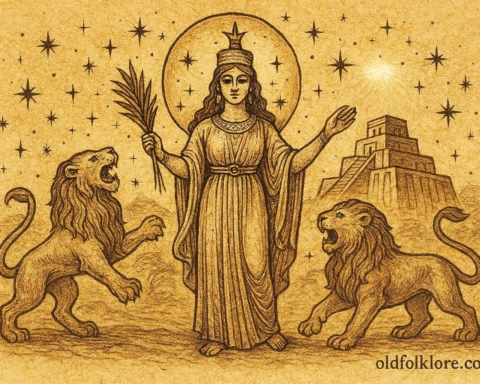
Marduk, the great god of Babylon, stands as the supreme deity of Mesopotamian mythology, the divine architect of the cosmos and champion of order over chaos. In earlier Sumerian traditions, he evolved from a local city-god into the cosmic ruler of heaven and earth, crowned king of the gods after his triumph in the Enūma Eliš, the Babylonian creation epic.
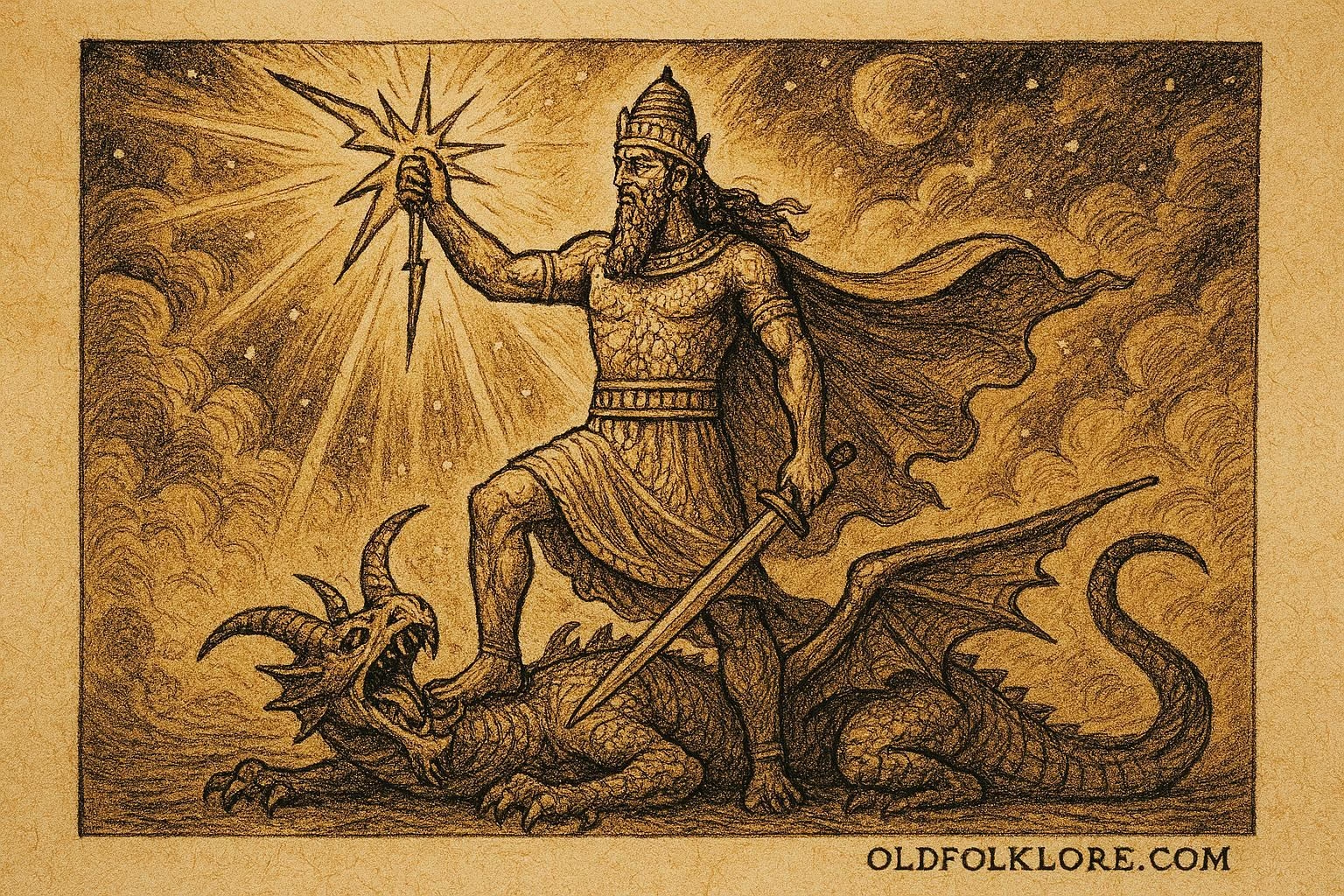
Depicted wielding thunderbolts and armed with a sacred bow, Marduk commands the four winds and rides a storm-chariot drawn by ferocious dragons. His symbols, the spade, the snake-dragon (mushussu), and the staff, embody divine authority and the power of creation.
Marduk’s consort, the goddess Sarpanit, joins him in the celestial realm, while his son Nabu, god of wisdom and writing, continues his legacy of intellect and kingship. In the temples of Babylon, priests honored Marduk through grand New Year (Akitu) festivals, re-enacting his victory over chaos to renew cosmic and royal order each year. His temple, the Esagila (“House of the Raised Head”), and its towering ziggurat, Etemenanki (“Temple of the Foundation of Heaven and Earth”), stood as the physical and spiritual heart of Babylon, the bridge between mortal and divine realms.
The Mythic Story: Marduk and the Defeat of Tiamat
Before heaven and earth were separated, before gods or humans bore names, there was only the primeval sea, the mingled waters of Apsu, the fresh deep, and Tiamat, the salt chaos. From their union came the first generation of gods, bright and unruly, whose laughter and noise disturbed the silent deep.
Apsu, weary of their clamor, plotted to destroy them, but the clever god Ea (also called Enki) uncovered his plan and cast a spell that put Apsu to sleep forever. From Apsu’s still waters, Ea built his dwelling, and there his son Marduk was born, radiant and strong, “the sun of the gods.”
As Marduk grew, his brilliance shone like lightning, his words stirred the winds, and his gaze commanded obedience. Yet far below, Tiamat seethed with rage over Apsu’s death. The mother of creation turned against her own offspring, raising an army of monstrous beings, serpents, dragons, scorpion-men, and storm-demons. To lead them, she appointed Kingu, her chosen consort, and placed in his hand the Tablet of Destinies, which conferred supreme power.
Terror spread among the younger gods. None dared face the dragon-mother’s wrath. The assembly trembled, until Marduk stepped forward. “If I am to be your champion,” he declared, “then proclaim me king among the gods. Let my word be law as your own.”
The gods agreed, crowning him their champion. They placed in his hand a bow and arrows, a club, and a shining net woven from the winds. Anointing him with oil and divine authority, they sent him forth to meet chaos.
Marduk mounted his storm-chariot, drawn by horses whose teeth foamed with lightning and whose eyes flashed fire. He set forth against Tiamat, his weapons blazing, his heart fearless.
When the two forces met, the cosmos trembled. The sea roared; the heavens convulsed. Tiamat opened her jaws to devour the storm-god, but Marduk released the evil wind, forcing her mouth wide open so she could not close it. Into that gaping maw he shot an arrow, and it pierced her heart.
The mighty mother of chaos fell. Her monstrous host scattered, and Marduk seized Kingu’s Tablet of Destinies, reclaiming divine order for the gods. But his work was not done. Taking his knife, Marduk split Tiamat’s vast corpse in two, with one half he formed the dome of heaven, and with the other, the firm ground of the earth.
He fixed the stars in their courses, set the moon to mark the months, and commanded the sun to light the day. From the blood of Kingu, mixed with clay, Marduk fashioned humankind, “to bear the burden of the gods,” so the divine could rest.
Finally, the grateful gods built Babylon as Marduk’s city, its ziggurat rising toward the heavens. There they decreed his fifty names, symbols of his cosmic dominion: creator, healer, judge, and protector. “He who restores order,” they proclaimed, “is lord of all.”
Every year, during the Akitu festival, priests and kings recited the Enūma Eliš, reenacting Marduk’s victory so that the world might be renewed, order once more arising from the abyss.
Author’s Note
Marduk’s triumph over Tiamat is more than a tale of divine battle, it is a profound reflection on civilization’s struggle to impose order upon chaos. To the Babylonians, his myth justified both the cosmos and their kingship, mirroring the rise of Babylon as the heart of the ancient world. In Marduk, we see the eternal pattern of creation through conflict, the storm that destroys only to bring structure and life anew.
Knowledge Check
Q1. What culture does Marduk belong to?
A: Marduk is the chief god of ancient Babylon in Mesopotamian mythology.
Q2. What is the Enūma Eliš?
A: The Babylonian creation epic that recounts Marduk’s battle with Tiamat and the formation of the world.
Q3. Who was Tiamat, and what did she represent?
A: Tiamat was the primordial sea goddess symbolizing chaos and disorder.
Q4. What was the purpose of the Akitu festival?
A: It celebrated Marduk’s victory and renewed cosmic and royal order each New Year.
Q5. What are Marduk’s main symbols?
A: The spade, snake-dragon (mushussu), thunderbolt, and the Tablet of Destinies.
Q6. What lesson does the myth teach?
A: That order and life emerge through the overcoming of chaos, guided by divine wisdom and courage.
Source: Enūma Eliš (Babylonian Creation Epic), Mesopotamia.
Source Origin: Mesopotamia (Ancient Babylon)