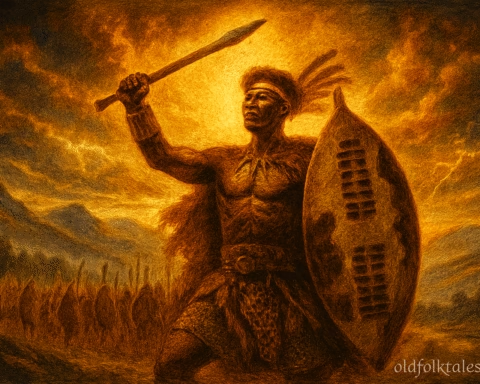
In the heart of the lush Ituri forests of Congo, among the proud Nyanga people, there was once born a child unlike any other, a divine child destined to unite heaven and earth. His name was Mwindo, son of Shemwindo, the proud ruler of Tubondo. His mother, Nyamwindo, was the youngest and most beloved of Shemwindo’s wives, but her pregnancy stirred both wonder and fear. For the wise men had whispered that her child would not be ordinary, that he would speak from the womb and come into the world bearing a flywhisk of power, a symbol of divine authority.
Shemwindo, fearing the prophecy, declared a cruel decree: “No son of mine shall challenge my rule! Every male born to my wives shall be slain at birth!” But destiny, carved by the gods, cannot be undone by mortal will. When Nyamwindo gave birth, Mwindo emerged laughing, speaking, and holding the flywhisk, his voice echoing with the cadence of the divine. “I am Mwindo,” he declared, “child of Nyamwindo, son of Shemwindo, born to bring justice and light!”
Terrified, Shemwindo tried to destroy him. First, he sealed the child in a copper drum and cast it into the river. But the drum floated, borne by the spirits of water, and Mwindo survived. Then, his father ordered lightning to strike the drum, yet the bolts danced harmlessly around it, for Mwindo’s spirit was protected by Mikoni, the Sky Father, and Nkuba, the God of Lightning. Finally, when all means failed, Shemwindo fled to the underworld, hoping to escape the destiny his own son carried.
Mwindo grew swiftly, his laughter echoing like thunder, his eyes alight with wisdom far beyond mortal measure. With each passing day, he learned the secrets of the gods, tutored by his mother and the ancestral spirits who saw in him the hope of balance between men and the divine.
When the time came, Mwindo set forth to find his father. He gathered his companions, the talking dog Kibuka, the brave warrior Kasiyembe, and a band of loyal spirits. He carried his flywhisk and a magical rope, conduits of justice and command, through which he could summon storms and bend elements to his will.
Their journey led them across burning plains and deep forests until they reached the gates of Tubondo. Shemwindo, desperate, called upon seven armies and seven sorcerers, but Mwindo’s voice, clear as a silver bell, commanded the winds. He defeated them not with cruelty but with divine restraint, showing that power must serve justice, not vengeance. When the last of the armies fell, he stood before the gates of his father’s palace.
“Father,” he said, “you sought to end my life before it began. Yet here I stand, not to destroy you, but to show you the path of truth.”
But Shemwindo’s heart was still darkened by pride. He opened a portal to the underworld, plunging himself into the realm of Muisa, the god of death and the dead. Mwindo, unafraid, descended after him.
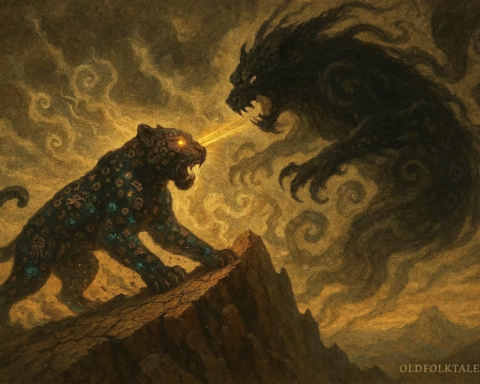
In the underworld, shadows coiled like serpents, and the air was thick with whispers of lost souls. Mwindo’s light illuminated the caverns of the dead, and the spirits bowed before him. Muisa, grim and ancient, challenged him: “No mortal leaves my realm alive. Why do you disturb the balance?”
Mwindo answered, “I come not to steal life, but to restore it. My father fled justice, and justice must be complete.”
Muisa set before him three trials: to plant a banana grove that would bear fruit in a single night, to fetch water from a lake of fire, and to overcome death itself. Mwindo, with courage and wisdom, completed each task, aided by divine spirits and the blessings of Nkuba. At dawn, he stood before Muisa triumphant, holding both fire and fruit in his hands.
“Then you are truly chosen,” said Muisa. “Take your father and go, for you have mastered life and death.”
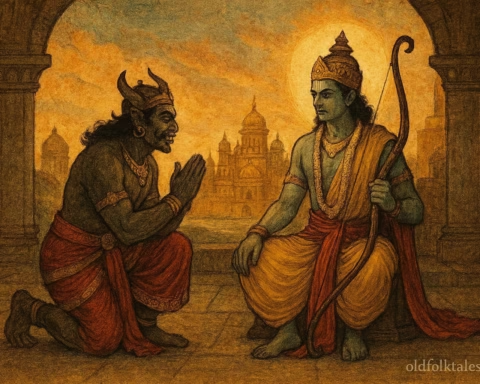
Mwindo found Shemwindo bound in shadows. He freed him, saying, “You are forgiven, but you must learn peace.” Together, they returned to the world of the living. Yet Mwindo knew his father’s time had passed. He took up the flywhisk once more, not as a weapon, but as a symbol of rule, and declared, “No man shall rule through fear. Let Tubondo be a land of harmony.”
He ruled wisely, bringing prosperity and law to his people. Under his reign, the Nyanga say, the rains fell in season, the soil bore fruit, and the rivers sang. And when Mwindo’s time upon the earth drew to a close, he ascended into the heavens on a pillar of light, his flywhisk shimmering like the tail of a comet. The people of Tubondo still tell his story in song and drum, praising the child who conquered darkness with justice and compassion.
Author’s Note
The Mwindo Epic of the Nyanga people is one of Africa’s great mythic narratives, a tale that bridges human and divine realms with timeless moral depth. Mwindo’s story is not just one of miraculous birth or heroic triumph; it is a parable of balance, between vengeance and mercy, power and wisdom, mortality and divinity. His journey mirrors the path of all leaders who must confront pride, overcome inherited wrongs, and rise toward reconciliation.
In modern Congo and across Africa, Mwindo endures as a symbol of moral courage and just leadership, a hero who transforms personal pain into communal peace, embodying the eternal truth that justice without forgiveness is hollow, and forgiveness without justice is blind.
Knowledge Check
-
What divine signs accompanied Mwindo’s birth, and what did they symbolize?
-
Why did Shemwindo seek to kill Mwindo, and how does this reflect on human fear of prophecy?
-
What items did Mwindo use as symbols of his divine power, and what did each represent?
-
Describe the three trials Mwindo faced in the underworld and their symbolic meanings.
-
How did Mwindo’s approach to justice differ from his father’s, and what moral does this teach?
-
In what ways does Mwindo’s legacy continue to influence the cultural identity of the Nyanga people today?
Cultural Origin: Nyanga People, Democratic Republic of Congo
Source: Daniel Biebuyck & Kahombo Mateene, The Mwindo Epic from the Banyanga (University of California Press, 1969)