Far beneath the sunlit islands of the Cook Islands, beyond the coral reefs and crashing waves, beyond the volcanic mountains and lush valleys, lies Avaiki, the realm of shadows where no living foot may tread. This is the underworld, the final destination of all who depart the world of light and breath. And in the deepest chamber of this dark kingdom reigns Miru, a goddess both powerful and terrible, whose name is whispered with reverence and fear by those who still walk beneath the sun.
Avaiki is not a place of fire or torment as some lands imagine their afterworlds. It is a realm of perpetual twilight, where dim light filters through from some unknown source, casting everything in shades of gray and shadow. The air hangs heavy and still, thick with the weight of eternity. Stone caverns stretch endlessly in all directions; their walls slick with moisture that never dries. Through this vast underground domain winds, a lake of dark waters, waters that hold secrets older than memory, waters that reflect no stars because no stars shine in Avaiki’s sunless sky.
Click to read all Myths & Legends – timeless stories of creation, fate, and the divine across every culture and continent
Here, Miru makes her dwelling, attended by her children and a host of servants who carry out her will without question. She is ancient beyond measure, a goddess who has presided over the fate of souls since the first ancestors closed their eyes for the final time. Her form is imposing tall and commanding, with eyes that pierce through the essence of every spirit that enters her domain. Some say her hair flows like smoke, others that it coils like the roots of trees that dig deep into earth. But all agree that her presence fills the caverns of Avaiki with an authority that cannot be challenged.
The journey to Avaiki begins when the breath leaves a body and the soul separates from flesh and bone. The spirit rises, confused and disoriented, then feels an inexorable pull downward. Down through soil and stone, down through the roots of the world, the soul travels. The path is long and exhausting, draining the spiritual essence with each descending step. By the time the dead arrive at the gates of Avaiki, they are weary beyond measure, their forms translucent and trembling.
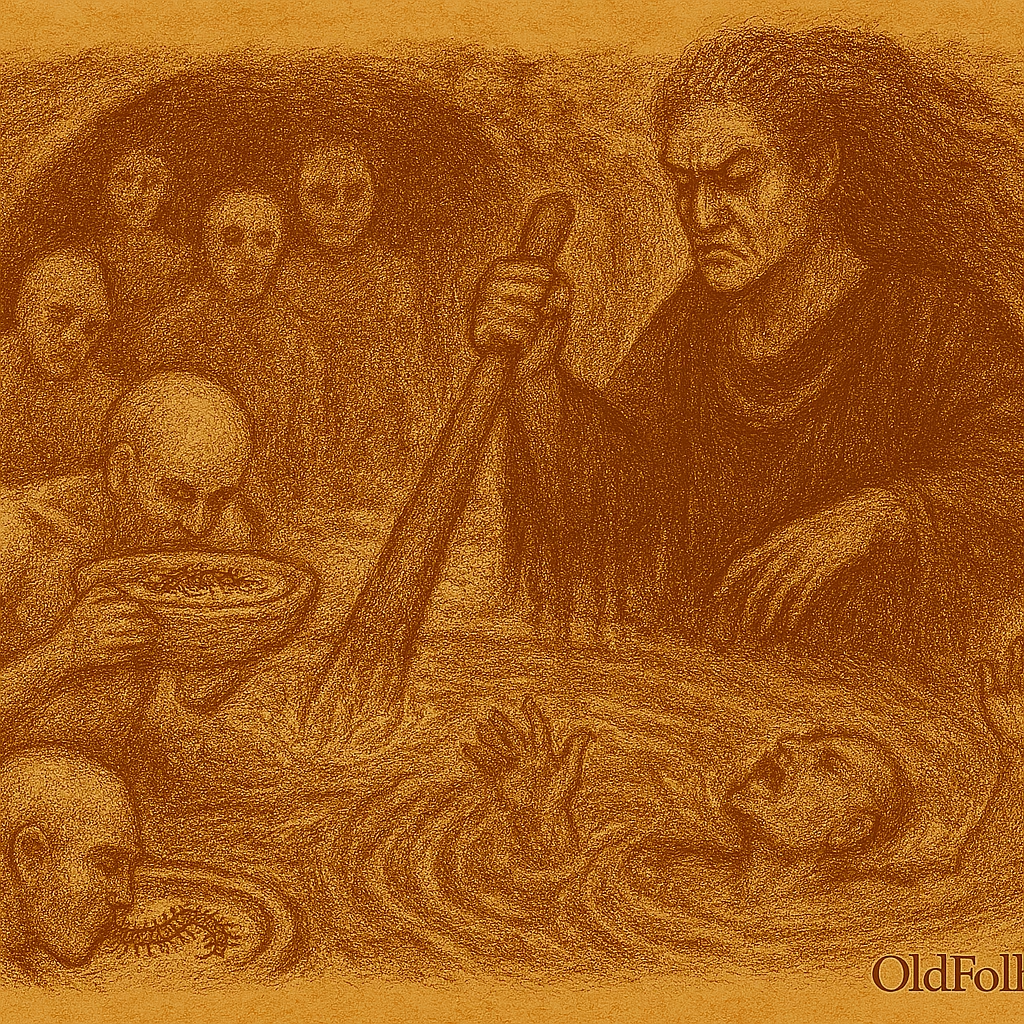
Miru does not greet her visitors with coldness or cruelty. No, she welcomes them as a host welcomes guests who have traveled far. Her servants guide the newly arrived spirits into her presence, where great bowls await. These vessels are filled with kava, the sacred drink known in the world above for its power to calm the mind and blur the senses. The exhausted souls, grateful for any comfort after their arduous journey, accept the offering eagerly.
But Miru’s kava is not the kava of the living world. It is brewed with ingredients found only in Avaiki, mixed with strange elements that exist nowhere else. And into each bowl, Miru places centipedes, creatures of many legs that writhe and coil in the dark liquid. The spirits, desperate and disoriented, drink deeply without hesitation. They do not question what they consume. They seek only relief from the weariness that weighs upon their ghostly forms.
The effects come swiftly. The kava, potent and otherworldly, clouds their senses completely. The spirits become dizzy, their forms wavering like reflections in troubled water. They stumble and sway, unable to maintain their balance, unable to think clearly or remember why they should be cautious. The centipedes work their own strange magic within them, weakening whatever strength remains.
Miru watches with patient eyes as the spirits, one by one, lose control. Her servants guide them or perhaps herd them toward the great lake that dominates her realm. The dark waters wait, still and deep, their surface like polished obsidian. The intoxicated souls stumble to the water’s edge, and there, lacking the coordination to stop themselves, they fall.
Into the lake they tumble, one after another, their translucent forms breaking the dark surface. And then Miru rises. She moves to the water’s edge with deliberate purpose, and with a long staff or perhaps with her own powerful hands, she begins to stir the waters. Round and round she moves, creating currents and whirlpools in the depths of the underworld lake.
The spirits, already weakened and confused, cannot resist the churning waters. They struggle briefly, their forms flickering beneath the surface like dying flames. But Avaiki’s lake is not like the waters of the living world it does not buoy the body or allow for swimming. The dead drown in its depths, their spiritual essence dissolving, breaking apart into pure energy.
And Miru, keeper of the underworld, consumes them. She draws their essence into herself, feeding upon the energy that once animated living bodies in the world above. This is how she sustains her vast power. This is how she maintains her dominion over Avaiki and ensures that the cosmic order remains intact. Death feeds death. Energy returns to the source. The cycle continues, unbroken and eternal.
Her children assist her in this endless work, each one learning the sacred duties of the underworld. Her servants ensure that no spirit escapes, that none slip back through the cracks in the earth to haunt the living world. They keep Avaiki in perfect order, a well-run realm where every soul is accounted for, where every arrival is processed according to ancient law.
The people of Rarotonga and the Cook Islands understand this truth: Miru is not evil, though she is fearsome. She is necessary. Without her, the souls of the dead would wander forever, lost between worlds. Without her consumption of their essence, the cosmic balance would fail. She is the end of the journey that begins with birth, the final gate through which all must pass, the power that ensures death is truly final and complete.
The Moral Lesson
The legend of Miru teaches us profound truths about the inevitable cycle of existence. Life and death are not opposing forces but interwoven parts of a greater cosmic order, where even in the afterworld, powerful beings maintain the balance of creation. Miru reminds us that death is not an ending to fear but a transformation to accept a necessary passage that sustains the universe itself. Her story warns that we must respect the natural order, understanding that what seems frightening may serve a purpose beyond our comprehension. Just as energy cannot be destroyed but only transformed, the souls she consumes continue the eternal cycle, their essence recycled into the vast machinery of existence.
Knowledge Check
Q1: Who is Miru in Cook Islands mythology and what is her primary role?
A1: Miru is a powerful and ancient goddess who rules over Avaiki, the underworld realm of the Cook Islands. Her primary role is to oversee the fate of souls after death, consuming their spiritual essence to sustain her power and maintain the cosmic balance between life and death in Polynesian cosmology.
Q2: What is Avaiki and how is it described in this Cook Islands legend?
A2: Avaiki is the underworld or realm of the dead in Cook Islands mythology, located deep beneath the physical world. It is described as a place of perpetual twilight with stone caverns, heavy air, and a vast dark lake. Unlike fire-and-torment afterworlds, Avaiki is a shadowy, gray domain where no stars shine and moisture never dries from the cavern walls.
Q3: How does Miru welcome the souls of the dead when they arrive in Avaiki?
A3: Miru welcomes newly arrived souls as a host welcoming weary travelers. She offers them bowls of kava mixed with centipedes. The exhausted spirits, grateful for comfort after their long journey from the world of light, drink the offering without question, not realizing it will lead to their ultimate fate.
Q4: What happens to the spirits after they drink Miru’s kava and why?
A4: After drinking Miru’s specially prepared kava with centipedes, the spirits become dizzy and disoriented, losing their coordination and mental clarity. In this weakened, intoxicated state, they stumble into the great lake of Avaiki, where Miru stirs the waters, causing them to drown as their spiritual essence dissolves.
Q5: What is the symbolic meaning of Miru consuming the souls of the dead?
A5: Miru’s consumption of souls represents the cosmic cycle of energy transformation and the necessity of death in maintaining universal balance. Her feeding sustains her power to rule the underworld and ensures the natural order continues. It symbolizes that death is not merely an ending but a transformation where spiritual energy is recycled back into the cosmos.
Q6: How do Miru’s children and servants contribute to the underworld’s function?
A6: Miru’s children and servants maintain order in Avaiki by assisting with the processing of souls, ensuring no spirits escape back to the world of the living, and learning the sacred duties of the underworld. They keep the realm functioning smoothly, guaranteeing that every soul is accounted for and the ancient laws of death are properly observed.
Cultural Origin: Cook Islands, specifically Rarotonga, Polynesia (South Pacific)