In the time when the earth was still young and the Niger River carved its sacred veins across the plains of Mali, the Bamana people lived in scattered clans, each proud, each fierce, and each burdened by the memory of ancient feuds. In those turbulent days, Kambili was foretold as the light destined to rise among them, a soul who would heal what centuries of bloodshed had broken, and whose birth the spirits themselves had whispered into the winds.
Kambili came into the world beneath the twin stars of Faro, the river spirit, and Nyama, the force of life. His mother, Fasa, was a weaver who spoke often with the wind; his father, Sori, was a hunter who vanished into the bush weeks before his son’s birth. On the night Kambili was born, the village women whispered that they saw the river shimmer white, and the old griot declared, “A mouth of Faro has come among us.”
From infancy, Kambili was unlike other children. He spoke before his teeth had grown, and when he cried, animals came close, as if soothed by his sorrow. By seven, he could trace the paths of stars and tell when the rains would come. The elders watched with reverence and fear. They brought him before the priest of Nyama, who saw in his eyes the reflection of eternity. “He carries two spirits,” the priest said. “One to speak the truth of heaven, and one to bear the weight of men.”
But prophecy is a burden that draws envy as surely as light draws moths. When Kambili began to dream of fire swallowing the plains, many warriors mocked him. The chieftains, drunk with pride, refused his warnings. “What can a child of the weaver know of destiny?” they said. Yet when the dry season came and the fields withered, when the clans turned on each other for water and cattle, Kambili’s words returned like thunder rolling across empty skies.
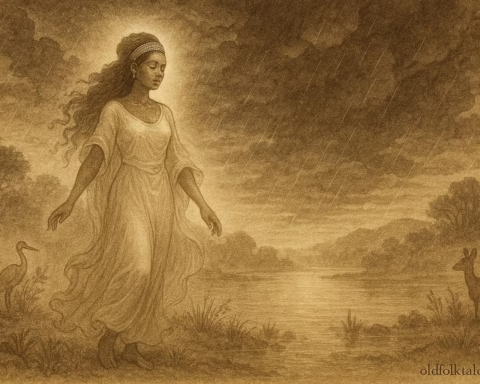
One night, as flames devoured the borderlands, Kambili fell into a trance. His spirit was lifted by Faro, the river goddess, whose body shimmered like silver fish scales beneath the moon. “Kambili,” she said, her voice like flowing water, “the world is breaking because men have forgotten the rhythm of life. You must restore it, not with the spear, but with the Word.”
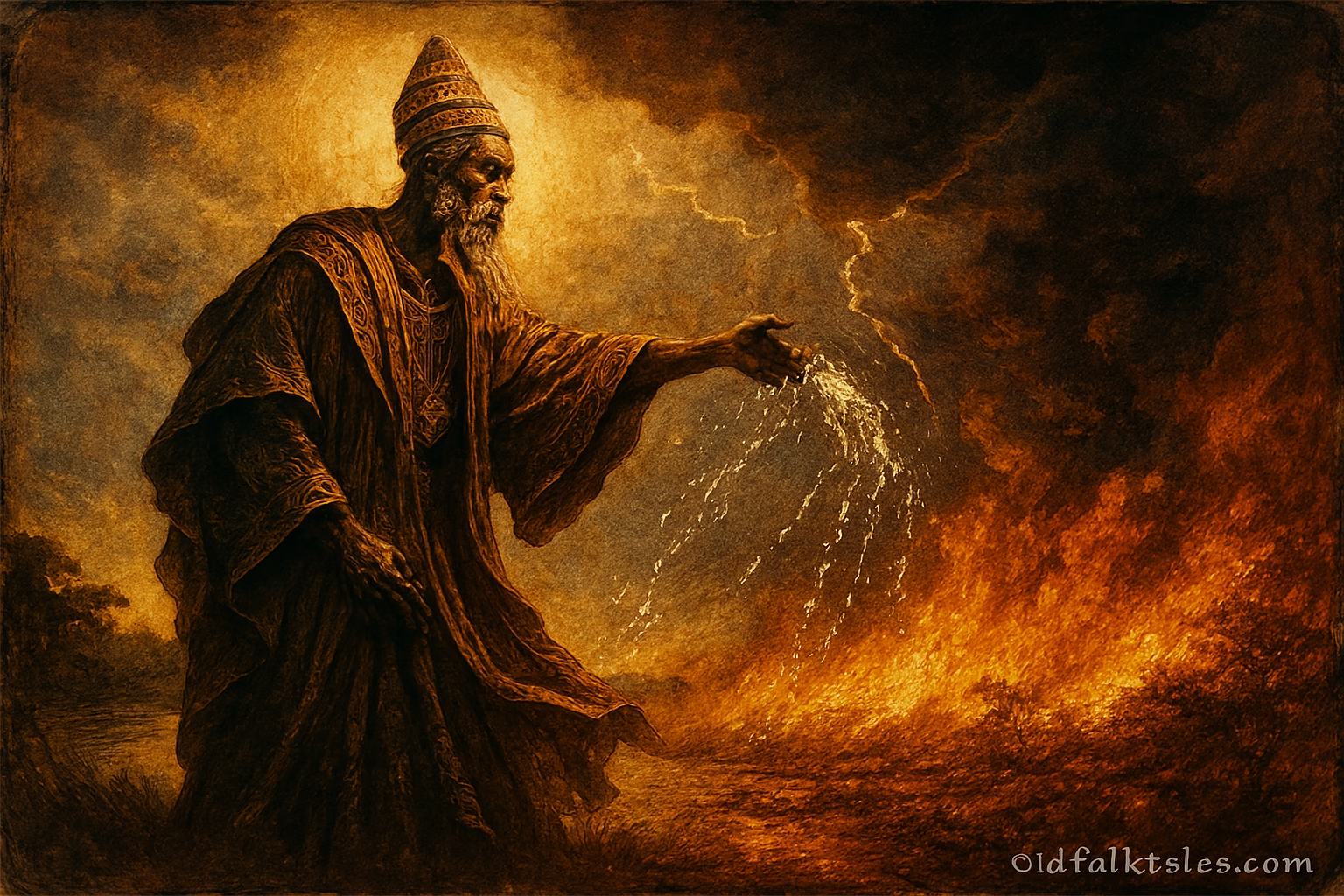
She placed in his hand a small calabash filled with river water. “Where this water touches, peace may flow again. But beware, the water will turn bitter if used for pride.”
When Kambili awoke, the calabash rested beside him, cool and glowing faintly. From that day, he journeyed across the warring lands, speaking in the marketplaces and the courtyards of chiefs. His words were not of conquest but of balance, the same balance that holds the sun in the sky and the seed in the soil.
To the warriors, he said, “Strength without wisdom is the thunder that breaks no rain.”
To the rulers, he said, “A king who feeds on his people drinks poison from a golden cup.”
And to the people, he said, “When one hand washes the other, the heart of the land becomes clean.”
Still, many refused him. Some clans accused him of weakening their spirit of battle. A chieftain named Dalo, proud leader of the Ségou plains, denounced him before his men. “You speak of peace, prophet,” Dalo shouted, “but peace is for the weak! The river obeys the one who dammed it.”
That night, Dalo’s warriors attacked a neighboring clan. Kambili came too late, the fields burned, and the river ran dark with ash. In anguish, he poured his sacred water upon the soil, but it hissed and turned black. He fell to his knees. “Faro,” he cried, “I have failed your trust!”
Then a wind rose from the east, and from the river came the voice of the goddess: “You have not failed, my child. Even the earth must burn before the new seed grows.”
Kambili took the ashes in his hands and scattered them to the four winds. “Let these be the last ashes of hatred,” he said. “From them shall rise the covenant of the clans.”
The next dawn, as the sun climbed the red hills, the rivers overflowed, softly, cleanly, as if the gods themselves wept. The warring clans awoke to find their weapons rusted, their thirst quenched, and their hearts strangely still. They came to Kambili, who stood by the riverbank, his calabash empty, his eyes weary but bright.
“Teach us your law,” they begged.
So he gathered them beneath the baobab and spoke of the Nya, the harmony between human will and divine order. He taught them to listen to the wind before they spoke, to honor the river before they drank, to remember that the strength of one clan is the peace of all. These teachings became the foundation of the Bamana moral code, maaya, the essence of humanity.
Years passed, and Kambili withdrew from the world. Some said he turned into light and entered the river. Others believed he became a heron that still circles the Niger at dusk, calling softly to the children of men. But all agreed on one truth: after Kambili, the land was never the same.
Author’s Note
The tale of Kambili the Prophet survives in fragments within the Bamana oral archives, recorded in Bamako University field collections (1950s–60s). Though details vary by region, all versions honor him as a divine seer sent by Faro to heal divisions through spiritual wisdom rather than war. His teachings echo the Bamana ideals of maaya (humanity) and nyama (vital force), emphasizing balance, communal harmony, and humility before the sacred order. Kambili remains a symbol of moral vision, one who turned conflict into covenant.
Knowledge Check
-
What celestial or divine signs marked Kambili’s birth?
-
What gift did the river goddess Faro bestow upon Kambili, and what was its symbolic meaning?
-
How did Kambili’s teachings differ from the warriors’ understanding of strength?
-
What happened when Kambili tried to use the sacred water after the clans ignored his warning?
-
What moral code emerged from Kambili’s teachings, and how did it shape Bamana society?
-
What does Kambili’s transformation or disappearance at the end symbolize within the context of Bamana spirituality?
Source: African Studies Center Oral Archives, Bamako University (Field Collection, 1950s–60s).
Cultural Origin: Bamana (Mali) Oral Tradition.