Before Roland was ever entrusted with the banner of France, legends whispered that his courage was not born solely of mortal flesh. On the night of his birth, a wandering hermit, said by some to be the Archangel Michael in humble guise, arrived at the house of his mother, Bertha. He laid a silver horn beside the newborn, declaring that the child would be “the shield of the West, the voice that calls angels to witness.” This horn would one day be Oliphant, and with it came a destiny threaded between heaven and earth. Thus Roland grew as one touched by divine purpose, unyielding, fiery, and impossibly loyal.
Under the reign of Charlemagne, Roland became one of the Twelve Peers, the mightiest paladins who bore the emperor’s trust. Yet even among them he burned brightest, his zeal unmatched, his sword Durendal gleaming like dawn’s first fire. Some said the blade carried a tooth of Saint Peter, others that an angel had set the gems in its hilt. Whatever the truth, Roland believed it was a weapon not merely of war, but of witness, to fight with it was to testify to righteousness.
So it was that Roland found himself riding into Spain during the long campaigns against the Saracens. After years of conquest, the emperor negotiated a peace with the pagan king Marsile. But the peace was a lie; treachery waited in the Pyrenees. Roland’s own stepfather, the embittered Ganelon, accepted the role of envoy, only to swear in secret alliance with Marsile. He named Roland, his rival in honor, as the commander of the rearguard, knowing the trap he set.
When the great Frankish host marched toward France, Roland took his place at the back with twenty thousand warriors. The mountain air was crisp, the sunlight gold upon the crags, but a strange stillness lay over the narrow pass of Roncevaux. Roland felt it. So did his friend, the wise Oliver.
“Brother,” Oliver warned, “I fear treachery. Let us sound the horn now, that the emperor may return.”
But Roland shook his head. “Never will I call for aid against a rabble. Our honor must not be stained with fear.”
Thus the die was cast.
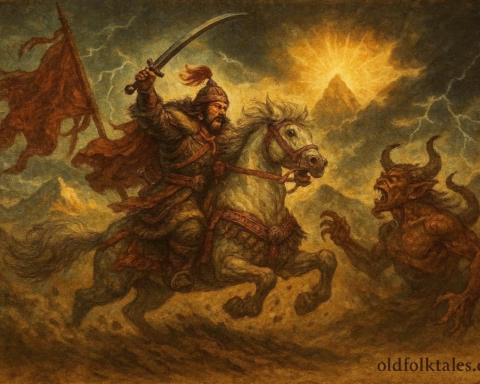
From the cliffs poured the armies of Spain, hundreds of thousands, darkening the mountains like thunderclouds. Drums roared, horns blared, and the enemy tide crashed down upon the Franks. Roland felt the tremor of destiny in his bones, and with a shout lifted Durendal. The sword seemed to blaze. Then began a battle sung by centuries.
Roland cut paths through warriors as a flame through dry grass, each stroke bright and terrible. Beside him Oliver fought with grim wisdom, anchoring their scattered men. The bishop Turpin, saintly and fierce, blessed the dying even as he drove his spear through foes. The Franks stood as a fortress of faith, but wave after wave crashed against them.
At last the once-green valley lay soaked in blood. The mountains echoed not with birdsong but with the roar of war, and many of Roland’s companions had fallen. Oliver, wounded unto death, staggered toward Roland, grief carving deep lines into his face.
“Sound the horn,” he whispered. “Not for ourselves, but for France. For Charlemagne. For justice.”
This time Roland wavered.
His heart was a battlefield far greater than Roncevaux. Pride warred with duty, zeal with reason, earthly honor with heavenly mandate. Had he not been chosen as a living shield? Had he not vowed never to call for help? But could he let his men die unavenged, unremembered?
He lifted Oliphant.
The horn was heavy, carved from a giant’s ivory, bound in gold and crystal. When Roland blew it, the mountains shook. The blast tore open the sky. Charlemagne, miles away, heard the cry and knew instantly that Roland was in peril. But the call came too late. The emperor would need time to return. Time Roland no longer had.
Blood burst from Roland’s temples as he blew again, and again. The divine spark of his youth blazed fiercely, burning his mortal frame. But he had made his choice. Pride had been conquered by sacrifice. Valor had been refined into martyrdom.
When the last notes faded, Roland staggered to a hill beneath a pine tree. He laid Durendal on the ground, trying to break it against a boulder so that no unworthy hand might wield it. The sword resisted; heaven itself seemed to preserve it. Finally Roland lay upon his shield, turning his face toward Spain’s frontier, offering his soul to God. Angels descended, unseen by human eyes, to bear him upward.
Moments before the end, he murmured, “May France be defended. May honor stand.”
And thus Roland, paladin of France, passed from mortal struggle into eternal legend.
When Charlemagne returned and found him, he wept as emperors rarely do. The pass of Roncevaux became sacred. The horn, cracked by his final breath, became a relic. And through centuries Roland stood as the symbol of unwavering loyalty, flawed, proud, but noble unto death.
Author’s Note
Roland’s legend endures as one of medieval Europe’s greatest epics, a meditation on honor pushed to its limit, on loyalty tested in fire, and on sacrifice as a sacred act. His story reflects feudal ideals of devotion to king and faith, shaped by the Christian worldview of 11th-century France.
Knowledge Check
-
What divine sign marked Roland’s birth?
-
Why did Ganelon betray Roland?
-
What was Roland’s initial reason for refusing to blow Oliphant?
-
How did Roland’s moral struggle evolve during the battle?
-
Why could Roland not break Durendal?
-
What symbolic meaning does Roland’s final act hold for French epic tradition?
Source: La Chanson de Roland, trans. Dorothy L. Sayers (Penguin Classics, 1957).
Cultural Origin: Medieval France, Carolingian epic tradition.