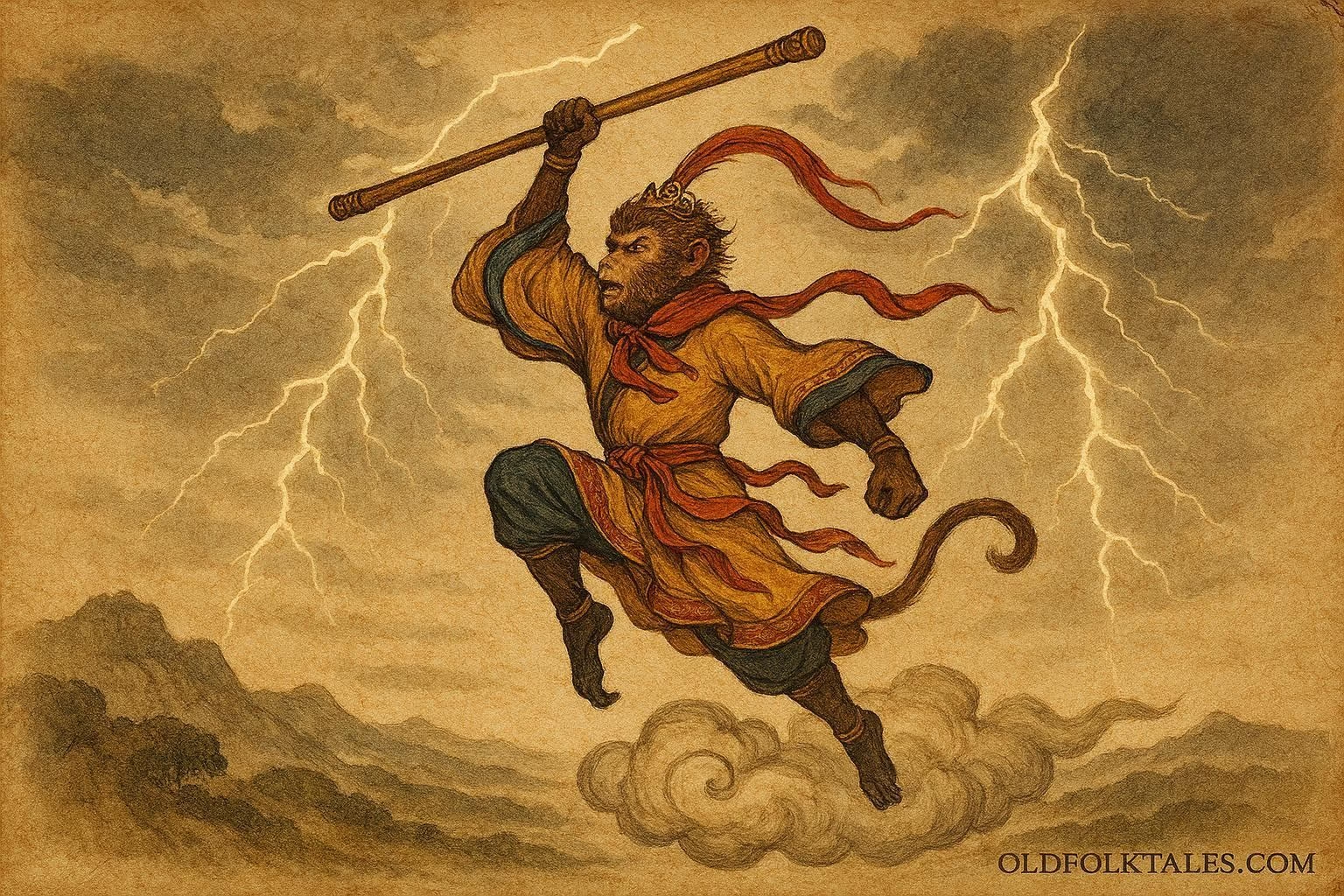
Before the first songs of men were written on bamboo, before emperors carved their names into stone, the Mountain of Flowers and Fruit crowned its peak with a single egg of shimmering jade. From it burst a being neither of heaven nor earth, a stone monkey, eyes bright as twin suns, body humming with the breath of creation itself. This was Sun Wukong, born not from womb or lineage, but from the cosmic pulse of chaos, the same divine force that once separated sky from earth.
From his first breath, he leapt into destiny.
Wukong grew swiftly among the troop of mortal monkeys, but he was hardly content with games and fruit. His spirit burned too fiercely. When he discovered a waterfall that concealed a cavern fit for a king, he dove through its roaring veil, emerging into a palace untouched since the world’s youth. The other monkeys hailed him their ruler, yet even crowned in joy, Wukong felt a hunger no feast could quell.
He sought immortality.
Thus began his wanderings across distant shores and forgotten realms. He crossed seas upon drifting logs, wandered through villages veiled in mist, and climbed mountains older than recorded time. At last he found a sage who recognized in him something dangerous and brilliant, a creature shaped by heaven but untamed by its laws. Under this master’s stern gaze, Wukong learned spells that bent the winds, cloud-somersaults that leapt across the world in a breath, and transformations beyond mortal imagination.
But knowledge fed ambition, and ambition awoke arrogance.
Armed with his new powers, Wukong descended to the underwater Dragon Palace and demanded a weapon worthy of him. From its vaults he drew the Ruyi Jingu Bang, the iron staff forged for stabilizing the seas in the age of creation. It shrank to a needle behind his ear or expanded to pierce the skies, an impossible treasure he claimed by force.
In the heavens, the Dragon Kings trembled.
In the underworld, the judges hid their scrolls.
In the celestial court, the immortals whispered:
A stone-born king was rising.
To tame him, the Jade Emperor offered Wukong a humble heavenly post. But when Wukong learned he had been entrusted only with tending celestial horses, he flew into a storm of fury. He proclaimed himself Great Sage Equal to Heaven, shattered the palace gates, and sent constellations scattering like frightened birds.
The heavens marched against him.
Armies of gods descended.
Yet none could subdue the stone-born immortal.
At last the Buddha himself intervened, challenging Wukong to leap beyond the borders of existence. With a laugh and a cloud-somersault, Wukong crossed impossible distances, yet he landed not in the ends of creation, but in the Buddha’s palm. In that instant, he realized his pride had mocked the heavens themselves.
He was cast beneath Five-Element Mountain, crushed by stone, sealed by scripture. For five hundred silent years, he tasted the dust of regret.
Then came Xuanzang, the monk chosen by the gods to bring divine scriptures from the West. When he lifted the seal on Wukong’s prison, he offered not freedom but responsibility. A golden circlet was placed on Wukong’s brow, tightening in pain whenever he let pride or rage rule him.
Wukong accepted this bondage, not because he was defeated, but because he sensed a path he had never taken: the path inward.
The journey westward was fraught with demons who sought the monk’s pure spirit, monsters born of ancient grudges, and spirits who could smell divinity in Wukong’s veins. Over and over, Wukong faced challenges that pitted his raw power against the discipline he struggled to learn. Many times he wanted to unleash destruction without restraint. Many times he raged at the monk’s chastising words.
But the golden circlet was not his true restraint, it was a mirror to his heart.
Slowly, the stone-born warrior learned compassion. He defended villagers who once feared him. He protected Xuanzang even when unthanked. He curbed greed, silenced wrath, and tempered his might with wisdom. His greatest battles were not against demon kings, but against the chaos within him, the same chaos that birthed him.
When the pilgrimage was complete and the scriptures restored to the East, the heavens opened once more. But this time, Wukong was not summoned as a rebel, a prisoner, or a boastful challenger.
He was invited as a Buddha.
Stone no longer bound him. Pride no longer clouded him. He had crossed the true mountains, those within the soul, and emerged radiant.
Thus the Monkey King, once the terror of heaven, rose as Victorious Fighting Buddha, symbol of transformation, perseverance, and the wild divine spirit that tames itself not with chains, but with purpose.
AUTHOR’S NOTE
Sun Wukong endures as one of humanity’s greatest mythic figures, a trickster, warrior, and redeemed immortal whose journey mirrors the spiritual transformation central to Chinese thought. His tale shows that even boundless power must bow to moral discipline, and that redemption is not a single act but a lifelong path. Across cultures, he stands as a symbol of rebellion refined into wisdom.
KNOWLEDGE CHECK (6 Questions)
-
What was Sun Wukong’s divine origin?
-
Why did he seek immortality?
-
What was the significance of the Ruyi Jingu Bang?
-
How did the Buddha defeat Wukong?
-
What moral struggle defined his journey with Xuanzang?
-
What symbolic transformation marked the end of his story?
CULTURAL ORIGIN: Chinese mythology; Ming dynasty literary tradition.
SOURCE: Wu Cheng’en, Journey to the West (16th century); Anthony C. Yu, The Journey to the West (1977–1983).