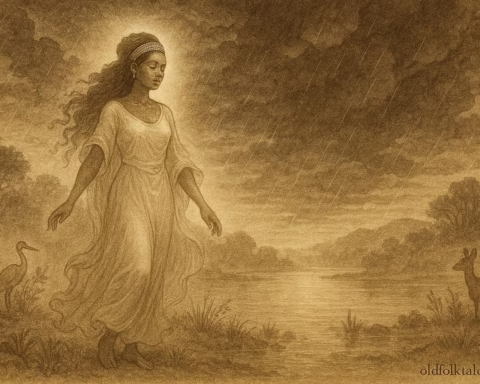
In the coastal villages of East Africa, where the scent of the sea drifts gently through the palms and the evenings glow with the softness of lantern light, parents often tell their children to be wary of voices heard after sunset. The night along the Swahili coast is filled with music. Rhythms from distant gatherings, drums carried by the breeze, and travelers singing ancient songs as they walk the moonlit paths. Yet hidden among these familiar sounds is a voice unlike any other, a voice so sweet and entrancing that even adults feel their hearts lean toward it. This is the voice of the Zimwi.
The Zimwi is said to be an ogre spirit that roams from village to village, drifting between shadow and moonlight. In the daytime, it remains unseen, hiding in thickets or shadowed forests. But when the sky grows deep blue and the first stars rise like sparks along the horizon, the Zimwi begins to sing.
The villagers say its voice is as smooth as flowing water and as gentle as a mother’s lullaby. It sings of long journeys, of shimmering seas, of places filled with wonder, and of promises so delightful that any listener feels their heart pull forward as if guided by invisible hands. Children are especially drawn to its melodies, for the Zimwi knows exactly the songs that stir curiosity and joy in young hearts.
Explore the mysterious creatures of legend, from guardians of the sacred to bringers of chaos
One evening in the village of Kizingo, a girl named Amina heard the voice. She was known for her love of music and her habit of humming even while grinding millet or helping her mother gather firewood. Her family often sang together at night, and the sound of music was one of her greatest comforts. That evening, as Amina prepared to fetch water before dark, a voice rose from the path near the mangroves.
It was soft at first, drifting like the whisper of a flute. Then it grew richer, warm and inviting, weaving into melodies she had never heard. Amina froze, the clay pot in her hands tilting slightly. The song wrapped around her like a fragrant breeze, soothing and beautiful. Without thinking, she stepped toward it.
But her grandmother, Mama Shida, was nearby and heard the same voice. Unlike Amina, she felt a chill move through her bones. Mama Shida had grown up hearing warnings about the Zimwi, and she could recognize a spirit song from the first note. She dropped the straw mat she was weaving and hurried to the door.
“Amina,” she called firmly, “do not follow that voice.”
Amina blinked as though waking from a dream. “But Bibi, it is so beautiful. Who sings like that”
“No human,” her grandmother answered quietly. “Come inside before the darkness thickens.”
Reluctantly Amina returned, though her heart still fluttered with curiosity and wonder. The voice continued to sing outside, circling the village, drifting past walls and windows like a beckoning hand. When it realized Amina was no longer following, the melody shifted. It became more sorrowful, then more pleading, as if begging someone to join it. But Mama Shida remained unmoved.
After several minutes the singing stopped, swallowed abruptly by the night. Only then did the villagers dare to speak again, whispering about the spirit that had passed through and the child it had almost taken.
That night Amina could not sleep. The song lingered in her mind, and though she tried to hum other tunes, nothing could cover the memory of that enchanting voice. She wondered what the singer looked like. A traveler perhaps, or a wandering musician searching for company. She could not believe something so beautiful could be dangerous.
The next morning she slipped out early, determined to learn more. She followed the path where she had first heard the voice. She saw footprints in the dirt, but they were strange, oddly shaped, too long and too wide for any human. The hairs on her arms stood up. She stepped back cautiously, remembering her grandmother’s warning.
While she stood staring at the tracks, Mama Shida appeared behind her. “Curiosity is a fire,” she said gently. “It can warm the spirit or burn the soul. You must learn when to step away from it.”
Amina nodded, swallowing the unease rising in her chest. “But why does the Zimwi sing so beautifully if it means harm”
“Some spirits hide their teeth behind sweetness,” Mama Shida replied. “A song is a mask as easily worn as any face. The Zimwi wants what it cannot earn honestly. It deceives. But you must remember this. True beauty in music comes from the heart that sings it. If the heart is wicked, the music may charm, but it will never bring peace.”
Amina listened quietly. The villagers later gathered to perform a protection ritual, placing coconut leaves and sacred herbs near their homes. Music filled the village that night too, but this time it was their own singing, their own voices rising in harmony. They filled the air so completely that no spirit could slip through unnoticed.
Days passed, and the Zimwi did not return. Amina’s fear faded, but the lesson remained with her. She still loved music, but she now understood that not every melody should be followed. Sometimes the sweetest voice hides the darkest truth, and wisdom comes from knowing the difference.
Author’s Note
This story teaches that beauty can disguise danger and that discernment is essential when facing unknown influences. The Zimwi remains one of East Africa’s enduring reminders that music holds power, both good and harmful, depending on its source.
Knowledge Check
1. Why does the Zimwi sing such beautiful songs?
It uses music to deceive and lure children.
2. Why was Amina drawn to the mysterious voice?
She loved music and did not recognize the danger.
3. How did Mama Shida know the singer was a spirit?
She recognized the unnatural beauty of the voice and remembered old warnings.
4. What did the villagers do to protect themselves?
They performed rituals and filled the night with their own songs.
5. What lesson does Amina learn by the end of the story?
She learns that not every beautiful sound comes from a good source.
6. What does the Zimwi symbolize?
Deception, hidden danger, and the need for vigilance.
Source
Adapted from Swahili Tales collected by Edward Steere in 1894
Cultural Origin
Swahili Peoples of East Africa