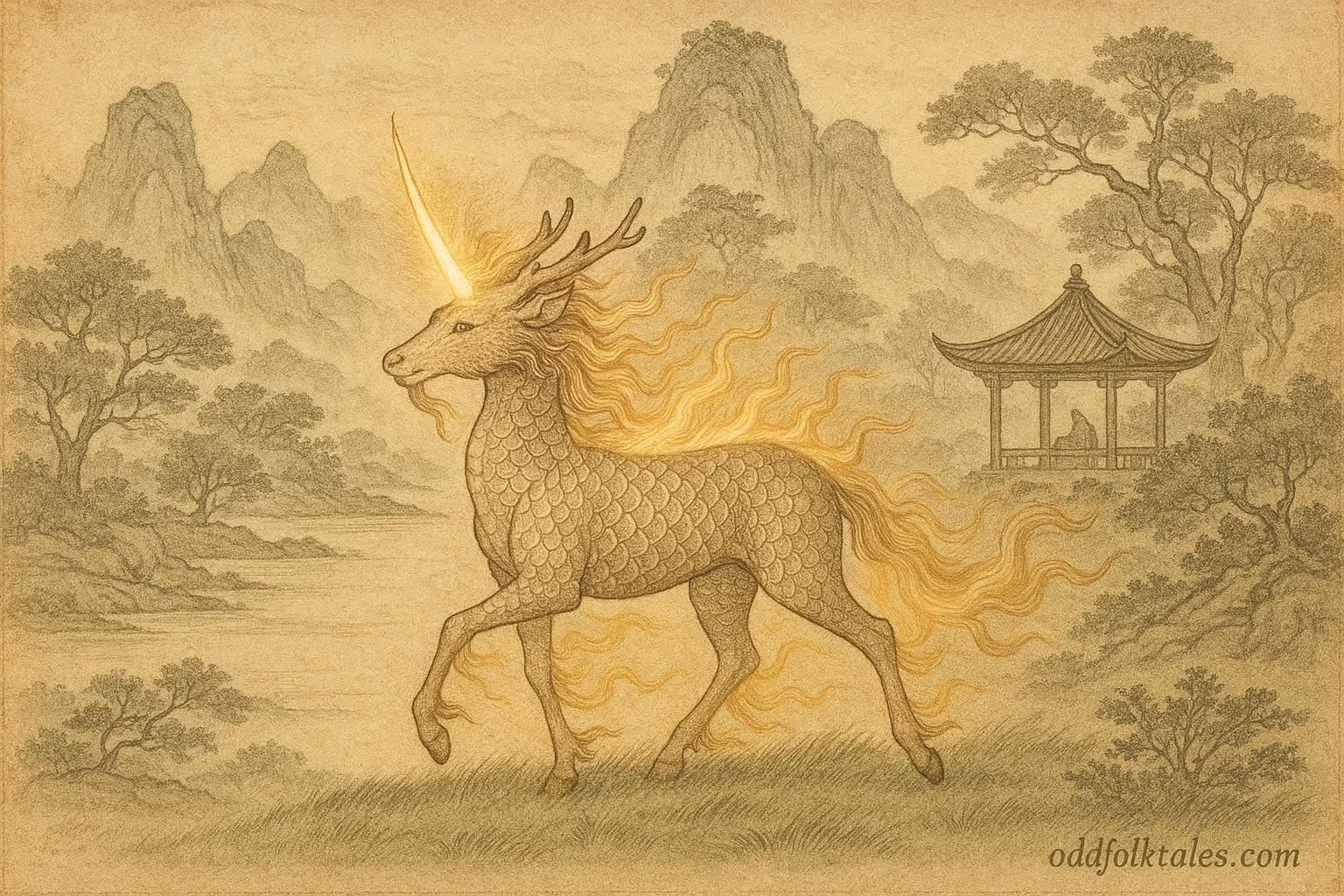
Among all the mythic beasts of the Chinese cultural imagination, few carry the moral weight, spiritual refinement, and cosmic dignity of the Qilin (麒麟). Often imperfectly called the “Chinese unicorn,” the qilin is not a simple one-horned creature but a richly layered chimera whose form embodies the harmony of nature and whose appearance signals an age of benevolent rule. Ancient texts describe it as a creature combining features of several noble animals: the body of a deer, tail of an ox, hooved feet, dragon-like or fish-like scales, and above all a single luminous horn rising from its forehead. One early classical description states that “a qilin has the body of a deer, the tail of an ox, a single horn, gentle of disposition, it never walks on verdant grass.”
To understand the qilin, it is necessary to recognize its place within a cosmology where animals are not merely beasts but embodiments of moral order and cosmic virtues. Unlike the fierce dragon or the martial tiger, the qilin is a creature of serenity and righteousness. Its scales gleam like multicolored fire, yet it emits no heat. Its very step is careful and soft, touching neither living grass nor insects, reflecting its nature as a being incapable of causing harm.
Explore ancient traditions that connected the human spirit to divine realms and cosmic order
Appearance Across Dynasties and Regions
Historical depictions vary across time and geography. In earlier Chinese bronzes and Han-era art, the qilin appears lean and deerlike, with delicate curves and a single antler-shaped horn. By the Ming dynasty, its form becomes more dramatic: a muscular, leonine body covered in dragon scales, flowing whiskers, and fiery patterns along its limbs and back. This later iconography often reflects the influence of Buddhist and pan-Asian mythological imagery, particularly when the creature entered Korea (girin) and Japan (kirin). In Japan, the kirin sometimes appears more horse-like, while in Korea the girin takes on a gentler, elongated form.
Yet despite these artistic shifts, the qilin retains three essential traits across all cultures:
- A chimerical form combining the noblest features of multiple species.
- A single horn (in most versions) as a sign of its heavenly authority.
- An inherently peaceful nature that harms nothing.
Mythic Function and Recorded Appearances
Unlike dragons, who command rain, rivers, and imperial power, the qilin operates within a moral and philosophical dimension. It never appears casually. The qilin visits the human world only during moments of great significance, usually connected to the birth, death, or era of a sage-king. In traditional lore, its arrival signals a period when the Dao (cosmic order) is fully aligned with human governance.
Perhaps the most famous legend connects the qilin to Confucius, whose mother is said to have encountered a qilin that spat out a jade tablet predicting her son’s greatness. Centuries later, according to ritual literature, a qilin appeared near Confucius shortly before his death, interpreted as a final acknowledgment of his moral legacy.
Other tales describe qilin appearing at the courts of ancient sage-kings such as Yao, Shun, and Huangdi. In these stories the qilin either stands silently, acknowledging the ruler’s virtue, or bows its head, offering celestial witness to a just reign. Its appearances often coincide with natural abundance, peaceful harvests, rainfall in ideal measure, and social harmony.
While the qilin is not a central character in long narrative epics like the dragon or fox spirit, its mythic power lies in symbolic moments rather than adventure stories. It is a messenger of Heaven, a cosmic auditor of ethics, and a living barometer of the moral climate.
Powers and Abilities
Though gentle, the qilin is not powerless. Classical texts attribute several supernatural traits:
- Moral Awareness: It can distinguish good from evil and will punish only the truly wicked.
- Celestial Sight: It perceives events across great distances and sees into human hearts.
- Fire and Light: Some versions say its body is surrounded by flames or radiant light, symbolizing purity.
- Longevity: It is an immortal or near-immortal being whose life spans thousands of years.
- Speech or Omens: In rare accounts, the qilin communicates heavenly warnings or prophecies.
Some late imperial stories describe the qilin as able to repel demons, not through violence, but by radiating moral force so pure that malevolent beings cannot approach.
Behavior and Temperament
Above all, the qilin is defined by its gentleness. It avoids stepping on living plants, does not consume flesh, and makes no sound of aggression. It defends itself only in the direst moral circumstances. Because of its restraint, ancient texts sometimes call it “the beast of benevolence” (仁兽).
The qilin’s movement is said to resemble floating, its hooves barely touching the ground. Its presence calms turbulent winds and stills aggressive animals. If a qilin appears near a river, the waters clear; if near a forest, predators retreat.
Thus, its behavior reinforces the core message: the qilin does not disrupt nature. Instead, it restores balance where moral disorder has lingered.
Cultural Role & Symbolism
The qilin symbolizes:
- Benevolent governance
- Moral clarity and righteousness
- The arrival of sages or the restoration of order
- Fertility and peaceful prosperity
- Harmony between Heaven and humanity
In Chinese art and architecture, especially in imperial contexts, qilin images adorn throne halls, scholar’s robes, temples, and tomb gates, marking the presence of virtue. Their diffusion across Asia reflects the widespread value placed on good governance and moral leadership.
In essence, the qilin represents the possibility of a world without cruelty, a realm where power serves justice and wisdom.
Encounter dragons, spirits, and beasts that roamed the myths of every civilization
Author’s Note
The qilin’s mythos is subtle and deeply philosophical. Rather than thrilling battles or dramatic transformations, its stories revolve around moral ideals. In writing this entry, I focused on preserving that quiet dignity, a reminder that in some traditions, the most powerful beings do not conquer but inspire.
Knowledge Check (Q&A)
- Q: What does the appearance of a qilin usually signify?
A: The birth or death of a sage, or a time of peaceful, virtuous governance. - Q: Why is the qilin sometimes called the “Chinese unicorn”?
A: Because it often has a single horn, though its overall form differs greatly from Western unicorns. - Q: Name two animals whose features appear in the qilin’s body.
A: Deer (body), ox (tail), and dragon/fish (scales). - Q: What is the qilin’s temperament?
A: Extremely gentle; it avoids harming any living thing. - Q: In one famous legend, what does a qilin do to foretell Confucius’s destiny?
A: It spits out a jade tablet with a prophecy. - Q: What moral concept does the qilin symbolize above all?
A: Benevolence and righteous leadership.
Source: Classical Chinese texts (Lüshi Chunqiu, Book of Rites, Han sources), encyclopedia references, traditional iconography
Origin: China (with cultural diffusion to Korea, Japan, Vietnam)