Before the world had settled into harmony, when Heaven’s decrees still trembled like fresh ink upon silk, a strange omen shimmered over the coastal fortress of Chentang Pass. For three years Lady Yin had carried a child in her womb, long beyond mortal reckoning, until, at last, thunder split the horizon and a radiant lotus unfurled at her feet. From its petals stepped a boy not crying, but shining: Nezha, lotus-born, a child of divine mandate.
His father, General Li Jing, saw in him both wonder and danger. The child glowed with celestial qi, and the ancient spirits whispered, This one will tilt the balance of Heaven and Earth. So Nezha was raised not as a noble infant but as a force, taught martial rites, wind-walking, and spell-summoning. Even before he grew tall, he could leap across rivers, churn storms, and summon fire from the hollow of his palms.
Yet divine gifts came with divine consequences.
One evening, as Nezha played along the shore, the Dragon King’s third son rose from the waves, scales glittering like green jade, and challenged the boy who stirred the tides without permission. Nezha, unafraid, lifted his fiery spear. The duel sparked wind and lightning, and though still a youth, Nezha slew the dragon prince in a single burning stroke.
The victory shook the deep. The Dragon King thundered to the court of Heaven, demanding justice, threatening to drown the province in endless tides. Mortal lives trembled upon the edge. The fault, the gods agreed, belonged to Nezha, and thus to his father.
When Li Jing learned he would be punished in his son’s stead, his grief was heavier than armor. Nezha saw his father’s despair and understood: his existence, miraculous yet terrifying, brought peril to those he cherished. On the temple altar he knelt, trembling not with fear but with duty. With his spear he carved his flesh away, returning his body to his parents, muscle to mother, bone to father, blood to both, and his spirit rose like a white flame into the sky.
But death could not still a soul born of lotus light.
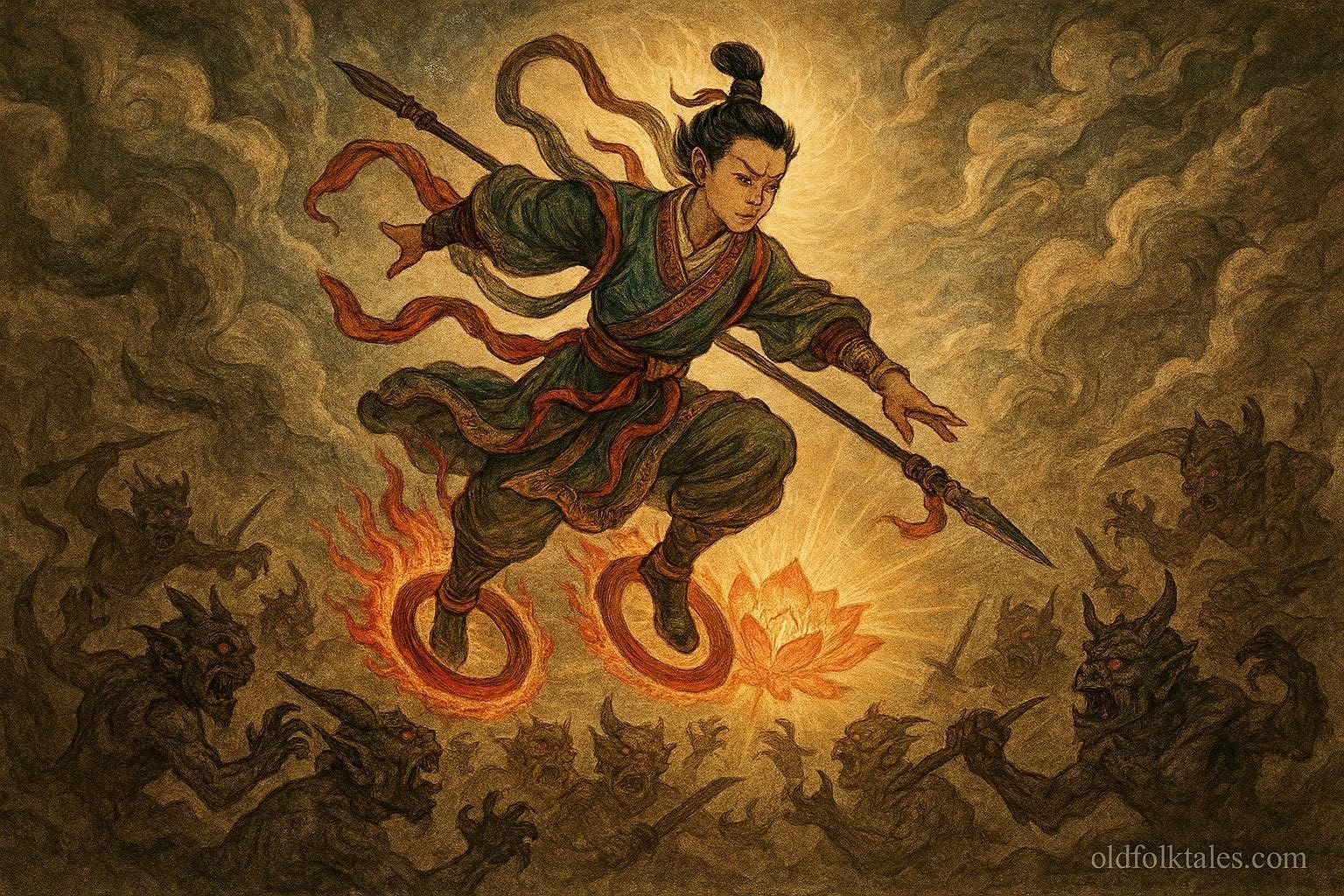
Across mountain mists, the immortal Taiyi Zhenren felt Nezha’s essence flicker like a fallen star. Gathering lotus roots and sacred herbs, he wove a new body of pure celestial bloom, breathing life into petals shaped like limbs, fragrance shaped like breath. And from this second birth Nezha rose transformed, reborn not as a child but as a warrior of destiny. His feet rested upon Wind-Fire Wheels, and upon his arms he bore the Universe Ring and Silk of Heaven, weapons attuned to cosmic order.
He returned not for vengeance, but for purpose.
Yet when Li Jing saw the reborn spirit of his son, fear overcame him. To him, Nezha was no longer a child but an omen of upheaval. He tried to strike him down, thinking he protected the mortal world. Nezha parried gently, refusing harm. The greater war was not with his father, but against the forces of chaos rising across the realm.
Demons gathered under the shadow of the archfiend Shen Gongbao. Armies of monstrous forms marched through burning valleys, seeking to tear apart the strands of Heaven’s Mandate. The winds grew sharp with prophecy: A lotus-born warrior will stand between cosmos and collapse.
Nezha answered.
He soared upon his flaming wheels across battlefields of shattered stone. His spear opened paths through demon ranks like a comet splitting night. Yet even amid triumph, he felt the tug of moral struggle, was he a savior, or a storm unleashed by divine will? His second life was not his own; it belonged to mission, sacrifice, and endless conflict.
During the climactic confrontation, a demon general of iron hide and molten breath roared: “You are a child pretending to hold the heavens!” Nezha’s heart flinched, for he feared the words carried truth. Yet he stood firm. “I am not Heaven’s child,” he declared. “I am the protector of those who cannot lift a spear.”
Their clash cracked mountains. Nezha, battered and near spent, unleashed the full radiance of the lotus-body. Blinding light burst forth, consuming the demon horde in a wave of purifying bloom. Petals, thousands upon thousands, drifted into the sky, settling like soft judgment over the ruined battlefield.
When the light faded, Nezha stood alone amid quiet earth.
Order had been restored; chaos, pushed back beyond the mortal realm. But the cost weighed upon him: he was reborn to fight, forever walking the thin line between duty and selfhood. Still, he accepted this path, not as punishment, but as purpose.
Thus Nezha journeyed on, spear in hand, Wind-Fire Wheels blazing beneath his feet, a guardian whose very existence reminded gods and mortals alike that sacrifice can give birth to hope, and that even divine spirits must struggle to discover the meaning of their power.
AUTHOR’S NOTE
Nezha’s legend endures because it blends cosmic grandeur with intimate human struggle. Though born divine, he wrestles with identity, guilt, duty, and transformation. His symbolic lotus body represents purity after suffering, and his tale resonates as an anthem of rebirth, showing that destiny is not merely inherited, but forged through sacrifice and resilience.
KNOWLEDGE CHECK
-
What omen marked Nezha’s birth?
-
Why did the Dragon King demand justice?
-
How did Nezha save his parents from punishment?
-
Who recreated Nezha’s body after his sacrifice?
-
What inner struggle challenged Nezha during the final battle?
-
What symbolic meaning does his lotus-body represent?
CULTURAL ORIGIN: Chinese mythology; Ming dynasty epic tradition.
SOURCE: Fengshen Yanyi (Investiture of the Gods), Ming dynasty; translated by Marshall (2001).