In the mist-veiled highlands of Cymru, where rivers coil like silver serpents and mountains brood beneath eternal cloud, Peredur son of Efrawg was born beneath a star that had not risen in an age. His mother, widowed by war and wearied by fate, fled with the child into the forested wilds to keep him from the chivalric path that had claimed his father and brothers. Yet destiny clings as tightly as shadow; Peredur was marked from birth with the quiet fire of a divine gift, the strange foresight that arrives as dreams whose symbols burn brighter than waking truth.
He grew tall among the trees, knowing neither steel nor saddle, fed on tales his mother whispered of knights, dangerous stories, she warned, for they stirred the heart toward ruin. But stories are seeds. One morning, when dawn bled red over the horizon like a wound, Peredur saw a band of knights riding through the valley, their armor ablaze with sunlight. They seemed like beings from another realm, glimmering, mighty, ordained. In that moment, the spark within him ignited into flame.
Explore ancient traditions that connected the human spirit to divine realms and cosmic order
Leaving his mother’s lamenting cries behind, Peredur followed the knights to King Arthur’s court at Caerleon. His innocence was so complete it bordered on holiness, he knew not how to greet a lord nor how to ask for knighthood, but his purity, untainted by ambition or guile, caught Arthur’s attention. He was granted a place among the king’s warriors, though his path would not mirror theirs. For Peredur carried a destiny older than Arthur’s throne, a thread woven in the secret looms of prophecy.
His trials began quickly. To avenge the insult of the Red Knight who spilled wine upon Arthur’s queen, Peredur faced the seasoned warrior with nothing but raw instinct. Guided by the whisper of a vision, strike where his shadow bends, Peredur slew him and claimed his armor. But victory awakened a darker force: a creeping pride, a hunger for recognition. Thus began the hero’s moral struggle, the pull between humility and honor, purity and power.
Peredur wandered from court to forest, from hermit’s cell to enchanted stronghold, learning through hardship what no teacher could grant. He battled witches of the caer who summoned storms with their tongues, giants whose footsteps shook the moors, and demons of sorrow who fed on despair. Each trial drew from him a deeper strength, but each also pressed upon his soul another question: Was he chosen for glory, or for sacrifice?
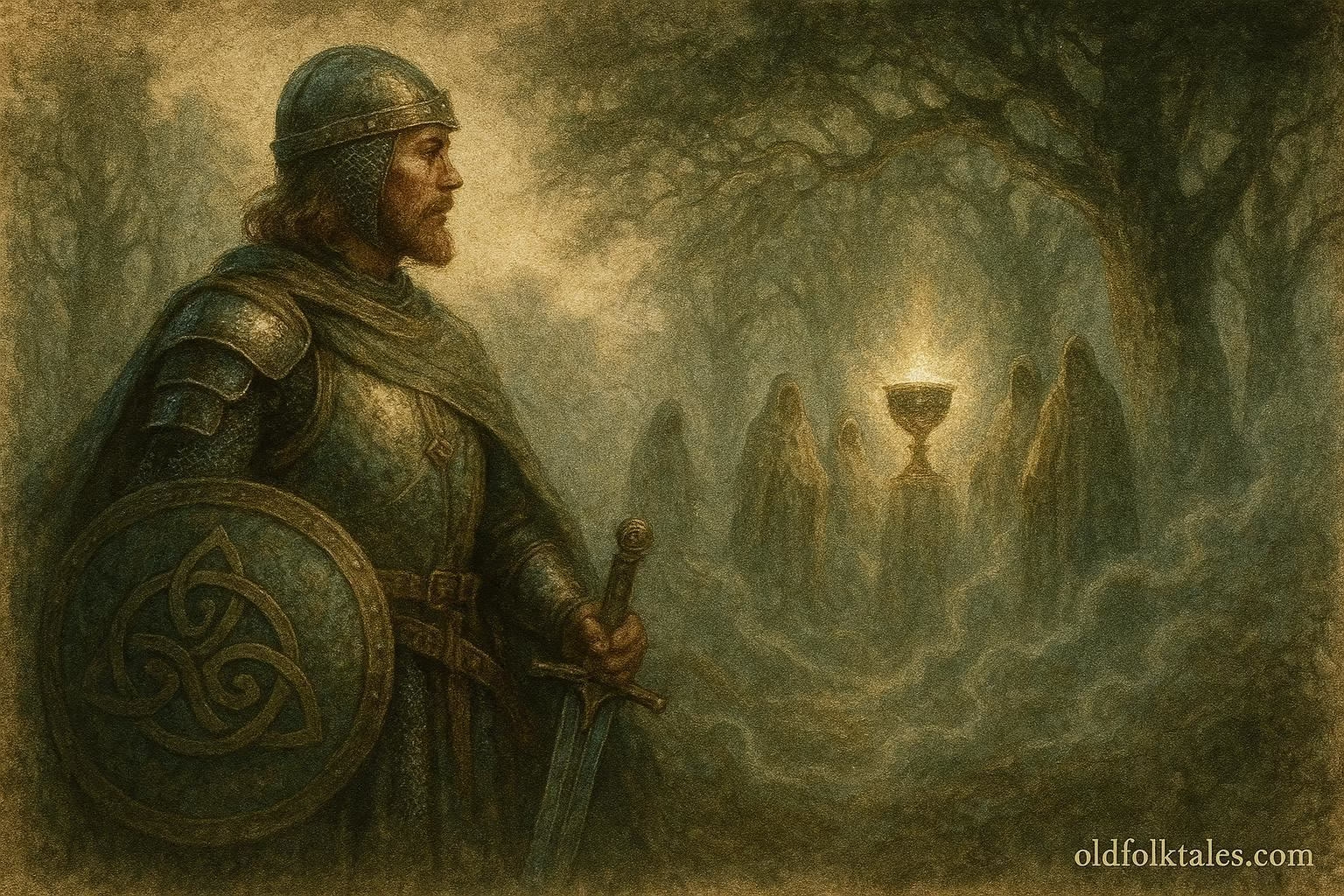
It was during one twilight journey, when the sky bruised into indigo, that Peredur came upon a mysterious hall blazing with firelight. There, in a silence thick and holy, a solemn procession unfolded before him. A maiden walked first, carrying a golden chalice whose radiance shimmered like dawn upon water. Behind her came a youth bearing a bleeding lance, each drop falling soundlessly upon the stone. And upon a couch lay a noble man, pale as moon-washed linen, stricken by a wound that would not heal.
Peredur felt meaning trembling at the edge of speech, a sign, a summons, a divine riddle. But remembering the harsh rebukes he had faced for asking foolish questions in his early years, he held his tongue. The procession passed, leaving only the echo of sacred silence.
When dawn came, the hall was empty.
And Peredur’s heart was heavy.
Later, from a wise hermit deep in the wilds, he learned the truth of what he had seen. The bleeding lance belonged to an ancient lineage stained by betrayal, and the chalice, the Grail itself, held the mysteries of life, death, and divine mercy. The wounded king he could have saved had depended on one thing only: Peredur’s question, the question that acknowledged compassion over pride.
He had failed not in strength, but in empathy.
Stricken with remorse, Peredur swore a vow beneath the yew trees: he would seek again the Grail procession, ask the healing question, and bring restoration where silence had wrought suffering. His quest became not one of victory but of redemption.
For years he traveled, through broken kingdoms, over storm-lashed seas, into the lairs of beasts shaped by ancient curses. Each battle carved deeper into him the understanding that heroism is not the absence of error but the courage to rise beyond it. Visions guided his path: the image of the wounded king, the gleam of the chalice, the soft golden glow of forgiveness.
At last, in a fortress hidden behind veils of enchantment, Peredur found what he sought. The procession returned, solemn as fate. This time he spoke.
“What ails thee, lord?” he asked, voice trembling with humility.
The question broke the ancient curse. Light cascaded through the hall like a river of dawn. The king rose healed, the land revived, and the Grail shone with a radiance that filled Peredur’s soul with both peace and awe. He had uncovered the deeper truth beneath knightly valor: that the purest strength is compassion, the purest victory the healing of what is broken.
And so Peredur, knight of prophecy, passed into legend, not merely for his battles, but for the luminous transformation of his spirit.
Author’s Note
Peredur’s tale is a cornerstone of medieval Welsh epic tradition. His journey from innocence to wisdom mirrors the spiritual quest for understanding that lies at the heart of many Grail narratives. Unlike later continental versions, Peredur’s story emphasizes moral awakening over ritual, compassion over conquest. His legacy endures as a uniquely Welsh expression of heroic purity and divine insight.
Knowledge Check
-
What divine or prophetic traits mark Peredur from birth?
-
Why does he initially leave his mother’s forest home?
-
What internal conflict defines Peredur’s early knightly journey?
-
What is the significance of the Grail procession he witnesses?
-
What mistake prevents him from healing the wounded king at first?
-
What moral truth does Peredur ultimately learn through his quest?
Cultural Origin: Medieval Welsh epic tradition; part of the Mabinogion cycle.
Source: Jeffrey Gantz (trans.), The Mabinogion. Penguin Classics, 1976.