Before the seas breathed and before the winds wandered across the empty sky, there was only Te Bomatemaki, the Great Darkness. Within its vast, silent womb drifted two beings made not of flesh nor bone, but of pure intention: Nareau the Great, the First Mind, and his sibling-spirit Nareau the Younger, the First Echo. Where others would see void, they saw possibility. Where others would hear stillness, they heard the pulse of a world waiting to be born.
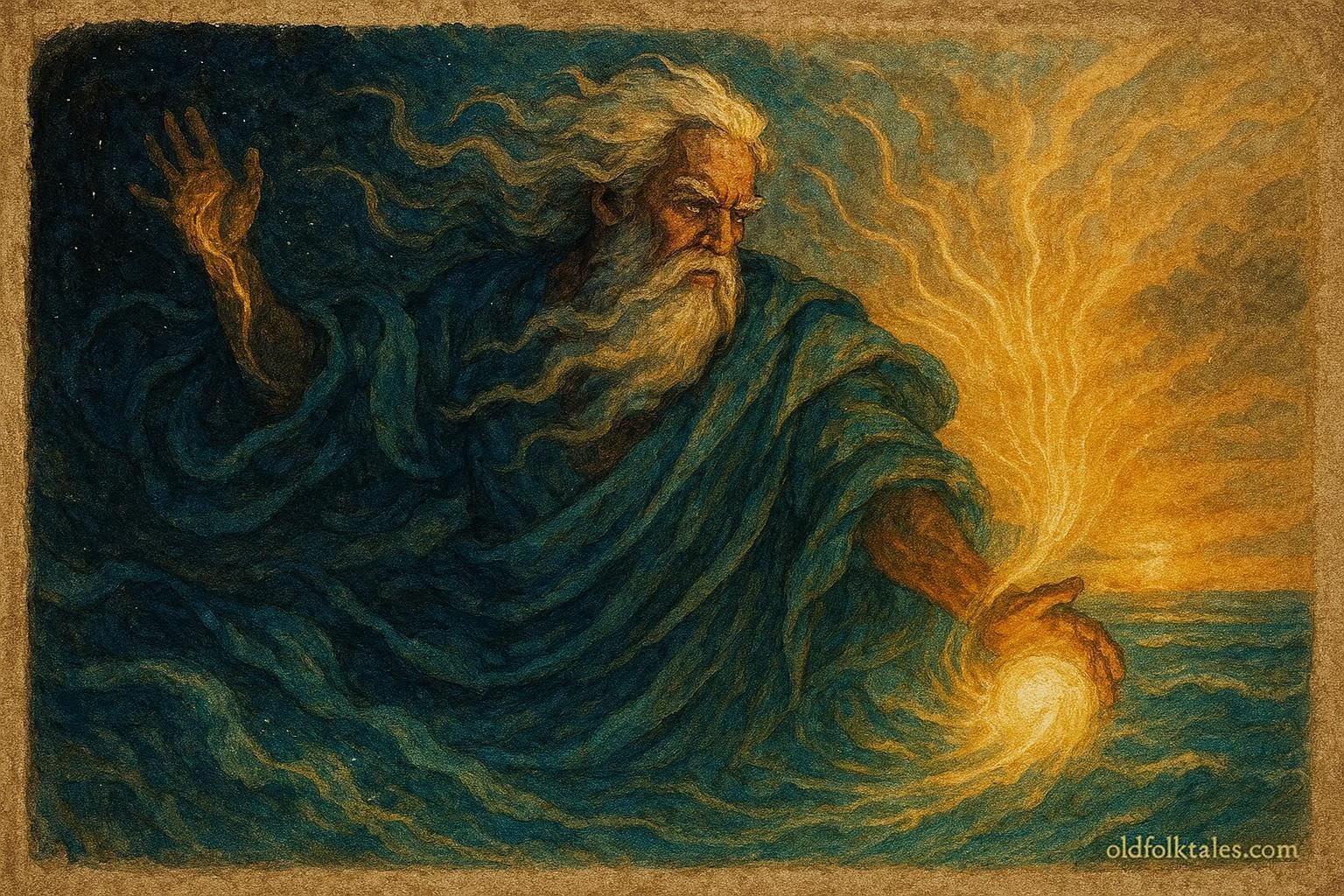
Nareau the Great stirred first. His thoughts rippled through darkness like currents under an unseen sea. He shaped the shadows into form: a shell of pure night, a cradle where creation might grow. But shadows alone could not give life. “There must be division,” he spoke, “for without contrast, nothing may come to be.” And so he reached into himself, pulling forth a spark of brilliance, a trembling seed of light, and set it against the endless black.
The collision birthed the First Dawn. Light spread like molten gold across the void, and the Darkness recoiled but did not vanish; instead, it folded itself into caverns and corners, giving way for balance. Thus began the cosmic order.
With light and dark separated, Nareau the Great looked upon his younger counterpart. “Now let us call forth those who will shape the world with their hands, for a creator’s thoughts must be anchored by the labor of others.”
From strands of light he molded the Spider Ancestors, beings with many hands and boundless craft. From coils of darkness he shaped the Earth Shapers, patient spirits who knew the weight and slowness of stone. Together, these spirits wove the first net of reality, threading water, air, earth, and sky into a single tapestry.
But the weaving faltered.
The worlds they created sagged or tore. Waters leaked into sky; winds drowned within stone. For every solution, another flaw emerged. Soon, quarrels erupted between light-born and dark-born spirits. The Spider Ancestors blamed the Earth Shapers for moving too slowly. The Earth Shapers accused the Spiders of crafting without foundation.
The discord threatened to unravel everything the creators had shaped.
Seeing this chaos, Nareau the Great knew he must intervene.
He stepped into the center of creation, his radiance dimming the stars that were still being forged. “Creation is not competition,” he declared. “It is balance. And balance demands sacrifice.”
Yet even Nareau faced a challenge: the worlds could not be fixed without a single center, an anchor capable of holding sky above, earth below, and the waters between. To achieve this, something of great power had to be given up.
The spirits looked to Nareau the Great. And Nareau looked inward.
To bring order, he would have to divide himself.
The moral weight of this decision pressed upon him. He was the First Mind, the origin of all things. If he diminished himself, would his creation endure? Would the cosmos hold? Could chaos return stronger without him?
He wrestled with this truth in silence. Creation had given rise not only to form but to moral choice, the burden of all who shape worlds. If he clung to wholeness, his creation would collapse. If he chose sacrifice, he would no longer be the supreme being he once was.
In the stillness between breaths of infinity, Nareau made his choice.
With a gesture gentle as drifting sand, he drew forth from his own essence three mighty spirits who would become pillars of the world. From his strength came Auriaria, the Sky-Bearer. From his wisdom came Tabakea, the Cosmic Turtle whose shell would hold the earth. From his breath came Na Areau, a reflection of his younger self who would guard the boundary between realms.
Each spirit took their place: Auriaria lifting the heavens, Tabakea shaping the land upon his back, and Na Areau governing the shifting spaces between sea and sky.
But the act weakened Nareau the Great. He no longer shone as he once did; his brightness softened into a calm guiding glow. Yet as the cosmos settled, waters flowing into their basins, air rising, mountains forming upon Tabakea’s shell, Nareau felt the quiet triumph of creation completed.
The Spider Ancestors resumed their weaving with respect rather than rivalry. The Earth Shapers breathed deep and steady, anchoring the world with patient strength. Light and darkness found harmony, and the universe no longer trembled.
At the edge of the new-made world, Nareau gazed upon the horizon where dawn touched ocean. “From sacrifice,” he murmured, “comes stability.”
And thus the heroism of Nareau was not in battle, nor in victory over foes, but in the surrender of his own greatness for the survival of all things. The cosmos would never forget this gift, and every sunrise across Kiribati would echo his first division of light from darkness, his eternal signature upon creation.
AUTHOR’S NOTE
In Kiribati creation lore, Nareau represents the divine intellect and moral courage at the heart of existence. His heroism lies in choosing cosmic balance over personal supremacy, modeling the principle that harmony is preserved through humility and sacrifice. He stands as one of Micronesia’s most profound creator figures, embodying the world’s transition from formlessness to order.
KNOWLEDGE CHECK
-
What existed before Nareau shaped the cosmos?
-
Why did Nareau separate light from darkness?
-
Who were the Spider Ancestors and Earth Shapers?
-
What moral struggle did Nareau face during creation?
-
What three spirits were born from Nareau’s sacrifice?
-
How does the sunrise symbolize Nareau’s legacy?
CULTURAL ORIGIN: Micronesian (Kiribati) Creation Epics
SOURCE: A. Grimble, Myths from the Gilbert Islands (1924).