
In the time before time, when the world was young and still taking shape, the Inuit people lived in perpetual darkness in their homeland at the roof of the world. The sun had never kissed their faces. The stars were their only companions in the endless black void that stretched across the tundra. They knew nothing of daylight, nothing of the golden glow that could transform ice into diamonds and reveal the vast beauty of their Arctic home.
Then came Crow, a traveler who journeyed between the lightless north and the radiant south. The spoke of wonders the Inuit had never imagined of a brilliant orb that rose each morning to paint the sky in shades of pink and gold, of shadows that danced across the land, of colors so vivid they seemed to sing. The elders shook their heads in disbelief. Such tales seemed like nothing more than the fantasies of an old bird who had flown too far and seen too much.
But the younger people gathered around Crow with wide, wondering eyes. They pressed him to tell his stories again and again, until every detail was etched into their memories. They whispered among themselves in the darkness, their voices trembling with longing.
“Think of how far we could travel on a hunt if we could see,” one young hunter mused, his breath forming clouds in the frigid air.
“Yes, and we could spot the great white bear before it was upon us,” another agreed, remembering too many close calls in the blinding dark.
The yearning grew like a living thing in their hearts, spreading from person to person until it became impossible to ignore. Finally, the people gathered before Crow with a desperate plea: “Bring us the daylight. Bring us the light!”
Crow ruffled his midnight feathers and shook his head slowly. “I am old now,” he said, his voice carrying the weight of countless journeys. “The daylight lies far, far away in the southlands. My wings are not as strong as they once were. I do not know if I can make such a journey anymore.”
But the people would not be deterred. They begged and pleaded until Crow’s resistance crumbled like old ice. With a sigh that seemed to come from the depths of his ancient soul, he agreed to make one final, monumental journey.
Crow launched himself into the darkness, his wings beating steadily against the void. He flew through the endless night of the Arctic, over frozen seas and sleeping mountains. Many times his wings grew heavy with exhaustion. Many times he nearly turned back. But each time he remembered the faces of the people who lived their entire lives without ever seeing their own hands in the light, and he pressed on.
At last, after what seemed like an eternity, Crow saw something impossible a thin line of light glowing at the very edge of the world. His heart surged with hope, and he beat his wings with renewed vigor. Then, all at once, daylight burst upon him like a revelation.
The brilliance nearly blinded him. Colors he had forgotten existed flooded his vision the deep blue of the sky, the pure white of clouds, the green of distant forests, the brown of earth. Shapes and forms surrounded him in infinite variety. Overwhelmed, Crow descended to a tree near a village that nestled beside a wide, rushing river. He perched there, drinking in the beauty of the daylit world, scarcely believing what his eyes beheld.
As he rested, a beautiful young woman approached the river carrying a wooden bucket. She dipped it into the icy water, and as she turned to leave, Crow saw his opportunity. He transformed himself into the tiniest speck of dust, lighter than air itself, and drifted down to settle into the soft fur of her cloak.
The girl walked through the village to a large snow lodge clearly the home of someone important. Inside, warmth enveloped them. Crow’s sharp eyes immediately noticed a box in the corner that glowed with an otherworldly light, its edges illuminated as if the sun itself were trapped within. A small boy played on the floor, laughing as he tumbled about.
The speck of dust that was Crow floated from the girl’s cloak and slipped into the child’s ear. The boy sat up suddenly, rubbing at his ear with confusion. His face crumpled, and he began to cry.
A dignified man clearly the chief, and by the look of tender concern on his face, the boy’s doting grandfather rushed to the child’s side. “What troubles you, little one?” he asked, kneeling beside his grandson with worry creasing his brow.
Inside the boy’s ear, Crow whispered softly: “You want to play with a ball of daylight.”
The child rubbed his ear and then, in his innocent voice, repeated exactly what Crow had said.
Without hesitation, the chief motioned to his daughter. She approached the glowing box and opened it carefully, revealing several balls of pure light within. She selected one and brought it to her father, who tied it with a string and placed it in the boy’s small hands.
The child’s tears vanished instantly. He giggled with delight as the ball bounced and swayed on its string, casting dancing shadows across the walls of the lodge. Light and color swirled within it like captured dreams.
But then Crow scratched the inside of the boy’s ear again, and fresh tears spilled down his cheeks.
“Please don’t cry,” the grandfather pleaded, his voice soft with concern. “Tell me what you need.”
Crow whispered again: “You want to go outside to play.”
The boy repeated the words, and immediately the chief scooped him up in his arms and carried him out into the daylight. The worried mother followed close behind.
The moment they stepped outside, Crow burst from the child’s ear and exploded back into his true form. His black wings spread wide as he dove toward the startled boy, snatching the string from his tiny hand. Then Crow rose up and up into the endless blue sky, the ball of daylight trailing behind him like a comet.
The chief and his family could only watch in astonishment as the black bird grew smaller and smaller, disappearing into the distance with their treasure.
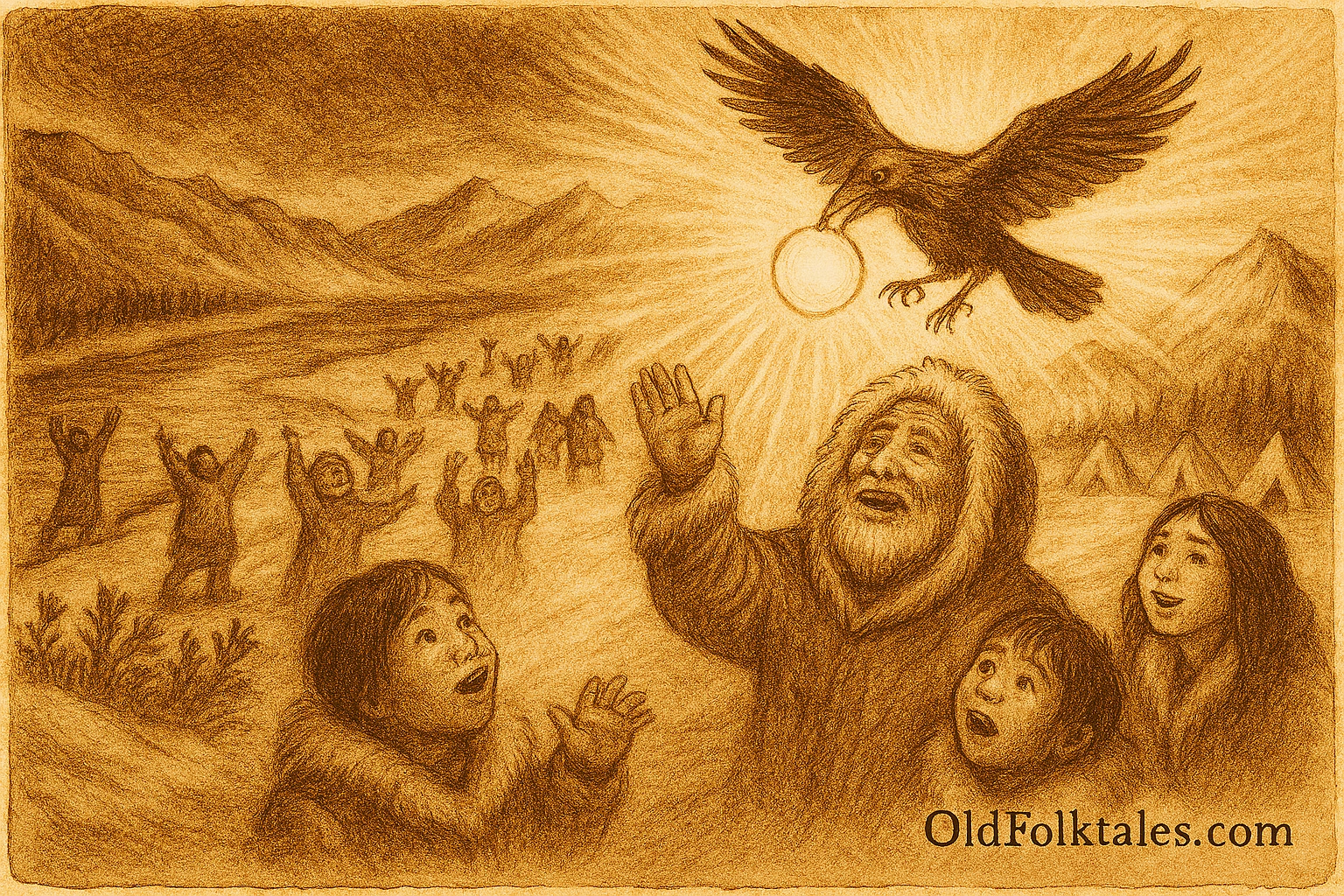
Far to the north, the Inuit saw something they had never seen before a tiny spark of light piercing the darkness. At first, they thought their eyes were playing tricks on them. But the light grew brighter and brighter, swelling until they could make out the silhouette of Crow flying toward them, his wings pumping steadily, the glowing ball sailing in his wake.
The people shouted and pointed, their voices rising in excitement and disbelief. Children jumped up and down. Elders clasped their hands together in wonder.
Crow reached the center of their village and released the ball. It fell through the air and shattered upon the frozen ground, exploding outward in a cascade of brilliance. Light rushed in every direction at once, flooding into every shadow, illuminating every corner of their world.
The sky transformed from black to blue. The mountains revealed themselves in shades of gray and white and purple. The snow and ice sparkled with such intensity that the people had to shield their eyes with their hands. They could see each other’s faces clearly for the first time in their lives the lines of age, the brightness of youth, the tears of joy streaming down every cheek.
They laughed and wept and exclaimed over the miracle that had been given to them. But Crow raised his voice above their celebration with an important warning: “The daylight will not last forever. I was able to steal only one ball of light from the people of the south. It will need to rest for six months of every year to regain its strength. During those months, the darkness will return to you.”
The people looked at one another, and then back at Crow. Their smiles did not fade.
“Half a year of daylight is more than enough,” they said. “Before you brought us this gift, we lived our entire lives in darkness. We are grateful beyond words.”
And they thanked Crow again and again, showering him with praise and promises.
To this day, the Inuit live half the year in darkness and half the year in daylight, just as Crow warned them. And they are always kind to Crow and his descendants, for it was Crow who loved them enough to make an impossible journey, who was clever enough to steal the light, and who was generous enough to share it with those who lived in endless night.
Click to read all Myths & Legends – timeless stories of creation, fate, and the divine across every culture and continent
The Moral of the Story
Crow Brings the Daylight teaches us that great gifts often require great sacrifice and cleverness. Crow was old and weary, yet he undertook an exhausting journey out of compassion for people living in darkness. His intelligence and resourcefulness allowed him to overcome impossible obstacles and bring transformative change to an entire community. This Inuit legend reminds us that wisdom, courage, and creativity can illuminate even the darkest places, and that we should honor those who risk everything to bring light into our lives. It also teaches gratitude the Inuit people appreciated even half a year of daylight because they understood the value of what they had been given.
Knowledge Check
Q1: Why did the Inuit people initially live in complete darkness?
A: The Inuit lived in darkness because they were in the far north where daylight had never reached. This myth explains the Arctic phenomenon of polar night, when the sun does not rise for extended periods. The story represents a creation myth explaining how light first came to the northern regions and why the Arctic experiences both continuous daylight and continuous darkness at different times of the year.
Q2: What role does Crow play in Inuit mythology and this story?
A: Crow serves as a trickster hero and culture bearer in Inuit mythology. In this story, he acts as a bridge between two worlds—traveling between the dark north and the light-filled south. His intelligence, shapeshifting abilities, and willingness to help others make him the perfect character to steal daylight and bring it to the Inuit people. Crow represents wisdom, adaptability, and the power of cleverness over brute strength.
Q3: How did Crow manage to steal the ball of daylight?
A: Crow used his shapeshifting abilities and cleverness to steal the daylight. He transformed himself into a tiny speck of dust, entered the ear of the chief’s grandson, and whispered suggestions that the boy then repeated. By manipulating the child’s desires, Crow convinced the doting grandfather to give the boy the ball of daylight and take him outside, where Crow could snatch it and fly away.
Q4: Why does the Arctic have six months of daylight and six months of darkness?
A: According to the myth, Crow was only able to steal one ball of daylight from the southern village. This single ball needed to rest for six months each year to regain its strength, which is why darkness returns to the Arctic for half the year. This legend provides a cultural explanation for the natural phenomenon of polar night and midnight sun experienced in Arctic regions.
Q5: What does this story reveal about Inuit values and culture?
A: The story reveals several important Inuit values: gratitude (the people were thankful for even half a year of light), respect for elders and wisdom (Crow was old but his knowledge was invaluable), the importance of cleverness and intelligence over physical strength, and deep appreciation for helpers and gift-givers. The Inuit’s kindness to crows reflects the cultural practice of honoring those who have helped the community.
Q6: What is the significance of the trickster archetype in Indigenous North American stories?
A: In Indigenous North American mythology, trickster figures like Crow, Raven, and Coyote use intelligence, cunning, and deception to benefit humanity or reshape the world. Unlike villains, tricksters often break rules or deceive others for a greater good in this case, bringing light to people living in darkness. They represent the power of wit, adaptability, and creative problem-solving, showing that intelligence can overcome seemingly impossible obstacles.
Source: Adapted from traditional Inuit oral narratives and retellings of Arctic creation myths.
Cultural Origin: Inuit peoples, Arctic regions of Alaska, United States, and circumpolar Arctic territories






