
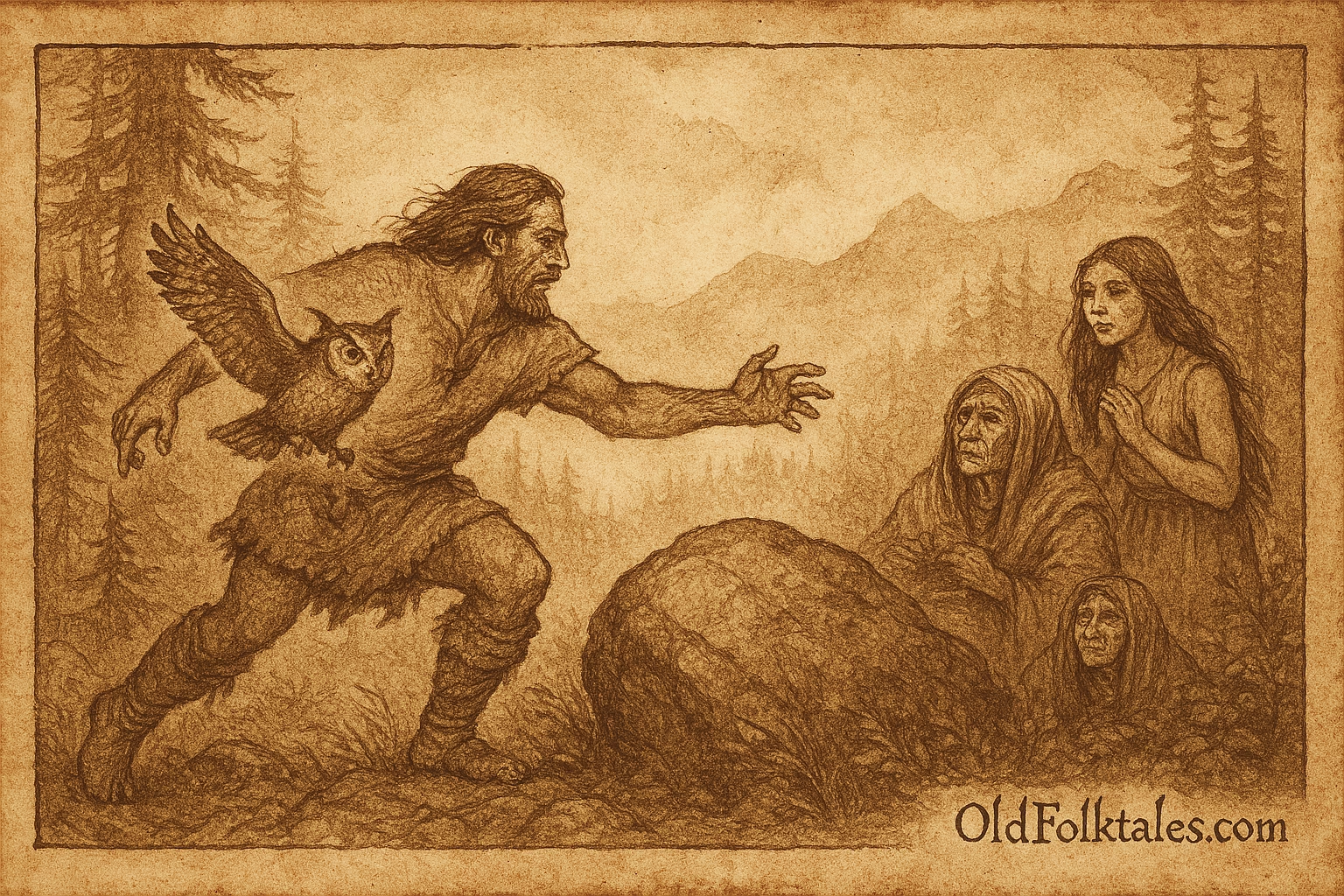
One summer, long ago, a young warrior brought his wife and his elderly mother to the coastal lands where the city of Sitka would one day rise from the mist. They came seeking abundance, hoping to build a new life where the sea met the forest. But that summer proved harsh and unyielding, as if the very land itself had turned its face away from them.
The fish that usually crowded the coastal waters stayed far out at sea, their silver bodies flickering in waters the warrior could not reach. The deer and bear that normally roamed the mountains had moved beyond the ridges, following some ancient path known only to them. The warrior rose before dawn each day, setting his carefully woven traps among the trees and laying his nets in the cold waters of the sound. He walked until his feet bled, climbing rocky slopes and pushing through dense undergrowth, searching for any sign of game. But his efforts yielded nothing.
Click to read all Myths & Legends – timeless stories of creation, fate, and the divine across every culture and continent
The family survived on whatever they could gather from the land bitter berries that stained their fingers purple, tender green sprouts that offered little sustenance, and roots they dug from the earth with aching hands. Each day brought barely enough to keep their bodies alive, and even that meager harvest required hours of backbreaking labor.
As the days of hunger stretched into weeks, the warrior watched his old mother grow weaker. Her eyes, already dim with age and nearly blind, seemed to lose their light entirely. Her hands trembled as she worked, and her voice grew thin as a whisper. The warrior himself felt his own strength ebbing away, his muscles growing slack, his mind clouding with the fog of starvation.
Yet his young wife remained strong and healthy, her skin glowing, her movements quick and sure. While the warrior and his mother grew gaunt and hollow-eyed, she seemed untouched by their suffering. Each evening at their poor meal, she would pick delicately at the roots and berries, eating only a few bites before setting her portion aside with apparent disinterest.
The warrior puzzled over this mystery, turning it over in his mind as he lay awake at night, too hungry to sleep. How could she remain so strong when they all ate from the same meager supply? What secret kept her flesh from melting away like his own?
Then, one morning before the sun had begun to paint the eastern sky, his old mother came to him. Her weathered face was tight with pain and anger, and she clutched his arm with surprising strength as she told him a story that made his heart grow cold.
The night before, she had awakened from a dream of roasted fish a cruel dream that haunted the starving woman. But as she opened her failing eyes, she realized the smell was real. Through the darkness of the lodge, she saw a small fire crackling, its flames casting dancing shadows on the walls. And there, crouched beside that secret fire like a creature hoarding treasure, was the warrior’s wife.
The girl was cooking a fish a beautiful, fat fish that glistened with oil as it roasted. The old mother watched in disbelief as her son’s wife tore into the hot flesh, chewing eagerly, her eyes half-closed with pleasure at the taste.
“Please,” the old mother had cried out, her voice breaking with desperation. “Give me just a morsel, just a bite to ease this terrible hunger.”
But the girl’s face had hardened. “You’re dreaming, old woman,” she said coldly. “There is no fish. Go back to sleep.”
The old mother begged again and again, her pride forgotten in the face of starvation. “Just one bite, daughter. Please, just one small piece.”
The selfish girl’s answer was to strip the last scraps of flesh from the bones and thrust the bare skeleton into the old woman’s outstretched hands. The bones were still hot from the fire, and they burned the old mother’s palms, leaving angry red marks on her papery skin. The old woman wept bitter tears as she retreated to her corner, clutching those cruel bones, while the girl finished her secret feast.
When the warrior heard this story, rage rose in his chest like a tide. But he forced himself to remain calm. “Say nothing to her,” he told his mother quietly. “Let her believe her secret is still safe.”
When the young wife awoke that morning, the warrior greeted her with the same gentle words he always used. He watched her throughout the day, noting how she moved, where she looked, what excuses she made. He saw the calculation in her eyes, the way she glanced toward the shore when she thought no one was watching.
That night, the warrior lay very still in his blankets, breathing slowly and evenly as if deep in sleep. In the darkness, he heard his wife rise and slip from the lodge like a shadow. He waited a few heartbeats, then followed her silently through the night.
The young wife made her way down to the shore, where the waves lapped gently against the rocks. She stood at the water’s edge and began to chant strange words in a language the warrior had never heard before words that seemed to pull at the very fabric of the world. The warrior crouched behind a large boulder and listened carefully, committing every syllable to memory.
At the sound of her spell, the dark waters began to churn. A school of herring appeared, their bodies flashing silver in the moonlight as they swam straight to the shore. The girl swept two of the largest fish into her basket, then hurried back toward the lodge, never knowing that her husband had seen everything.
The warrior rushed back by a different path and slipped into his blankets just before she returned. Through barely opened eyes, he watched her cook and devour the fish, then carefully bury the bones beneath loose earth near the back of the lodge.
The next morning, the warrior went hunting with renewed purpose. Using the knowledge his wife’s magic had revealed that the fish were indeed near the coast he caught a fat seal. That evening, the entire family feasted on the rich meat, their bellies full for the first time in weeks.
The young wife ate her fill and soon fell into a deep, satisfied sleep. At midnight, when her breathing had grown slow and regular, the warrior rose and walked down to the shore. Standing where his wife had stood, he spoke the strange words of her spell. The herring came to him as they had come to her, and he filled his basket with the largest and finest fish.
When dawn broke and light filtered through the lodge, the young wife opened her eyes to an unexpected sight. Her husband and his old mother sat beside a crackling fire, eating roasted herring. The old woman savored each bite with obvious relish, and between mouthfuls, she cast triumphant glances at the girl. In that moment, the young wife understood that her shameful secret had been discovered.
She greeted her husband with forced cheerfulness, her mind racing with fear. Then she excused herself and walked toward the forest, trying to appear casual and unconcerned. But as soon as she was out of sight, terror seized her heart and she began to run.
Behind her, she heard the warrior call her name. She heard his footsteps pounding after her. She ran faster, her breath coming in ragged gasps, her heart hammering against her ribs. She fled up the mountainside, climbing desperately over rocks and fallen logs. A massive boulder loomed before her, and she scrambled up its face, her fingers scrabbling for purchase.
As she climbed, a strange sensation swept through her body. She felt herself shrinking, growing smaller and smaller with each desperate movement. Her arms began to change, feathers sprouting from her skin in a wave of transformation. She opened her mouth to scream, but the only sound that emerged was a soft, eerie hooting.
The magic she had used so selfishly, keeping food from her starving family while they suffered, was turning against her. It was exacting its price for her cruelty and greed.
By the time the warrior reached the boulder, his wife’s transformation was complete. Where the girl had been, a small owl now perched on the rock. Its large eyes still holding a trace of his wife’s pleading gaze stared up at him with a mixture of fear and sorrow.
The warrior reached out his hand, his heart breaking. He had not pursued her in anger. He had wanted to speak to her gently, to show her that love and kindness could heal the selfishness in her heart. He had hoped to save her from herself.
But the owl backed away from his outstretched hand. As he watched, the last traces of humanity faded from its eyes. The creature shook itself, spread its newly formed wings, and flew away into the dark forest, its plaintive hooting echoing through the trees.
The warrior stood alone on the mountainside, staring after the bird that had been his wife. Grief weighed heavy on his shoulders as he realized that the evil forces she had wielded so selfishly had claimed her completely. There was nothing he could do but return to his lodge and tell his old mother what had happened.
To this day, when you hear the lonely hooting of an owl in the wilds of Alaska, remember the young wife who valued her own comfort above all else. Her cry echoes through the forests still, a reminder of the terrible price that selfishness demands.
The Moral of the Story
The Selfish Wife Who Became an Owl teaches us that selfishness and cruelty, especially toward those who depend on us, carry consequences that can destroy us from within. The young wife possessed magic and abundance but refused to share even a morsel with her starving family, particularly the vulnerable old mother. Her transformation into an owl represents how selfishness dehumanizes us, stripping away our humanity until we become something less than we were meant to be. This Tlingit legend reminds us that magic, power, and gifts are meant to be used for the good of the community, not hoarded for personal gain. True humanity lies in compassion, generosity, and caring for those who cannot care for themselves.
Knowledge Check
Q1: What Tlingit tribe cultural values are reflected in this story?
A: The story reflects core Tlingit values including communal responsibility, respect for elders, and the importance of sharing resources within the family unit. In Tlingit culture, caring for elders is a sacred duty, and resources are meant to benefit the entire community rather than being hoarded by individuals. The wife’s punishment demonstrates that violating these fundamental values brings supernatural consequences, teaching that selfishness threatens the social fabric that allows communities to survive in harsh environments.
Q2: Why did the young wife transform into an owl specifically?
A: The owl transformation is symbolically significant in Northwest Coast Indigenous cultures. Owls are often associated with secrets, darkness, and the supernatural reflecting how the wife operated in secrecy at night using magic for selfish purposes. The owl’s plaintive hooting represents her eternal regret and isolation. Additionally, owls are solitary hunters, mirroring how her selfishness separated her from her family and community. The transformation shows how her actions made her less human and more like a creature that operates alone in darkness.
Q3: What role does magic play in this Tlingit story?
A: Magic in this story is portrayed as a neutral force that can be used for good or evil. The wife’s spell to summon herring could have saved her entire family from starvation, but she chose to use it only for herself. The story teaches that magic or any special gift carries responsibility when used selfishly, it turns against the user as a form of cosmic justice. This reflects the Tlingit belief that supernatural powers must be used wisely and for the benefit of the community, not for personal gain at others’ expense.
Q4: How does the setting of Sitka, Alaska contribute to the story’s meaning?
A: The story is set in the location where Sitka now stands, in Southeast Alaska’s coastal region where the Tlingit people have lived for thousands of years. The harsh summer of scarcity reflects the reality of subsistence living where survival depends on cooperation and sharing. The coastal setting with its fish, seals, and mountainous terrain is integral to understanding why the wife’s hoarding was so cruel. In an environment where starvation is a real threat, refusing to share food with family members is not just unkind but potentially deadly.
Q5: What was the warrior’s intended response to his wife’s betrayal, and why is this significant?
A: The warrior did not pursue his wife in anger or to punish her he wanted to approach her with love and kindness, hoping to heal her selfishness through compassion. This is significant because it shows the Tlingit value of redemption and rehabilitation over vengeance. The tragedy of the story is that her own selfishness and the magic she misused transformed her before he could offer forgiveness. This teaches that some consequences cannot be undone once set in motion, emphasizing the importance of choosing wisely before it’s too late.
Q6: What is the significance of the old mother’s near-blindness in the story?
A: The old mother’s blindness makes her particularly vulnerable and dependent on her family’s care, which makes the wife’s cruelty even more heinous. In Tlingit and many Indigenous cultures, elders hold wisdom and deserve special protection and respect. The fact that the wife burned the old woman’s hands with fish bones while she was nearly blind and starving represents the ultimate betrayal of family duty. The contrast between the mother’s vulnerability and the wife’s strength highlights how the wife abused her position of power within the family hierarchy.
Source: Adapted from traditional Tlingit oral narratives collected from Southeast Alaska.
Cultural Origin: Tlingit Nation, Southeast Alaska, United States (specifically the Sitka region)






