Long ago, in a small village on the frozen shores of Alaska, there lived a man and his wife who were blessed with five strong sons. The boys were their pride and joy, the light of their igloo during the long Arctic nights. The family lived contentedly, hunting seals and fishing through the ice, following the rhythms of their ancestors.
But as the oldest son grew into a young man, a restlessness stirred within his heart. One day, he approached his father with eyes full of determination and dreams of distant horizons.
“Father,” he said, “we have always remained in this same place, seeing the same faces, walking the same frozen paths. I believe it is time for me to venture out in search of another village, to see what lies beyond our world.”
Though his parents’ hearts grew heavy with worry, they understood the call of adventure that sang in young blood. They watched as their firstborn gathered his hunting knife, slung his strong bow across his shoulder, filled his quiver with arrows, and set off into the vast white wilderness. His figure grew smaller and smaller until he disappeared like a shadow into the endless snow.
The very next day, the second son declared he must follow his brother. Then the third son left, and soon after, the fourth. One by one, like geese flying south, the boys departed, each certain he would find his brothers and share in whatever wonders awaited them.
The parents found themselves alone with only their youngest son, who was still just a boy too young, they thought, for such dangerous journeys. But the child’s eyes burned with the same fire that had consumed his brothers. He begged and pleaded to follow them, to prove himself worthy of the family name.
Grief-stricken at the thought of losing all five sons, the mother and father refused. They locked the boy inside their house and took turns standing guard, watching his every move with hawk-like vigilance. Days passed in this tense standoff, the boy growing more determined with each passing hour.
Then, one afternoon, exhaustion finally claimed the mother. Her eyelids grew heavy, her head nodded forward, and sleep wrapped around her like a warm blanket. The boy, who had been waiting for precisely this moment, slipped silently through the door and ran. His feet flew across the snow, his heart pounding like a ceremonial drum. He ran until his lungs burned, until he was certain his parents could never catch him.
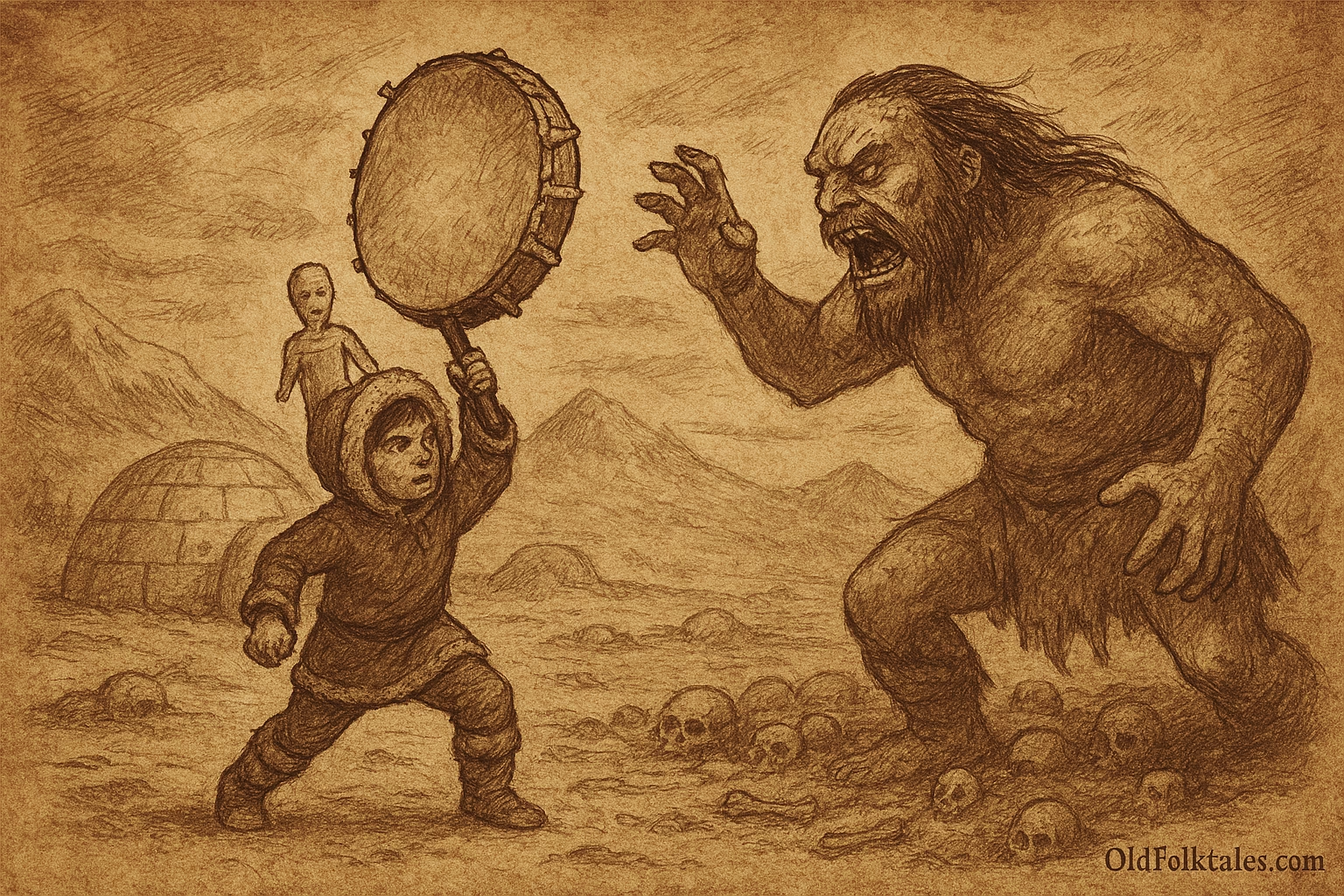
When he finally stopped to catch his breath, an idea sparked in his clever mind. He gathered strips of birchbark and carefully fashioned them into the image of a man a decoy figure with a distinct head and torso. He fastened this creation to the top of his parka hood, where it stood up high and white, visible from a distance. Satisfied with his handiwork, he continued on his journey with renewed confidence.
The boy walked for many hours across the frozen landscape, following tracks and intuition. Eventually, he saw something that made his blood run cold: an enormous house, larger than any dwelling he had ever seen. And standing before it like a mountain of flesh and bone was a giant a creature of nightmares, impossibly tall, with eyes that glittered with cruelty and hunger.
Beside the giant hung the strangest drum the boy had ever witnessed. It was a massive box, covered on both ends with stretched seal intestine that gleamed in the pale Arctic light. All around its edges were sharp bones edges honed like knife blades, capable of cutting through flesh and bone. The boy knew ceremonial drums from his village, but this instrument of death was something entirely different.
The ground surrounding the giant was a horror beyond words: skulls and bones scattered everywhere, the remains of countless men who had fallen victim to this monster’s appetite. The boy’s instinct screamed at him to flee, to run back to his parents and forget this foolish quest.
But it was too late. The giant had spotted him.
“DANCE!” the giant’s voice boomed across the ice like thunder, shaking the very ground beneath the boy’s feet.
Trembling, the boy began to dance. He moved his feet in the traditional patterns his people had taught him, though terror made his movements stiff and awkward. The giant raised a massive hand and began beating the drum, creating a rhythm that echoed across the frozen wasteland. As he drummed, he sang a long, terrible song filled with dark magic and ancient malice.
When the giant reached the end of his song, he let out a mighty shout that split the air. With supernatural strength, he hurled the massive drum directly at the boy’s head. The drum whirled through the air like a deadly disc, its bone edges glinting, ready to slice clean through anything in its path.
The drum struck the arm of the birchbark figure atop the boy’s hood, severing it completely. The giant roared in frustration, thinking he had merely wounded his prey.
Now it was the boy’s turn. With shaking hands, he caught the drum and began to sing the giant’s own song back to him, mimicking the words and melody perfectly. When he finished, he threw the drum with all his might. It sailed through the air and struck the giant, slicing off one enormous arm. Dark blood stained the snow.
Back and forth they threw the deadly drum. The birchbark image lost another piece, a leg this time. The giant lost his other arm. The terrible game continued, each throw more desperate than the last. The birchbark figure was gradually destroyed, piece by piece, until nothing remained on the boy’s hood.
But the giant fared far worse. With one final, perfect throw, the boy sent the drum spinning through the air. It struck the giant’s massive neck, and with a gurgling roar, the creature toppled backward and crashed to the ground like a falling mountain. The earth shook from the impact. The giant lay still, his reign of terror finally ended.
The boy stood frozen, scarcely able to believe what he had done. He, the youngest and smallest, had killed a giant that had devoured countless warriors. He waited at a safe distance, watching for any sign of movement. When he was certain the giant was truly dead, he gathered his courage and approached the enormous house.
Inside, he heard something unexpected: the sound of weeping. The cries seemed to come from beneath the floor itself. Following the sound, the boy discovered a deep pit hidden under wooden planks. There, huddled in the darkness, were his four brothers alive, but terrified and weak.
“Brother!” they cried when they saw him. “Thank the spirits you’ve come!”
They explained that the giant had captured them one by one as they passed by his house. He had thrown them into this pit, keeping them alive for a great feast planned for the very next day. If the youngest brother had arrived even two days later, he would have found nothing but their bones scattered among the others outside.
The brothers could hardly believe their small, young sibling had defeated the terrible giant. They praised his cleverness in creating the birchbark decoy, his courage in facing such a monster, and his quick thinking during the deadly drum dance. The boy helped them climb from the pit, and together they took the giant’s drum as proof of their victory.
The five brothers hurried home as fast as their legs would carry them, the youngest leading the way. When they finally reached their village and fell into their parents’ arms, there were tears of joy and relief. The mother and father wept to see all five sons alive and together again.
The family gathered around the fire that night, and the youngest son told the tale of his victory over the giant. The great drum stood in the corner of their home as a reminder of both the dangers that lurked in the world and the power of cleverness combined with courage.
After that adventure, all five brothers were content to remain in their village. They hunted walruses and whales alongside their father, fished through the ice, and told stories to the children who gathered around them. They had seen enough of the world beyond their home and learned that sometimes the greatest adventures are the ones that bring you back to those you love.
Click to read all Myths & Legends – timeless stories of creation, fate, and the divine across every culture and continent
The Moral of the Story
This powerful Inuit legend teaches us that true strength comes not from size or physical power, but from cleverness, preparation, and courage in the face of overwhelming odds. The youngest brother succeeded where his older siblings failed because he used his intelligence to create the birchbark decoy, turning the giant’s own weapon and methods against him. The story reminds us that underestimating someone based on their age or size can be a fatal mistake, and that ingenuity can triumph over brute force. Additionally, the tale warns against reckless adventure-seeking and emphasizes the importance of family the youngest brother’s quest was not for glory, but to save his brothers and reunite his family. Sometimes, the bravest act is not seeking adventure but facing danger to protect those we love.
Knowledge Check
Q1: Who is the main hero in The Giant’s Drum Native American legend?
A1: The hero is the youngest of five brothers, a boy who was considered too young and small to venture out alone. Despite his youth, he uses cleverness and courage to defeat a man-eating giant and rescue his four older brothers who had been captured and imprisoned in a pit beneath the giant’s house.
Q2: What is the significance of the birchbark figure in the Inuit giant story?
A2: The birchbark figure represents cleverness and strategic thinking. The boy created this decoy and attached it to his parka hood to trick the giant into aiming at the false target instead of his real head. Each time the giant threw the deadly drum, it struck the birchbark image instead of the boy, ultimately saving his life while allowing him to fight back.
Q3: What does the giant’s drum symbolize in Alaska Native mythology?
A3: The giant’s drum symbolizes both death and ceremony twisted into a weapon. While traditional Inuit drums are used for sacred ceremonial dances and community gatherings, the giant’s drum with its bone-knife edges represents the perversion of cultural traditions for evil purposes. It becomes an instrument of murder rather than celebration, making the boy’s victory even more significant as he reclaims this cultural symbol.
Q4: What moral lessons does The Giant’s Drum teach?
A4: The legend teaches multiple lessons: intelligence and preparation can overcome brute strength; never underestimate someone based on age or size; reckless adventure-seeking can lead to danger; family bonds are worth risking everything to protect; and courage combined with cleverness is more powerful than physical might alone.
Q5: Where does The Giant’s Drum folktale originate?
A5: The Giant’s Drum is an authentic Inuit (also called Eskimo in historical texts) folktale originating from Alaska. It was passed down through oral tradition among the indigenous peoples of the Arctic regions and reflects the values, fears, and cultural practices of the Inuit communities who lived in harsh, dangerous environments.
Q6: Why did all five brothers want to leave their village in the legend?
A6: The brothers were driven by youthful restlessness and curiosity about the world beyond their village. The oldest wanted to see new places and meet different people, and each brother after him followed out of loyalty, adventure-seeking, and the desire not to be left behind. The youngest was motivated by both adventure and the need to find and protect his missing brothers.
Source: Adapted from Animal Stories from Eskimo Land by Renee Coudert Riggs (Frederick A. Stokes Company, 1923), retold by S.E. Schlosser.
Cultural Origin: Inuit people of Alaska, United States (Arctic region)