
In the age when Christendom’s kingdoms were young and their borders shaped by sword and miracle alike, a prophecy traveled across the windswept cliffs of Gaul: “From the sea shall rise a child of perfect heart, whose courage will calm tempests and whose love will outshine the iron of war.” And so it was that Amadís, born of a secret union between King Perion of Gaul and Princess Elisena of Britain, was cast upon the waters in a casket of carved cedar, entrusted to Providence.
The waves bore him not to ruin, but to sanctuary. A knight named Gandales discovered the infant, shimmering with a faint radiance, an omen the ancients knew well: a child favored by divine watchers. Raised far from courts and crowns, Amadís learned humility before he learned mastery, compassion before the strike of the blade. Yet all who met him sensed the fire within him, a fire without smoke or arrogance, a flame of purity that caused men to straighten their spines and women to whisper of old prophecies stirring anew.
When he came of age, Amadís entered the world of knights, where honor was fragile and steel spoke loudly. His strength grew prodigious, no mortal seemed to match him in contest, but greater still was the clarity of his spirit. He fought not for glory, nor gold, nor favor, but to protect the innocent and mend the wounds left by ambition’s cruelty. In those days of youthful victory, he met Oriana, daughter of the King of Britain, whose beauty was matched only by the quickness of her mind. Their bond was immediate, elemental, as though formed before their births.
But destiny never allows peace without price.
When the sorceress-queen Urganda the Unknown appeared before Amadís in a whirl of smoke-laced starlight, she warned him that divine favor is both blessing and trial: “To shine is to be tested. All purity must prove itself in darkness.” And darkness came swiftly.
A giant named Famongomadan, feared from Iberia to the Pillars of Hercules, laid siege upon the coasts. His fist shattered fortresses; his roar drowned prayers. Amadís rode to meet him on a moonless night. The duel was thunderous, steel sparking like meteors, earth trembling beneath the titan’s tread. Though Amadís triumphed, the cost was grave: he saw men slain who had trusted him, lifeless on the battlefield. Victory tasted bitter.
This was the first crack in his spirit. For the first time, doubt entered the pure knight’s heart.
The wound deepened when false rumors of betrayal reached Oriana, seeded by courtiers who envied the knight’s virtues and feared his growing legend. Believing Amadís unfaithful, she banished him from her presence. The words struck him harder than any blow dealt in war. Stripped of love’s light, Amadís wandered into the Peña Pobre, a hermitage on a barren cliff, where he lived as a shadow, neither knight nor lover, only a man wrestling with the chasm inside him.
There, alone with wind and stone, he faced his greatest enemy: himself.
He saw how pride had wrapped itself in purity, how devotion to Oriana had turned to silent worship, and how even good men bend beneath the weight of perfection. He wept not for lost honor, but for the humanity he had tried to transcend. In that cold solitude, Amadís finally understood: true purity is not flawlessness, it is the courage to rise again after being shattered.
His revelation reached heaven. A divine sign split the sky: a column of silver light upon the sea, the same sea that once carried him as an infant. Amadís emerged renewed, no longer the untouched knight of prophecy, but a tempered soul, stronger for his suffering.
When he returned to the world, war had erupted between Britain and Gaul, and Oriana was trapped within the besieged Island of the Boiling Lake, its waters cursed by sorcery. Amadís, now at the height of his destiny, rallied knights, soothed rival kings, and rode across waters that hissed with demonic steam. His sword became like a beam of dawn, cleaving through enchantments and despair.
At the island’s heart, he found Oriana. No words were needed, his long suffering had answered her doubts. Together they stood as prophecy foretold: love restored, virtues balanced, destiny fulfilled.
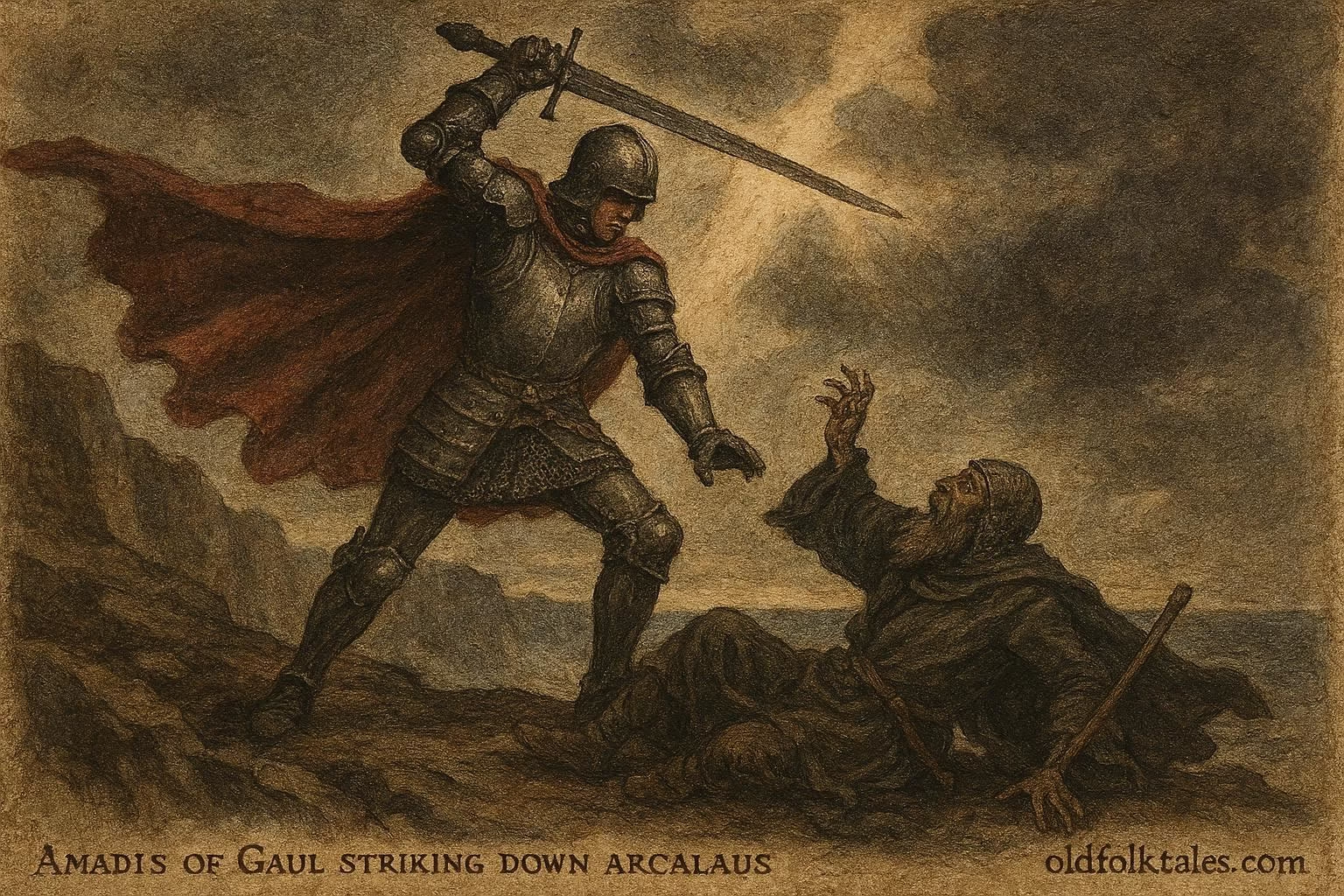
In the final battle, Amadís faced Arcalaus the Enchanter, master of illusions and corrupter of noble hearts. Their clash was a war between truth and deceit. Amadís struck him down not with brute force but with an unshakeable spirit forged through trial.
Peace followed. Kingdoms reconciled under the banner of his chivalry, and from his union with Oriana came a lineage of heroes and queens whose names embroidered the future of Iberia.
The Pure Knight did not fade into myth, he ascended into it, carried by song and story, his symbol a sword reflected in still water: power held in purity, strength refined through sorrow.
AUTHOR’S NOTE
Amadís of Gaul shaped the very idea of the perfect knight, virtuous, unwavering, yet profoundly human beneath divine expectation. His tale transformed Iberian romance, influencing European chivalric literature for centuries and inspiring even Cervantes’ satirical homage. His legacy endures as a reminder that true nobility lies not in perfection, but in resilience.
KNOWLEDGE CHECK (6 Questions)
-
What prophecy foretold Amadís’s destiny?
-
Who raised Amadís after he was cast into the sea?
-
What was the core cause of Amadís’s spiritual crisis?
-
How did Amadís regain his sense of purpose in the Peña Pobre?
-
What island did he rescue Oriana from?
-
What symbolic meaning does Amadís’s purified sword represent?
CULTURAL ORIGIN: Iberian Peninsula (Spain and Portugal), Medieval Romance Tradition.
SOURCE: Garci Rodríguez de Montalvo, Amadís de Gaula (1508).









