The old stories of the Visayas say that shadows have memories of their own. They record what people do, what they say, and even the emotions they hide behind closed doors. Most of the time, these shadows cling quietly to their owners, following them from sunrise to sunset without complaint. But in certain homes where jealousy lingers, where bitterness simmers beneath polite greetings, and where arguments grow louder than prayers, the shadows become heavy and restless. It is said that in these places the Sigbin begins to stir.
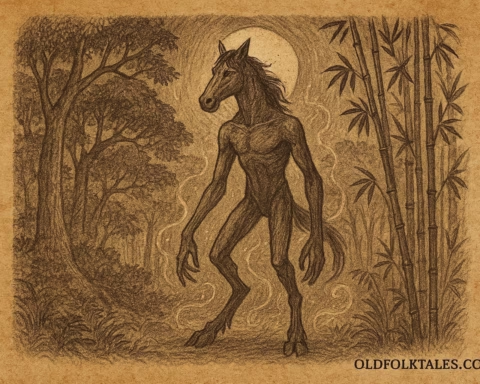
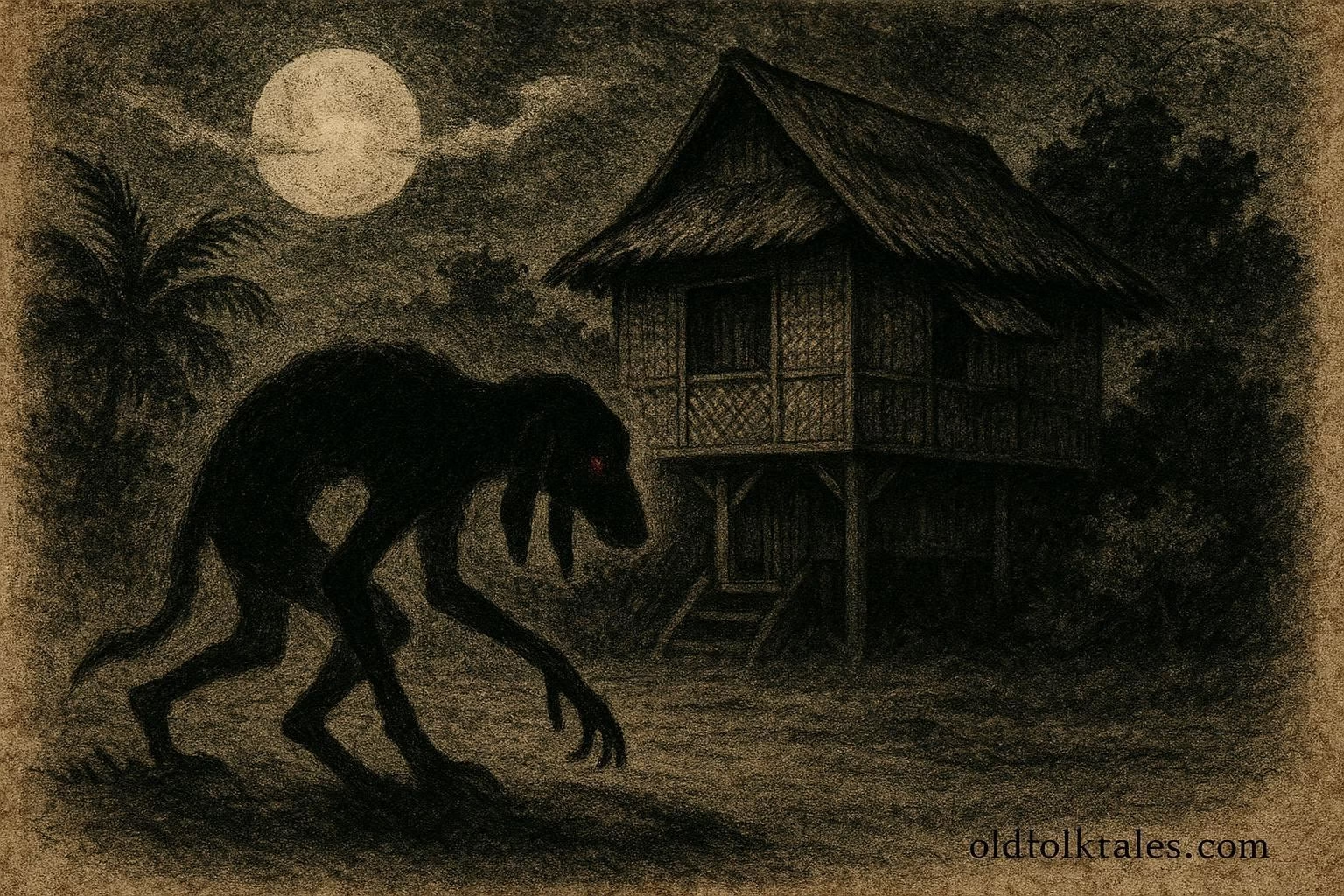
The Sigbin is unlike any creature that roams the forests or swims the rivers. It is a spirit animal, a familiar of emotional turmoil, shaped by the energy that families release when they allow discord to rule their days. Descriptions of the Sigbin vary, yet all agree that it walks backward on long limbs bent like branches, its head hanging low as if listening to the ground. Its ears droop like wilted leaves, and its body flickers between substance and shadow. Most unsettling of all is its hunger. The Sigbin does not devour flesh. Instead, it feeds on the shadows of those who quarrel, slowly draining their strength, joy, and clarity until the home falls into deeper disarray.
Long ago in a Visayan village by the river, a family lived in constant conflict. The father blamed the mother for every misfortune, the children quarreled over the smallest items, and the house was filled with sharp words instead of laughter. Their neighbors avoided the home, sensing an unseen heaviness that clung to the walls like thick smoke. But one elderly healer, known as Lola Amparo, understood what was happening.
Discover the gods, goddesses, and divine spirits who ruled the heavens and shaped human fate
One night, as the moon rose pale and thin, she approached the house and saw a dark shape crouched on the thatched roof. It moved backward in slow, deliberate steps, its limbs bent at unnatural angles. When it paused, it lifted its head and revealed a pair of red eyes glowing faintly like embers hidden in ashes. Lola Amparo knew at once that the Sigbin had found its feast.
Inside the house, the family felt its presence without seeing it. The father grew tired even after resting all day. The mother felt a coldness follow her from room to room. The children had strange dreams in which something sniffed at their shadows, snatching pieces of them before disappearing into the corners of the house. Confusion, fear, and frustration wrapped around them like vines, tightening a little more with every argument they had.
Determined to help them, Lola Amparo gathered the family and brought them to sit outside under the moonlight. She lit a small clay bowl filled with herbs that produced a fragrant, purifying smoke. Then she began to speak, not to the Sigbin, but to the people.
She asked the father why he clung to anger. She asked the mother why she kept her worry hidden until it turned into bitterness. She asked the children why they allowed envy to split the bond they were meant to protect. At first they resisted, offering excuses and pointing fingers. But as the smoke rose around them, they felt their shadows lighten and their voices soften.
The Sigbin watched from the rooftop, shifting uneasily. Its meal was slipping away.
Lola Amparo warned the family that the Sigbin could not be chased by force. It fed on what they offered. If they nourished peace, it would starve and move on. If they returned to anger, it would grow stronger and take more of their shadows. The choice was theirs.
For the first time in many months, the family listened to one another. Apologies were offered. Tears flowed like the first rain after drought. Their shadows, which had stretched long and heavy across the ground, slowly drew back to normal size, becoming lighter and clearer.
The Sigbin gave one final backward leap, disappearing into the trees that lined the river. Without discord to feed on, it had no reason to stay.
In the days that followed, the family worked to rebuild their harmony. They spoke gently, shared their burdens, and learned to correct their mistakes without cruelty. Their home gradually brightened, and visitors once again felt welcome. Though the Sigbin was gone, the memory of its presence remained a reminder of what grows in places where grudge and spite are allowed to settle.
To this day, the people of the Visayas say that the Sigbin still roams, slipping in and out of homes where conflict has taken root. Sometimes it is only a whisper in a hallway or a darting shadow along the wall. Other times it is felt in the weight of unexplained sadness, the exhaustion that follows constant arguing, or the sense that something unseen is listening in the silence of night. It is not a mindless monster. It is a reflection, a physical echo of human emotion.
Those who respect their loved ones, who speak with kindness and resolve their quarrels, will never see it. But those who sow discord should remember the backward walking creature that feeds not on bodies, but on the shadows of the restless heart.
Explore the shadows of world mythology, where demons test the soul and spirits watch over mankind
Author’s Note
The Sigbin’s legend speaks to the emotional and spiritual health of the home. Whether taken literally or symbolically, it reminds us that destructive emotions create environments where harm thrives. Harmony is a form of protection, and every act of humility strengthens the spirit of the household.
Knowledge Check
1. What does the Sigbin feed on?
It feeds on the shadows of those who live in discord.
2. Why did the Sigbin appear at the family’s home?
Because constant arguments and emotional turmoil attracted it.
3. What physical traits distinguish the Sigbin?
It walks backward, has drooping ears, bent limbs, and a shadowy body.
4. How did Lola Amparo weaken the Sigbin’s influence?
By helping the family heal their emotional conflicts.
5. Why can the Sigbin not be chased away by force?
Because it feeds on emotions, not physical presence.
6. What message does the Sigbin’s tale teach?
Harmony protects a home, while discord invites spiritual danger.