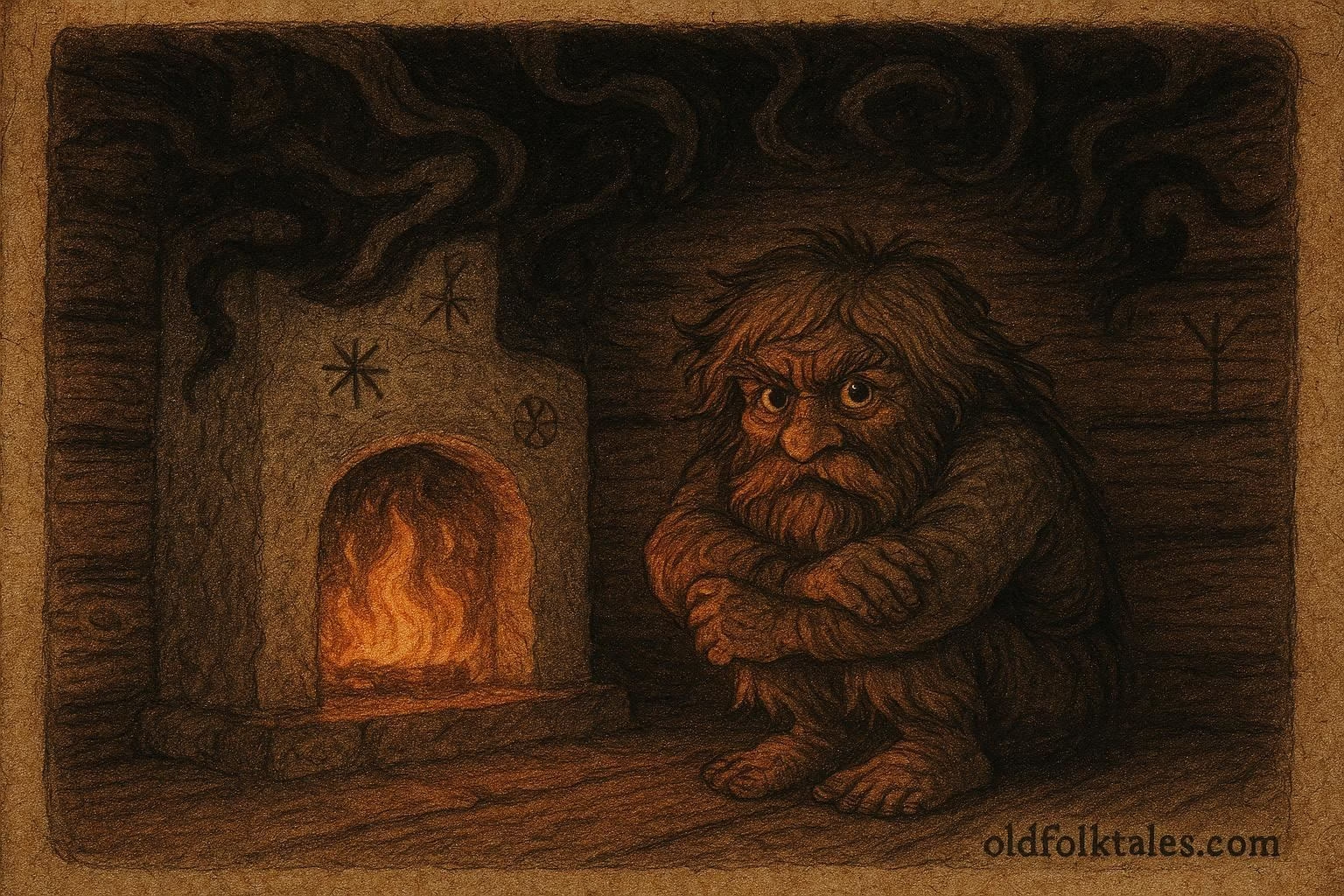
The Domovoi is one of the most enduring spirits in the Slavic world, an intimate guardian of the hearth who lives inside the home, watches the family, and silently shapes their fortunes. He is not a grand deity of storms or mountains; he is a spirit of the quiet places: the stove corner, the empty threshing floor, the attic shadows, the stable at night. His presence is felt in creaking boards, soft footsteps, or the tug of a blanket. In rural villages from Russia to Belarus and across Poland and Ukraine, ethnographers recorded that the Domovoi was “the soul of the house,” the invisible member of the family who could defend or destroy depending on how he was treated.
Appearance
Descriptions vary, but the Domovoi is often imagined as:
- a small, bearded old man covered in soft gray or brown hair
- about the height of a toddler, with bright eyes that glow like embers
- sometimes with an elongated face resembling a household ancestor
- capable of appearing as an animal (cat, mouse, dog)
- or, in rare tales, as the head of the male ancestor who founded the household line
Explore the shadows of world mythology, where demons test the soul and spirits watch over mankind
Kolberg noted parallels in Polish tradition: the domowik might appear as a hairy dwarf; Afanasyev’s Russian sources add that he often imitates the master of the house.
Yet despite these forms, he is most often invisible. His presence is known through small domestic signs: moved items, gentle touches at night, or a sudden warmth near the stove.
Behavior and Powers
The Domovoi’s power lies in domestic influence rather than elemental might. He is attentive, territorial, easily offended, but deeply loyal when respected. His main abilities include:
- Protection of the household:
He guards the home from thieves, witches, malevolent spirits, and even illnesses. If the family is in danger, the Domovoi may shout, knock loudly, or shake someone awake. - Household guidance and omens:
He blesses work by helping sweep floors, tending livestock, or calming restless horses, as many Russian peasants believed. But his displeasure appears in frightening ways: groaning walls, cold drafts, or a slap in the night. - Punishment of neglect:
If the household is dirty, quarrelsome, or disrespectful, he may pinch sleepers, tangle hair, spoil milk, hide tools, or make loud noises at night. - Shape-shifting:
The Domovoi can appear as a shadow, a pet, a relative, or a small old man. In some traditions, he takes the form of a mouse to explore the house unseen. - Control of livestock:
In agrarian households, the Domovoi tended animals. A horse whose mane was braided overnight was believed to have been ridden or favored by the house spirit; a horse that kicked or panicked was seen as rejecting him. - Warning dreams:
The Domovoi sometimes warns family members of misfortune by appearing in their dreams, either weeping (bad omen) or smiling (good fortune).
Myths, Beliefs, and Rituals
The Domovoi tradition permeates daily life and seasonal rituals.
- The First Night Ritual
When moving to a new house, families called the Domovoi with bread, salt, and the words:
“Grandfather, come with us.”
The belief was that the Domovoi must be invited or he might cling to the old structure, or worse, remain as a hostile spirit toward newcomers. - The Hearth as Sacred Space
The hearth was not merely a place to cook; it was the Domovoi’s seat. Ashes were never carelessly scattered, and fire was tended respectfully. Throwing sharp objects into the fire was considered an insult. - Nightly Offerings
Bread, porridge, or milk were left in small bowls near the stove. Livestock owners offered warm milk in the stable so the Domovoi would care for the herd. - Oath and Family Integrity
A common belief across Slavic cultures: the Domovoi hated family arguments. Domestic harmony strengthened him; bitterness weakened him. Quarreling families reported frightening manifestations, knocking, door slams, or sudden cold. - Death and Ancestral Connections
Some sources describe the Domovoi as an ancestral spirit, the first master of the house, continuing to watch over his descendants. This interpretation explains why he imitates the appearance of the male head of household and fiercely defends the family bloodline. - The Domovoi’s Departure or Wrath
If a family behaved wickedly, the Domovoi might leave. A house without a Domovoi was considered vulnerable to misfortune. In extreme cases, desecrating the hearth, cruelty to animals, or spilling blood inside the home, the Domovoi might transform into a destructive entity who tormented the inhabitants until rituals of appeasement restored order.
Symbolism
The Domovoi symbolizes:
- the sanctity of the home
- the moral weight of domestic behavior
- the invisible bonds between ancestors and living kin
- the principle that prosperity comes from harmony
- the moral responsibility of the household head
He is the embodiment of home as living spirit, a belief that the domestic sphere is sacred and must be treated with respect, cleanliness, and emotional balance.
Cultural Role
To Slavic peoples, the Domovoi was not a monster but a mediator between worlds: spiritual, ancestral, and domestic. His presence explained mysterious household events, but more importantly, he functioned as a moral compass. A happy home nourished him; a troubled one provoked his wrath.
In epic folklore, he rarely appears as a central figure; instead, he is woven into daily life. Ethnographers noted that even Christianized villagers spoke of him with affectionate caution, an example of old pagan belief blending seamlessly into rural Christianity.
Domovoi belief also reinforced social values: work hard, keep harmony, honor ancestors, tend animals, and maintain a clean household. In this way, the Domovoi acted as a guardian of tradition and community ethics.
Encounter dragons, spirits, and beasts that roamed the myths of every civilization
Author’s Note
The Domovoi fascinates me because he reveals how deeply spiritual the “ordinary” home once was. In Slavic tradition, the house was a cosmic space: the threshold, the stove, even the attic had meaning. The Domovoi personifies that worldview. He teaches that a home is not only shelter, but a living relationship requiring care, respect, and emotional balance. Whether viewed as a spirit or as a symbol, he remains one of folklore’s richest embodiments of domestic holiness.
Knowledge Check (Q&A)
- Q: What is the Domovoi’s primary domain?
A: The home, especially the hearth and domestic spaces. - Q: How does the Domovoi commonly appear?
A: As a small bearded man, an animal, or a shadowy figure. - Q: What behavior angers the Domovoi most?
A: Household conflict, neglect, dirtiness, or disrespect. - Q: Why are horses associated with him?
A: He cares for livestock and may braid horses’ manes or tame them at night. - Q: What offering was traditionally given to him?
A: Bread, milk, or porridge near the stove or in the stable. - Q: What symbolic role does he represent?
A: Domestic harmony and ancestral guardianship.
Source: 19th-century Slavic ethnographies, oral tradition; Afanasyev’s Narodnye russkie skazki; Oskar Kolberg’s Lud (Poland/Ukraine)
Origin: Russia, Ukraine, Belarus, Poland; Slavic household religion (pre-Christian roots with centuries of continuity)