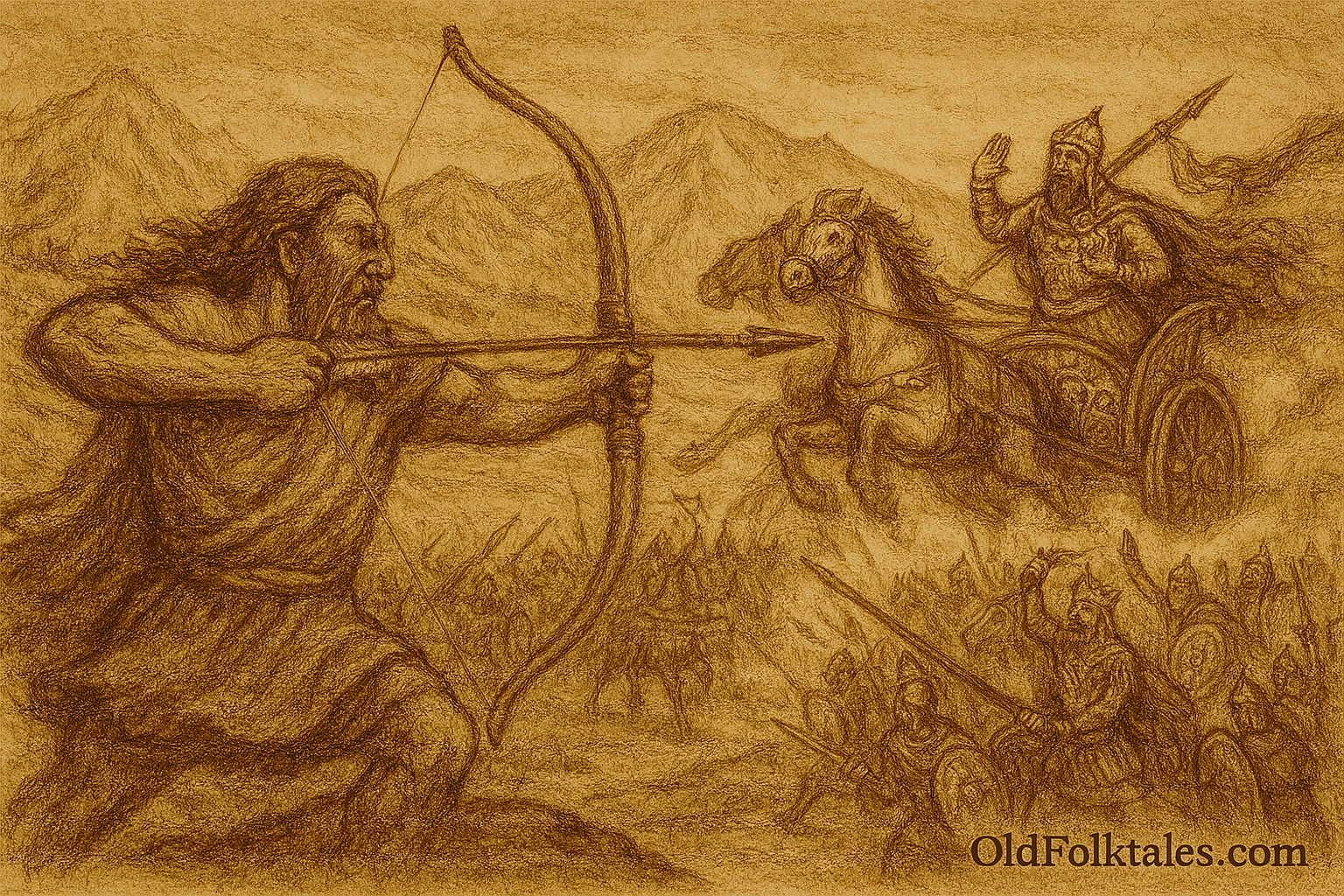
In the ancient days when gods still walked among mortals and mighty empires cast long shadows across the earth, there lived a man named Hayk in the northern lands where mountains touched the sky. He was no ordinary man, tall as a cedar tree, strong as a bear, and blessed with the keen eyes of an eagle. Hayk was the patriarch of his people, a descendant of the great Noah himself, and he led his clan with wisdom and courage through the rugged highlands that would one day bear his name.
To the south, in the scorching plains of Babylon, there ruled a tyrant named Bel. Some called him Nimrod, the mighty hunter, others knew him as a god-king who demanded worship from all nations. His empire stretched across vast territories, and his appetite for power knew no bounds. Bel’s palace towers pierced the heavens, and his armies were countless as locusts, sweeping across lands and subjugating every tribe and kingdom in their path.
Click to read all Myths & Legends – timeless stories of creation, fate, and the divine across every culture and continent
Hayk’s people had once lived peacefully in Babylon, working the fertile soil and raising their families. But as Bel’s tyranny grew more oppressive, as his demands for absolute loyalty became unbearable, Hayk made a fateful decision. He gathered his extended family, sons and daughters, grandchildren, cousins, and loyal kinsmen and led them northward, away from Bel’s suffocating rule, toward the free mountain lands where the air was clean and no man bowed to a tyrant.
They settled in a fertile valley surrounded by snow-capped peaks, where crystal rivers ran swift and cold, and forests of oak and pine climbed the mountainsides. Here, Hayk’s people built their homes, planted their crops, and lived according to their own laws. They worshipped their own gods, kept their own traditions, and answered to no emperor. For the first time in generations, they breathed the air of freedom.
But Bel could not tolerate defiance. His pride, vast as his empire, was wounded by Hayk’s departure. How dare this northern chieftain reject his authority? How dare he lead people away from Bel’s dominion? Messengers arrived at Hayk’s settlement, bearing scrolls sealed with the royal mark of Babylon.
“The great Bel commands your return,” the messengers proclaimed. “He demands that you and your people swear loyalty to him, acknowledge him as your sovereign lord, and return to his service. Refuse, and his wrath will be terrible.”
Hayk stood before the messengers, his powerful frame casting a long shadow in the morning sun. His voice, when he spoke, was like thunder rolling through mountain valleys. “Tell your master this: No Armenian will ever bow to oppression. We were not born to be slaves to any man, no matter how mighty he claims to be. We have chosen freedom, and we will defend it with our lives. Let Bel come if he dares, he will find us ready.”
The messengers departed, carrying Hayk’s defiant words back to Babylon. When Bel heard the response, his face darkened with rage. He immediately summoned his generals and ordered the mobilization of his greatest army. Thousands upon thousands of soldiers assembled spearmen with bronze-tipped weapons, archers with quivers full of arrows, charioteers with horses bred for war, and mighty warriors from every conquered nation. This vast force marched northward like a dark storm cloud, determined to crush the rebellious patriarch and his people.
Word of the approaching army reached Hayk’s settlement. He called together his clan the hunters who knew every mountain pass, the archers who could shoot a sparrow from the sky, the shepherds whose arms were strong from wrestling wolves, and the farmers who had learned to fight to protect their families. These were not professional soldiers, but free men and women defending their homes and their right to live without chains.
Hayk addressed his people with words that stirred their hearts. “We face a great trial. Bel comes with an army vast as the sands of the desert. But remember we fight not for conquest or glory, but for something far more precious. We fight for our freedom, for our children’s future, for the right to live as we choose. Every mountain in this land stands with us. Every river flow for our cause. And I promise you this: while I draw breath, no tyrant will rule over us.”
The two armies met in the valley of Hayots Dzor, a wide plain flanked by towering mountains. Bel’s forces spread across the valley floor like a dark sea, their weapons glinting in the sun, their war drums beating a rhythm of doom. At their head rode Bel himself, armored in gold and bronze, seated in a magnificent chariot, every inch the god-king he claimed to be.
Hayk’s forces, though far smaller, stood firm on the high ground. The patriarch himself stood at the very front, visible to all a mountain of a man who refused to hide behind his warriors. In his hands he carried his legendary weapon: a massive longbow, crafted from the wood of a sacred tree, strung with sinew and blessed by ancient prayers. No ordinary man could even draw such a bow, but in Hayk’s powerful hands, it seemed as natural as breathing.
Bel surveyed the opposition and laughed, his voice carrying across the valley. “Hayk! You old fool! Look at my army they are numberless! Surrender now, and I will show mercy. Resist, and I will destroy everything you love!”
Hayk’s response was not words, but action. He reached into his quiver and withdrew a single arrow longer and heavier than any normal shaft, fletched with eagle feathers, tipped with iron harder than any metal known to man. This was no ordinary arrow; it was forged with purpose, blessed with prayers, and destined for a singular target.
The patriarch fitted the arrow to his bowstring. Every eye on the battlefield watched as he drew back the massive bow, his muscles straining, the wood creaking with tension. For a moment, time seemed to stop. The wind held its breath. The mountains themselves leaned forward to witness what would come next.
Then Hayk released.
The arrow flew like a bolt of lightning splitting the sky. It crossed the distance between the armies in a heartbeat, trailing a sound like thunder. Bel, still laughing in his chariot, never saw it coming. The arrow struck him square in the chest with such force that it lifted him from his chariot and pinned him to the ground, killing the tyrant instantly.
Silence fell across the battlefield. The god-king who had claimed immortality lay dead, defeated by a single arrow from a man who refused to submit. Bel’s vast army, seeing their leader slain, their supposed god proven mortal, broke and fled in panic. They scattered like leaves before a storm, running south toward Babylon, abandoning their weapons, their pride, and their dreams of conquest.
Hayk’s people erupted in celebration. They had defended their freedom against impossible odds. They had proven that courage and righteousness could triumph over tyranny and overwhelming force. From that day forward, the people called themselves “Hay” in honor of their patriarch, and their land became known as “Hayastan” the land of Hayk, the land of the free.
The valley where the battle took place became sacred ground, remembered in songs and stories passed down through countless generations. And Hayk himself became more than a man he became the symbol of Armenian identity, the eternal reminder that freedom is worth any price, and that no people should ever bow to oppression.
The Moral Lesson
The legend of Hayk teaches that freedom and dignity are worth defending at any cost, even against overwhelming odds. It shows that courage, conviction, and refusal to submit to tyranny can overcome even the mightiest oppressor. The story emphasizes that true strength lies not in vast armies or claims of divinity, but in the unwavering spirit of people who choose liberty over submission. Hayk’s victory represents the birth of national identity through the defense of fundamental values a lesson that resonates across cultures and centuries about the power of standing firm for what is right.
Knowledge Check
Q1: Who was Hayk in Armenian mythology and why is he important?
A: Hayk was the legendary patriarch and founding father of the Armenian nation in Armenian mythology. He was a descendant of Noah who led his people away from Babylonian tyranny to establish an independent homeland in the northern mountains. Armenians still call themselves “Hay” and their country “Hayastan” in his honor, making him the symbol of Armenian national identity and independence.
Q2: Why did Hayk refuse to submit to Bel in the Armenian legend?
A: Hayk refused to submit to Bel (also called Nimrod) because he rejected tyranny and oppression. When Bel demanded absolute loyalty and worship from all nations, Hayk chose freedom over submission, leading his people northward to establish an independent homeland where they could live according to their own laws and traditions without bowing to any tyrant.
Q3: What was the significance of Hayk’s legendary longbow in Armenian mythology?
A: Hayk’s legendary longbow symbolized divine power, exceptional strength, and righteous purpose in Armenian mythology. The bow was so massive that only Hayk could draw it, and it was blessed with sacred power. The single arrow he shot from this bow killed the tyrant Bel instantly, representing how focused determination and moral righteousness can defeat even the mightiest evil.
Q4: Where did the battle between Hayk and Bel take place in Armenian legend?
A: The battle between Hayk and Bel took place in the valley of Hayots Dzor in the Armenian highlands. This location became sacred ground in Armenian tradition, remembered in songs and stories as the birthplace of Armenian independence and the site where their founding father defended freedom against a vast Babylonian army.
Q5: What does Hayk’s victory over Bel symbolize in Armenian culture?
A: Hayk’s victory over Bel symbolizes the birth of the Armenian nation and its commitment to independence and freedom. It represents the triumph of courage over tyranny, righteousness over oppression, and the power of a free people defending their homeland. The story embodies core Armenian values of resistance to subjugation and the preservation of national identity and dignity.
Q6: How did the names “Hay” and “Hayastan” originate according to this legend?
A: According to Armenian legend, after Hayk’s victory over Bel, his people adopted the name “Hay” (pronounced “high”) to honor their patriarch and founding father. Their land became known as “Hayastan,” meaning “land of Hayk” or “land of the Hay people.” These names are still used today Armenians call themselves “Hay” and their country “Hayastan” in their own language.
Source: Adapted from Armenian mythology and historical legends
Cultural Origin: Armenian Highlands, South Caucasus Region of Western Asia