In the age before cities, before banners or temples or the singing of priests, the Mexica wandered the northern wilds without a homeland. They travelled beneath the open sky, carrying only memory, hunger, and faith. And from that vast horizon of dust and omen came the prophecy of their destined lord: Huitzilopochtli, the warrior-son born not from mortal womb but from the sacred heart of Coatlicue, Mother of Earth, Stars, and Serpent Skies.
Coatlicue had swept her shrine upon Coatepec Mountain when a ball of shimmering feathers descended like dawn itself. When she tucked the fallen blessing into her breast-cloth, she felt a fierce fire kindle within her. So was Huitzilopochtli conceived, a god born of divine sign, a flame given form. But his siblings, the jealous Centzon Huitznahua and the moon-goddess Coyolxauhqui, raged against this strange miracle and swore to destroy their unborn brother.
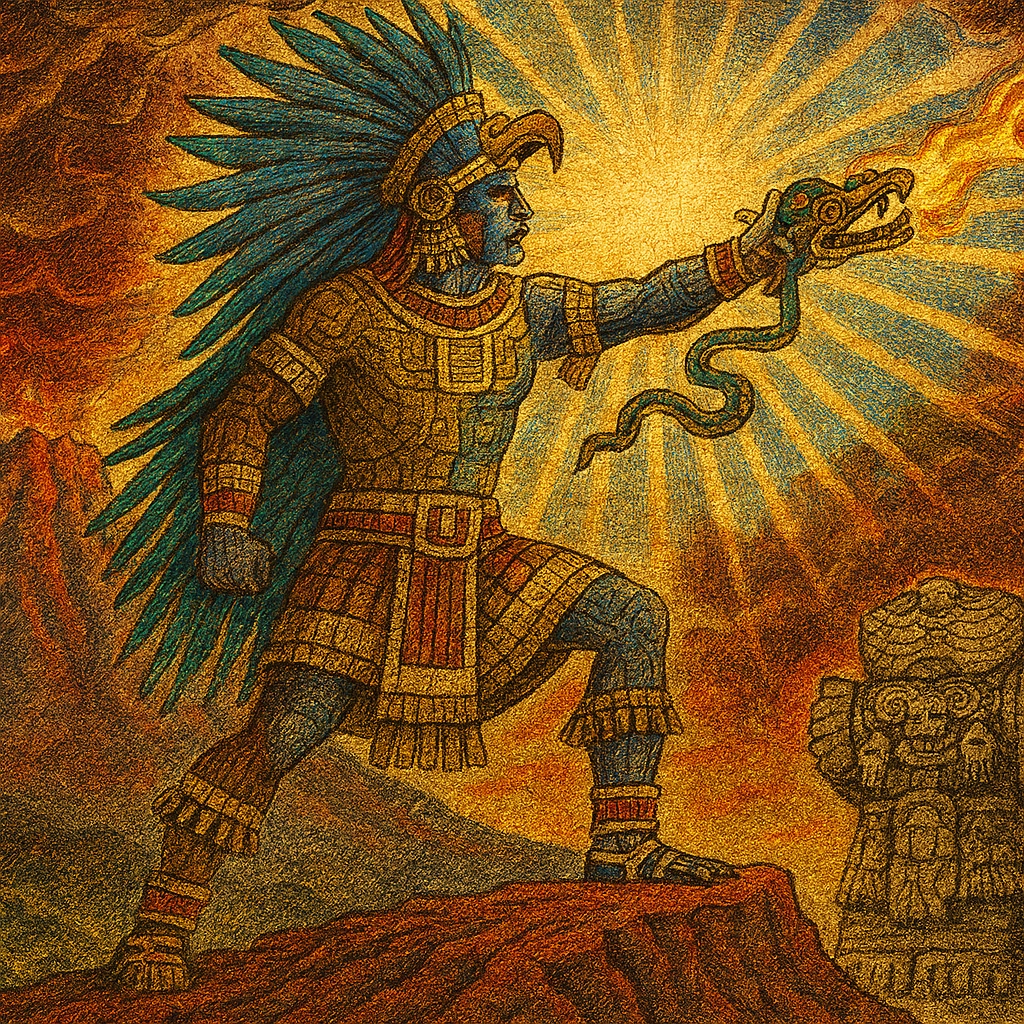
Before the first blade could pierce his mother, Huitzilopochtli burst forth in full armor, luminous as the rising sun. With the serpent-fire of his xiuhcoatl he scattered his foes, freeing Coatlicue and fulfilling the first of many destinies: to be the protector of his people. Yet even as victory echoed across Coatepec, his eyes turned southward, toward an unfinished command. The Mexica still wandered. Their home had not yet risen.
Thus began the long migration.
Huitzilopochtli descended as a presence, sometimes a voice in dreams, sometimes a hummingbird’s shadow, sometimes a blaze upon the horizon. He spoke to the chosen prophet-leaders, urging them to move ever onward:
“Seek the place where the eagle rises. There I will give you greatness.”
The Mexica obeyed, yet the path was neither straight nor gentle. They journeyed through valleys guarded by rival peoples, across deserts that left lips cracked and spirits sunken, beneath storms that battered them like obsidian hail. Some doubted the unseen god. Some longed for comfort more than destiny. Others challenged the priests, demanding signs more tangible than the beating of ritual drums.
In one harsh season, when famine thinned the children and even the warriors staggered, a splinter-group argued that the god had abandoned them. They whispered that the tribe should break apart and seek refuge in settlements where old enemies might show mercy. The leaders hesitated. Even the priests faltered.
That night, as the camp sat in fearful silence, a tremor ran through the earth. From a distant rise blazed a column of blue fire, brief yet unmistakable. The Mexica ran toward it, trembling. At the hilltop they found no ash, no charred stump, only a single hummingbird perched upon a cactus, glowing with an inward radiance.
The priests knelt in awe.
“He reminds us,” they declared.
And the Mexica rose renewed.
But still the trials grew darker. In the lakeside region of the Culhua, they were granted refuge and alliance. For a time it seemed peace might replace endless wandering. Yet the peace stained itself with conflict: a marriage alliance soured, a ritual misunderstood, a noble daughter sacrificed in Huitzilopochtli’s honor, a necessary offering to sustain the divine path, the priests insisted. Outrage erupted. The Mexica were driven out violently and hunted across the waters.
As they fled, many pleaded to abandon the harsh god whose commands seemed too costly. But Huitzilopochtli spoke again:
“Not one step backward. Forward is the only path to your name.”
Though tortured by fear and guilt, the Mexica obeyed. Their god’s demands weighed like stone, but they sensed in them a deeper purpose, a forging by fire, shaping a people who could survive what would come.
At last, after years that felt like centuries, they reached the marshy valley that would become the cradle of an empire. The lake shimmered beneath a setting sun, turning the reeds to gold. Exhausted, the Mexica prepared to move on once more, believing this was yet another stopping-place among hundreds.
Then a cry erupted from a scout.
On a small island of stone and water, upon a nopal cactus rooted in a fissure of rock, an eagle rose with wings spread wide, a serpent grasped in its talons, its feathers luminous with the brilliance of morning. Around it coiled the glow of divine presence.
The Mexica fell to their knees.
The hummingbird-shadow circled them, whispering on the wind:
“Here. Here I complete the promise. Build my temple. Build your city. From these waters I raise you to greatness.”
Tears fell upon the earth that would become Tenochtitlan. The priests buried offerings in the mud. The warriors plunged their spears into the soft ground as a vow. Every hardship, every exile, sacrifice, death, doubt, had been the steep road to this moment.
Under Huitzilopochtli’s guiding fire, the Mexica set their foundations. They raised temples from stone dragged across water, carved canals through reeds, built causeways like pathways of determination. From the dream of a god came the city that would reign over the Valley of Mexico, shining like a second sun.
And atop the highest temple, facing the cardinal points of creation, stood the image of Huitzilopochtli, the Prophet-King, war-born and destiny-bearing, the god who led a wandering people into the heart of their glory.
Author’s Note
The tale of Huitzilopochtli is both a mythic origin and a cultural compass. Through divine birth, fierce guardianship, and the long, punishing migration, he embodies the Mexica belief that greatness is earned through endurance, sacrifice, and unity of purpose. His legacy is not merely that of a war-god but of a guide, one who transforms suffering into strength and wandering into nationhood. To understand him is to understand the fire at the center of Mexica identity.
Knowledge Check
-
From whom was Huitzilopochtli divinely born?
-
What triggered the first battle of his existence?
-
How did Huitzilopochtli guide the Mexica during their migration?
-
What event caused the Mexica to be expelled from the Culhua region?
-
Which omen marked the place where they were to build Tenochtitlan?
-
What deeper symbolic meaning does the long migration represent?
Cultural Origin: Mexica/Aztec mythic cycles from central Mesoamerica, preserved in post-Conquest codical traditions.
Source: Historia de los Mexicanos por sus Pinturas (16th-century codical traditions).