
Centuries ago, long before the beautiful city of Klagenfurt rose with its elegant squares and church spires, the land of Carinthia lay wild and untamed. Where streets and buildings now stand, there stretched an endless expanse of marshland, a place where fog rolled thick as wool across stagnant waters and twisted trees rose from the muck like skeletal fingers reaching toward a gray sky. Reeds grew tall and dense, whispering secrets to one another in the wind, and the ground itself seemed alive, shifting and treacherous beneath any foot brave or foolish enough to tread upon it.
This was a place of shadows and silence, broken only by the lonely calls of waterbirds and the occasional splash of something unseen moving through the murky depths. Few dared to venture into this wilderness, and those who did often told stories that chilled the blood. The marshes, they said, were cursed. They were a realm where the natural world gave way to something older and far more terrible.
Travelers who attempted to cross the swamplands began to disappear. At first, it was only a few, lone wanderers or small groups of merchants hoping to find a shortcut through the wetlands. Their families waited in vain for their return, scanning the horizon each day with growing despair. Search parties ventured cautiously into the marshes, calling out names that echoed unanswered across the water. Sometimes they found abandoned wagons, their contents scattered and trampled. Sometimes they found nothing at all, as if the earth itself had simply swallowed the missing whole.
The few who managed to escape the marshes and return to civilization came back changed. Their faces were pale as death, their hands trembled when they tried to eat or drink, and their eyes held a haunted look that never quite faded. When pressed to tell what they had witnessed, they spoke in hushed, frightened voices. They described something enormous moving through the reeds, something that displaced water with the force of a landslide. They told of a creature with scales that gleamed like tarnished silver in the dim light, wings that stretched wider than the span of ten men standing fingertip to fingertip, and eyes that burned with an ancient, malevolent intelligence.
A Lindwurm, they called it. A dragon of terrible size and power that had made the swamps its domain. This was no mere beast driven by simple hunger. This was a monster from the depths of nightmare, a creature that seemed to take pleasure in the fear it inspired. It lurked in the deepest parts of the marsh, where the water ran black and the air hung thick with the smell of decay. From its hidden lair, it emerged to hunt, snatching travelers from the edges of solid ground and dragging them down into the dark waters where their screams were swallowed by the endless fog.
The people of the surrounding villages lived in terror. Farmers abandoned their fields near the marsh edges. Trade routes were diverted, adding weeks to journeys that had once taken only days. Parents forbade their children from wandering anywhere near the wetlands, and at night, families huddled in their homes, doors barred and windows shuttered, as if walls of wood and stone could protect them from a creature that commanded the very elements.
Years passed, and the Lindwurm’s reign of terror continued. The marshes expanded, fed by the creature’s dark presence, creeping closer to the villages with each passing season. It seemed that the dragon would rule forever, that the land would remain a place of death and despair for all time. But the human spirit, when pushed to its limits, often finds courage in the darkest hours.
A group of knights, men who had dedicated their lives to protecting the innocent and vanquishing evil, gathered to discuss the plague that had fallen upon Carinthia. These were warriors seasoned in battle, their armor bearing the scars of countless conflicts, their swords tested against both mortal foes and creatures of darkness. They had heard the stories, seen the devastation wrought by the Lindwurm, and witnessed the suffering of the people. They could stand idle no longer.
But these knights were not merely brave. They were also wise. They knew that charging blindly into the marsh to face the dragon in direct combat would mean certain death. The creature’s size and strength were too great, its lair too well protected by the treacherous terrain. They needed strategy, cunning, and a plan that would draw the beast out where they could face it on more favorable terms.
After much deliberation, they devised a scheme as bold as it was clever. They would use the dragon’s own nature against it. Like all predators, the Lindwurm was drawn by the scent of meat, by the promise of an easy meal. The knights procured the carcass of a massive bull, an animal of tremendous size that had been slaughtered for this very purpose. But this was no ordinary offering.
Working through the night by torchlight, the knights carefully prepared their trap. They stuffed the bull’s body with barbed hooks of iron, wickedly sharp implements that would lodge themselves in flesh and hold fast. They added materials that would cause great pain and confusion to any creature foolish enough to consume them. Some accounts speak of explosive powders, substances that would ignite and burn from within. The exact nature of their preparations was kept secret, knowledge passed only among those brave souls who would see the plan through to its end.
When dawn broke pale and cold over the marshlands, the knights carried their gruesome bait to a wooden platform they had constructed at the edge of the dragon’s territory. It was placed in a position carefully chosen to lure the beast out from the safety of the deep waters, yet give the knights room to maneuver and attack. The platform creaked under the weight of the bull, and the morning air soon carried the scent of fresh meat across the marsh.
Then they waited. Hidden among the reeds and behind natural cover, the knights stood ready, their weapons drawn, their hearts beating steady with the calm that comes to warriors before battle. They did not have to wait long.
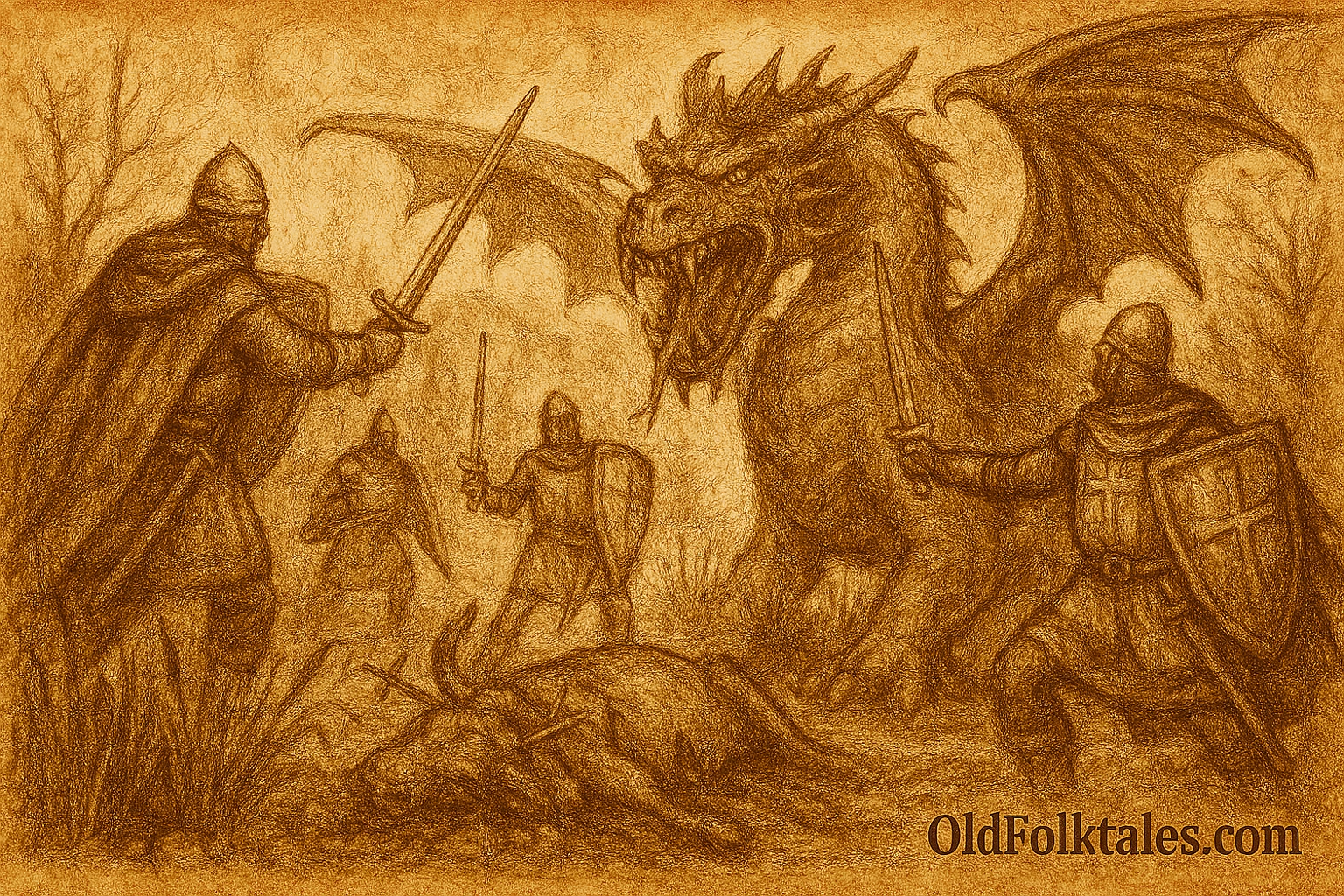
The water began to ripple, then to churn. A low rumbling sound rose from the depths of the marsh, a sound that seemed to come from the earth itself. Then the Lindwurm emerged. It rose from the black water like a nightmare given form, water cascading from its scaled hide in torrents. Its wings unfurled with a sound like thunder, sending up sprays of marsh water that caught the weak sunlight and fell like dark rain. The creature was even more massive than the stories had suggested, its body thick as an ancient oak, its claws long as swords, its jaws lined with teeth that could crush stone.
The dragon’s nostrils flared as it caught the scent of the dead bull. Its eyes, cold and reptilian, fixed upon the offering. Hunger and arrogance drove it forward. It had ruled these marshes for so long, had taken its prey so easily for so many years, that it had grown confident. It saw only food, not danger.
With a powerful leap that sent tremors through the ground, the Lindwurm landed upon the platform. The wood groaned but held. The dragon lowered its massive head and tore into the bull carcass with savage enthusiasm, its jaws working to rend the flesh.
And that was when the trap was sprung. The barbed hooks caught in the creature’s mouth and throat, lodging deep where they could not be dislodged. The dragon roared in pain and rage, a sound that echoed across the entire region, causing birds to flee from trees miles away. It thrashed and twisted, but the more it moved, the deeper the hooks bit into its flesh.
The knights seized their moment. With battle cries ringing across the marsh, they charged from their hiding places, surrounding the platform on all sides. They attacked with precision and fury, their swords and spears finding gaps in the dragon’s scales, their courage never wavering even when the beast’s tail swept toward them or its claws raked the air. It was a battle of desperation and determination, of mortal men against an immortal terror.
The fight was long and brutal. More than once it seemed the dragon might break free, might turn the tide and devour its attackers. But the knights fought as one, coordinating their strikes, protecting one another, pressing their advantage relentlessly. Slowly, inevitably, the Lindwurm weakened. Its roars became gasps, its movements grew sluggish, and finally, with one last shuddering breath, the great dragon fell.
Silence descended over the marshes. The knights stood among the reeds, breathing heavily, their armor splashed with marsh water and dragon blood. They had done what seemed impossible. They had slain the Lindwurm.
Word of the victory spread quickly throughout Carinthia. People who had lived in fear for generations emerged from their homes with tears of joy and relief. The marshes, no longer protected by the dragon’s malevolent presence, began to recede. The land was drained and cultivated, and in time, a great city rose where once there had been only death and despair.
To commemorate their deliverance, the people of Klagenfurt erected a statue in the main square of their growing city. It depicted the Lindwurm in all its terrible glory, a permanent reminder of the monster that once terrorized their ancestors and of the brave knights who dared to challenge it. The statue stands to this day, its stone form weathered by centuries but its message clear: courage and cleverness can overcome even the most fearsome evil, and the memory of great deeds should never be forgotten.
Click to read all Myths & Legends – timeless stories of creation, fate, and the divine across every culture and continent
The Moral Lesson
The legend of the Lindwurm of Klagenfurt teaches us that intelligence and strategy can triumph over brute force and terror. The knights understood that courage alone would not defeat the dragon; they needed a carefully crafted plan that exploited the creature’s weaknesses. This story illustrates the importance of working together toward a common goal, using both bravery and wisdom to overcome seemingly insurmountable challenges. The statue that commemorates the victory reminds us that communities must remember their struggles and celebrate those who sacrifice for the common good.
Knowledge Check
Q1: What was the Lindwurm and where did it live in Austrian folklore?
The Lindwurm was a massive winged dragon that terrorized the marshy wilderness around what is now Klagenfurt, Austria. This creature lurked in the swamps of Carinthia, emerging from its watery lair to devour travelers who ventured too close. It was described as having scales, enormous wings, powerful claws, and a malevolent intelligence that made it far more dangerous than an ordinary beast.
Q2: How did the Lindwurm affect the people and land of Carinthia?
The dragon created an atmosphere of terror throughout the region. Travelers regularly disappeared in the marshes, trade routes had to be diverted, and entire families lived in constant fear. The marshlands seemed to expand under the creature’s dark influence, creeping closer to villages. People abandoned fields and avoided the area entirely, severely impacting daily life and commerce in medieval Carinthia.
Q3: What clever strategy did the knights use to defeat the dragon?
Rather than confronting the Lindwurm directly in the swamps where it had the advantage, the knights created an elaborate trap. They prepared the carcass of a large bull, stuffing it with barbed iron hooks and explosive materials. They placed this bait on a wooden platform at the edge of the dragon’s territory. When the Lindwurm took the bait, the hooks lodged in its mouth and throat, immobilizing it long enough for the knights to attack from all sides and kill it.
Q4: Why is there a Lindwurm statue in Klagenfurt’s main square?
The statue was erected to commemorate the defeat of the dragon and honor the brave knights who freed the region from terror. It serves as a permanent reminder of the creature that once plagued the area and the courage required to overcome it. The monument symbolizes the transformation of the land from a cursed, dangerous marshland into a thriving city, celebrating both the victory and the community’s resilience.
Q5: What happened to the marshlands after the Lindwurm was defeated?
Once the dragon was slain, the marshes that had dominated the region began to recede. Without the creature’s malevolent presence, the land could be drained and cultivated. Over time, the former swampland was transformed into habitable territory, and the city of Klagenfurt was built where the treacherous wetlands once stood. This transformation represents the triumph of civilization over wild, untamed nature.
Q6: What does the Lindwurm legend symbolize in Austrian culture?
The Lindwurm legend symbolizes the triumph of human courage, intelligence, and cooperation over seemingly insurmountable evil. It represents the founding mythology of Klagenfurt, explaining how the city came to exist where once there was only dangerous wilderness. The story embodies Austrian values of bravery, strategic thinking, and community solidarity. The continued presence of the statue in the city center keeps this cultural heritage alive for modern generations.
Source: Adapted from Austrian folklore and local legends of Klagenfurt
Cultural Origin: Austrian folklore, Carinthia region, Klagenfurt, Austria






