In the golden years of the sixteenth century, when the Polish Lithuanian Commonwealth stretched across Eastern Europe, a love story unfolded that would echo through the centuries. Barbara Radziwiłł was her name, a woman of extraordinary beauty, with eyes that held both warmth and melancholy, and a grace that captivated all who encountered her. But it was not merely her beauty that made her remarkable. It was the depth of her heart and the strength of her devotion to the man who would become her husband: King Sigismund II Augustus.
Their love was the kind sung about in ballads, fierce and all-consuming. From the moment they met, Sigismund was drawn to Barbara with an intensity that defied reason and protocol. She was not of royal blood, not the match his advisors would have chosen, yet none of that mattered to the young king. He saw in her a companion of the soul, someone who understood the weight of his crown and the loneliness of power. Against the thunderous objections of his mother, Queen Bona Sforza, and the stern warnings of his nobles, Sigismund married Barbara in secret.
Click to read all Myths & Legends – timeless stories of creation, fate, and the divine across every culture and continent
The marriage, when finally revealed, sent shockwaves through the court. The nobility raged. How could their king bind himself to a woman of lower station? The political ramifications were dire, they argued. Queen Bona herself became Barbara’s most formidable enemy, viewing the young bride as a threat to her influence and the kingdom’s future. Courtiers whispered behind raised hands, and Barbara found herself surrounded by hostile eyes wherever she walked.
Yet through it all, the love between Barbara and Sigismund only deepened. In quiet moments away from the scrutiny of the court, they would speak of their dreams for the future, of the children they would have, of growing old together. Sigismund showered her with tenderness, and Barbara bore the court’s cruelty with quiet dignity, finding strength in her husband’s unwavering devotion.
But their happiness was tragically brief.
Within months of their marriage being made public, Barbara fell ill. It began with fatigue and pale cheeks, then progressed to something far more sinister. Physicians were summoned from across the realm, but their remedies proved useless. As Barbara weakened, whispers of poison began to circulate through the castle corridors. Had someone perhaps one of her many enemies decided to rid the court of this unwanted queen? The question hung in the air like smoke, unanswered and ominous.
Barbara Radziwiłł died in the spring of 1551, barely six months after being crowned queen. Sigismund was devastated beyond measure. Those who witnessed his grief said he seemed to age years in mere days. His anguished cries echoed through the palace halls. He refused to accept her death, sitting vigil by her body for days, speaking to her as though she might yet answer. When finally, they took her away for burial, something within the king broke that would never be repaired. He would never remarry, never love again. For the remaining twenty-one years of his life, Sigismund remained faithful to Barbara’s memory, a living monument to their love.
But death, it seemed, had not ended Barbara’s story.
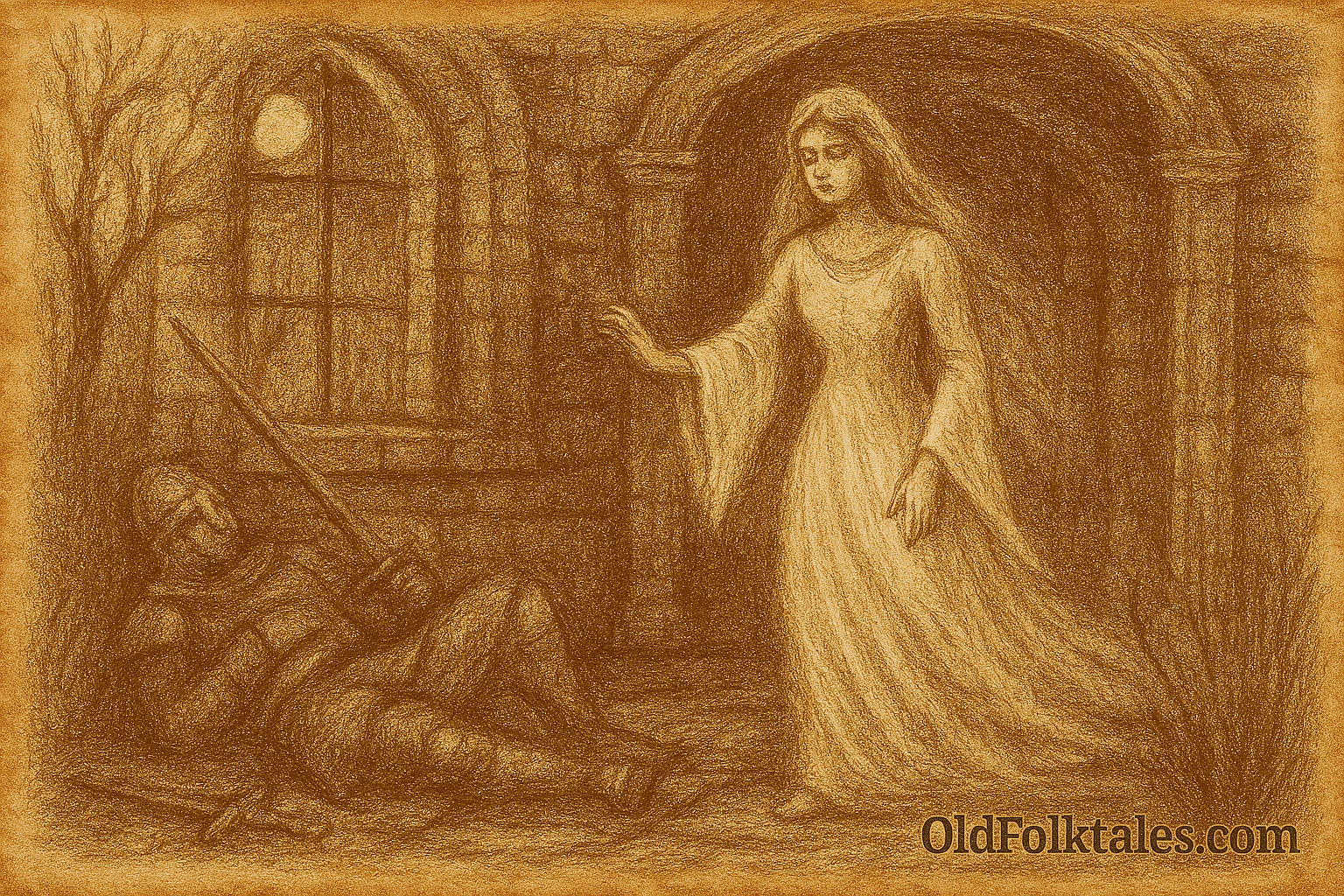
Strange occurrences began at Nesvizh Castle, the ancestral seat of the Radziwiłł family. It started with the servants, whispered accounts exchanged in the kitchens and servants’ quarters. They spoke of a woman seen in the dead of night, gliding through the halls with soundless steps. She wore a flowing white dress that seemed to shimmer in the moonlight filtering through the castle’s tall windows. Her face was pale as porcelain, beautiful yet filled with an unbearable sadness. Her eyes searched, always searching, as though seeking something precious that remained just beyond her reach.
One particularly brave guard decided he would confront this mysterious figure. Late one evening, as he made his rounds through the eastern corridor, he spotted her, the woman in white, standing motionless at the far end of the hallway. Gathering his courage, he approached, his footsteps echoing on the stone floor. But she heard nothing, or if she did, she gave no sign. As he drew closer, she slowly turned to face him. The guard froze, transfixed by the profound sorrow in her eyes.
He reached out, perhaps to touch her arm, to confirm she was real. But before his fingers could make contact, Barbara raised one pale hand. The gesture was not threatening, merely a warning, a boundary he should not cross. In that instant, an overwhelming wave of emotion crashed over him grief so powerful it stole his breath, longing so deep it seemed to tear at his very soul. The guard’s knees buckled, and he collapsed to the cold stone floor, unconscious.
When his fellow guards found him minutes later, he could barely speak. He described the encounter in halting words, and from that night forward, he refused to walk that corridor alone after dark.
The sightings continued through the years and into the centuries. Generation after generation of castle inhabitants reported glimpses of the White Lady. She appeared in the great halls where she once walked as queen, in the gardens where she might have sought solace from the court’s hostility, along the corridors she traversed during her brief, tragic life. Always she wore the same expression of yearning, always she searched with eyes that could not find rest.
The people of Belarus came to understand that Barbara Radziwiłł’s spirit was not a vengeful ghost seeking to frighten or harm. She was a soul bound to the world by the unbreakable chains of love and loss. Her wandering was a quest that could never be completed, the search for the husband she was forced to leave behind, for the life and love that were stolen from her far too soon. She remained, trapped between worlds, unable to move forward, unable to let go.
Even today, visitors to Nesvizh Castle report unusual experiences. Some feel sudden waves of sadness in certain rooms. Others claim to see, just at the edge of their vision, a flash of white disappearing around a corner. The White Lady of Nesvizh has become one of Belarus’s most enduring legends, a testament to the power of love that transcends even death itself.
The Moral of the Story
This haunting Belarusian legend reminds us that true love, once kindled, cannot be easily extinguished, not by opposition, not by tragedy, not even by death itself. Barbara’s eternal wandering speaks to the profound impact of love lost too soon and the grief that can bind a soul to the earthly realm. It teaches us to cherish those we love while we have them, for time is both precious and fleeting, and some losses leave wounds that never fully heal.
Knowledge Check
Q1: Who was Barbara Radziwiłł in Belarusian legend?
A1: Barbara Radziwiłł was the beloved wife of King Sigismund II Augustus of Poland-Lithuania. Despite fierce opposition from nobility and the queen mother, she married the king but died mysteriously shortly after, believed by many to have been poisoned. Her ghost became known as the White Lady of Nesvizh.
Q2: Why did Barbara Radziwiłł face opposition at court?
A2: Barbara faced opposition because she was not of royal blood and was considered an inappropriate match for the king by his mother, Queen Bona Sforza, and the nobility. Her marriage threatened political alliances and the established power structure of the court.
Q3: What happened to the guard who tried to approach Barbara’s ghost?
A3: When a guard attempted to approach the White Lady in the castle corridor, Barbara raised her hand toward him. He was immediately overwhelmed by intense emotions of grief and longing and collapsed unconscious on the stone floor.
Q4: What does the White Lady symbolize in Belarusian folklore?
A4: The White Lady symbolizes eternal love, grief, and longing that transcends death. Unlike vengeful spirits, Barbara’s ghost represents a soul unable to rest, forever searching for her lost love and the life that was taken from her too soon.
Q5: Where does the White Lady of Nesvizh appear?
A5: The White Lady appears throughout Nesvizh Castle in Belarus, particularly in the corridors, great halls, and gardens. She is seen wearing a flowing white dress, walking silently through the castle where she once lived as queen.
Q6: What is the cultural significance of Barbara Radziwiłł’s story in Belarus?
A6: Barbara Radziwiłł’s legend is one of Belarus’s most enduring ghost stories, representing themes of tragic love, political intrigue, and the supernatural. It connects to the historical Radziwiłł family and reflects cultural beliefs about love’s power to transcend death.
Source: Adapted from Belarusian folklore and historical accounts of Barbara Radziwiłł
Cultural Origin: Nesvizh Castle, Belarus