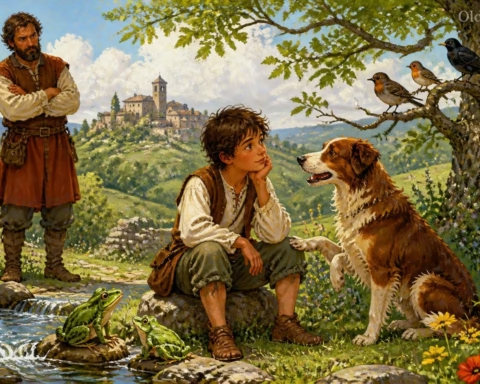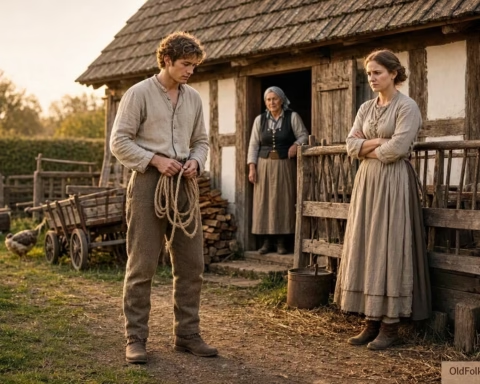
In the days when the boundary between earth and sky was less fixed than it is now, when spirits moved freely between the celestial realm and the mortal world, there lived a group of maidens whose home was among the clouds. These were no ordinary women; they were daughters of the sky, blessed with feathered cloaks that shimmered like moonlight on water, allowing them to soar through the heavens with the same grace as seabirds riding the ocean wind.
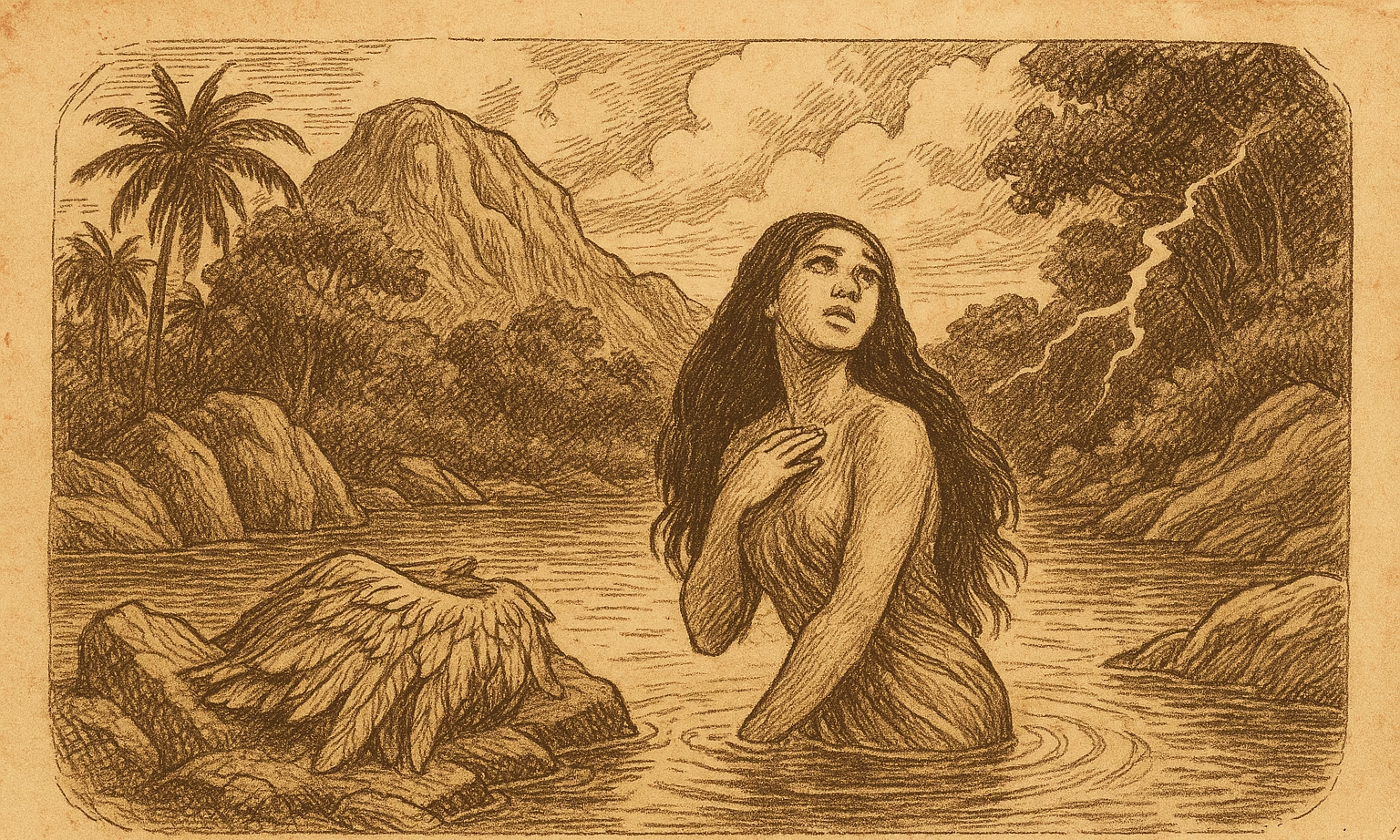
The sky maidens rarely descended to the earthly realm, but when they did, they sought out the most remote and pristine lagoons on the island of Nauru. There, hidden from mortal eyes by dense palm groves and volcanic rock formations, they would shed their magical cloaks and bathe in the crystalline waters, their laughter echoing across the lagoon like the tinkling of shells in the breeze. The water would shimmer around them, reflecting both the azure sky above and something otherworldly that clung to their skin, a luminescence that spoke of their celestial origins.
Click to read all Myths & Legends – timeless stories of creation, fate, and the divine across every culture and continent
On the island below lived a hunter named Arebit, known throughout his village for his keen eyes and patient spirit. He could track the swift-footed crab across coral beds and read the flight patterns of frigatebirds to predict where fish would gather. But nothing in all his years of hunting had prepared him for what he would discover one fateful evening.
Following the trail of a wild pig through the dense tropical undergrowth, Arebit pushed aside a curtain of pandanus leaves and found himself at the edge of a hidden lagoon he had never seen before. The setting sun painted the sky in shades of amber and rose, and there, in the water’s gentle embrace, he saw them the sky maidens, more beautiful than anything he had imagined possible. Their feathered cloaks lay draped carefully on the rocks at the water’s edge, each one glowing softly in the fading light.
Among them was Eijebong, whose beauty struck Arebit’s heart like lightning striking the tallest coconut palm. Her hair cascaded down her back like a midnight waterfall, and when she laughed, it seemed as though the very stars began to wake in the darkening sky. Arebit knew in that instant that his life had changed forever that he could no more forget this vision than he could forget his own name.
Driven by a desperate love and perhaps a touch of mortal foolishness, Arebit crept forward as silently as he stalked his prey. His hands trembled as he reached for Eijebong’s feathered cloak, the fabric feeling like captured starlight between his fingers. He gathered it quickly and retreated into the forest, his heart pounding like ceremonial drums.
When the sky maidens finished their bathing and reached for their cloaks, Eijebong’s hands found only bare stone. Panic seized her as her sisters, one by one, donned their feathered garments and rose gracefully into the darkening sky. She called out to them, her voice breaking with desperation, but they could not help her. Without her cloak, she was earthbound, as trapped as any mortal woman.
Arebit emerged from his hiding place then, and though Eijebong’s eyes flashed with anger and understanding, she was powerless. She had no choice but to follow him back to his village, to accept the life that fate or rather, Arebit’s interference had chosen for her.
Time passed, as it always does, and Eijebong and Arebit built a life together. She learned the ways of mortal women, how to weave mats from palm fronds and prepare breadfruit in the traditional manner. She bore Arebit a child, a son whose eyes seemed to hold depths that spoke of distant horizons and forgotten heights. To the villagers, she appeared to settle into her role, but those who looked closely could see how her gaze would drift upward whenever clouds passed overhead, how she would pause in her work when birds flew past, her expression full of an inexpressible yearning.
Despite the love she felt for her child and whatever affection had grown for her husband, Eijebong’s heart remained divided. At night, she dreamed of her sisters dancing among the stars, of the freedom of flight, of the vast sky that had once been her home. The longing grew within her like a seed pushing through volcanic soil, patient but inexorable.
Years passed before Eijebong discovered the truth. One day, while gathering firewood near a grove of ancient trees, she noticed a particular hollow in a gnarled trunk one that Arebit visited often but always alone. Curiosity overcame caution, and she reached inside. Her fingers touched something impossibly soft, something that seemed to sing to her soul. She pulled out her feathered cloak, still glowing with celestial light despite its long imprisonment.
Tears streamed down her face as she held the precious garment to her chest. She thought of her son, still young, his laughter filling their simple home. She thought of Arebit, who had stolen her freedom but who had also given her a life and family. The choice before her was agony to remain earthbound with those she had come to love, or to reclaim her true nature and return to the sky.
In the end, the call of home proved too powerful to resist. Perhaps it was not cruelty but necessity that guided her actions a force as natural and undeniable as the tide returning to the sea. Without a word, without a final embrace or explanation, Eijebong draped the feathered cloak across her shoulders. She rose into the air, slowly at first, then with increasing speed, ascending toward the realm she had been born to inhabit.
From the ground, her son watched his mother disappear into the clouds, his small hand raised in a gesture that was half farewell, half plea. Though she was gone, something of her remained in him a gift passed from mother to child, a blessing from both earth and sky.
The boy grew into a man of exceptional wisdom and insight. He became a great leader among his people, known for his ability to see solutions that others missed, to understand problems from perspectives that seemed to come from another realm entirely. The people said he had inherited knowledge from both worlds the practical wisdom of the earth and the vast understanding of the heavens. His descendants became known as a clan blessed with special gifts, their lineage traced back to that moment when a sky maiden chose freedom over captivity but left behind a legacy that would endure for generations.
The Moral Lesson
The legend of Eijebong teaches us about the complexity of love, freedom, and belonging. True love cannot be built on captivity or deception when we try to possess another being against their will, we may hold their physical form but never truly capture their heart. The story also reminds us that sometimes the most painful choices lead to the greatest blessings. Though Eijebong left her earthly family, her departure was not without purpose; she bestowed upon her child a unique heritage that enriched his people for generations. We learn that our true nature will always call to us, and that honoring that call however painful may be the greatest gift we can give to those we love.
Knowledge Check
Q1: Who was Eijebong in Nauruan mythology? A: Eijebong was a sky maiden, one of several celestial women who lived among the clouds and occasionally descended to earth to bathe in remote lagoons. She possessed a magical feathered cloak that allowed her to fly between the heavenly and earthly realms.
Q2: How did the hunter Arebit trap Eijebong on earth? A: While Eijebong and her sister maidens were bathing in a hidden lagoon, Arebit stole her feathered cloak and hid it, making it impossible for her to return to the sky. Without her magical garment, she was forced to remain on earth and eventually married him.
Q3: What does the feathered cloak symbolize in the story? A: The feathered cloak symbolizes freedom, identity, and one’s true nature. It represents Eijebong’s celestial heritage and her ability to return home. More broadly, it can be seen as a metaphor for personal autonomy and the essential qualities that define who we truly are.
Q4: Why did Eijebong leave her family to return to the sky? A: Despite the love she felt for her child and the life she had built on earth, Eijebong experienced an unshakable longing for her true home in the sky. When she discovered her hidden cloak, the call to return to her celestial realm proved too powerful to resist, representing the pull of one’s authentic nature and origins.
Q5: What blessing did Eijebong’s son receive from his mother’s dual heritage? A: Eijebong’s son inherited exceptional wisdom and insight from both his earthly father and his celestial mother. He grew to become a great leader blessed with knowledge from both earth and sky, able to understand problems from unique perspectives and see solutions others could not perceive.
Q6: What cultural significance does this legend hold for Nauruan clans? A: The legend of Eijebong explains the origin of exceptional wisdom and leadership abilities among certain Nauruan clans. It establishes a divine lineage connecting specific families to both the earthly and celestial realms, providing a mythological foundation for their special gifts and social standing within Nauruan society.
Cultural Origin: Indigenous Nauruan mythology, Republic of Nauru, Micronesia, Pacific Islands