
In the vast blue waters surrounding the islands of Fiji, where coral reefs bloom beneath the surface like underwater gardens and waves break white against black volcanic shores, there ruled a being of immense power and pride. This was Dakuwaqa, the shark god, whose domain stretched across the ocean depths and whose authority over sea creatures was absolute and unchallenged.
Dakuwaqa was not merely large; he was magnificent and terrible, a shark of supernatural size and strength. His body cut through the water with the speed of lightning across the sky, and his teeth gleamed like rows of daggers fashioned from moonlight and death. The other creatures of the ocean knew to move aside when Dakuwaqa passed, for he was both their ruler and their most dangerous predator. His reputation spread across the Pacific like ripples from a stone cast into still water: Dakuwaqa was strong, fearless, and possessed of a hot temper that could explode without warning into terrible violence.
Yet for all his fearsome nature, Dakuwaqa served an important purpose in the cosmic order. He controlled the ocean creatures, maintaining balance among the teeming life beneath the waves. He protected fishermen who showed him proper respect, guiding them to abundant catches and steering them away from hidden dangers. Villages along the coast offered prayers to him before voyages, knowing that his favor could mean the difference between safe return and disaster at sea.
But Dakuwaqa carried within him a flaw that threatened to undo all the good he might do: an insatiable hunger for conquest, an unquenchable need to prove his dominance over every reef, every current, every island in the archipelago. It was not enough for him to be respected and feared; he needed to conquer, to subdue, to demonstrate his superiority in ways that left no room for doubt.
Island after island fell under his control as he swam through Fijian waters, challenging the guardian spirits of each place and defeating them one by one. He would approach a reef or bay, announce his intention to claim it as his territory, and then overwhelm any spirit or creature that dared oppose him. His strength seemed limitless, his confidence unshakeable, his victories inevitable.
As his power grew, so did his arrogance. Dakuwaqa began to believe himself invincible, the greatest force in all the ocean, a being without equal or challenger. This pride, this certainty of his own supremacy, would ultimately lead him to the shores of an island that would change him forever.
Kadavu rose from the ocean like a green jewel, its mountains covered in dense tropical forest, its coastline protected by some of the most spectacular coral reefs in all of Fiji. The island was beautiful and rich with resources, a prize worthy of a conqueror, and Dakuwaqa desired it with an intensity that burned like fire in his shark’s heart.
One day, driven by his need to possess Kadavu and add it to his collection of conquered territories, Dakuwaqa set out from his usual hunting grounds. He swam with furious determination, his powerful tail propelling him through the water at speeds that created a wake visible from the shore. Fish scattered before him in panicked schools, and larger creatures dove deep to avoid his path. The ocean itself seemed to sense his approach, the waters churning and roiling as if disturbed by an underwater storm.
As Dakuwaqa neared Kadavu, his confidence was at its peak. He had defeated every challenger, conquered every territory, proved his superiority time and time again. What could possibly stand in his way now? He approached the reef that protected Kadavu’s waters, ready to announce his dominion and crush any opposition.
But the reef around Kadavu was not undefended. As Dakuwaqa surged forward, intent on claiming his prize, a figure emerged from a cave in the coral: the goddess of the octopus, ancient guardian of Kadavu’s waters, a being whose power had been protecting these shores since time beyond memory.
She was not large in the way Dakuwaqa was large, but she possessed eight arms of incredible strength and flexibility, each one lined with suckers that could grip with the force of stone. Her intelligence was vast, her patience legendary, and unlike Dakuwaqa, she did not fight with hot tempered fury but with calculated precision and perfect control.
Dakuwaqa, seeing her rise from the reef, laughed with contempt. What was an octopus compared to the mighty shark god? He charged forward, jaws open, ready to demonstrate once again his unchallengeable supremacy.
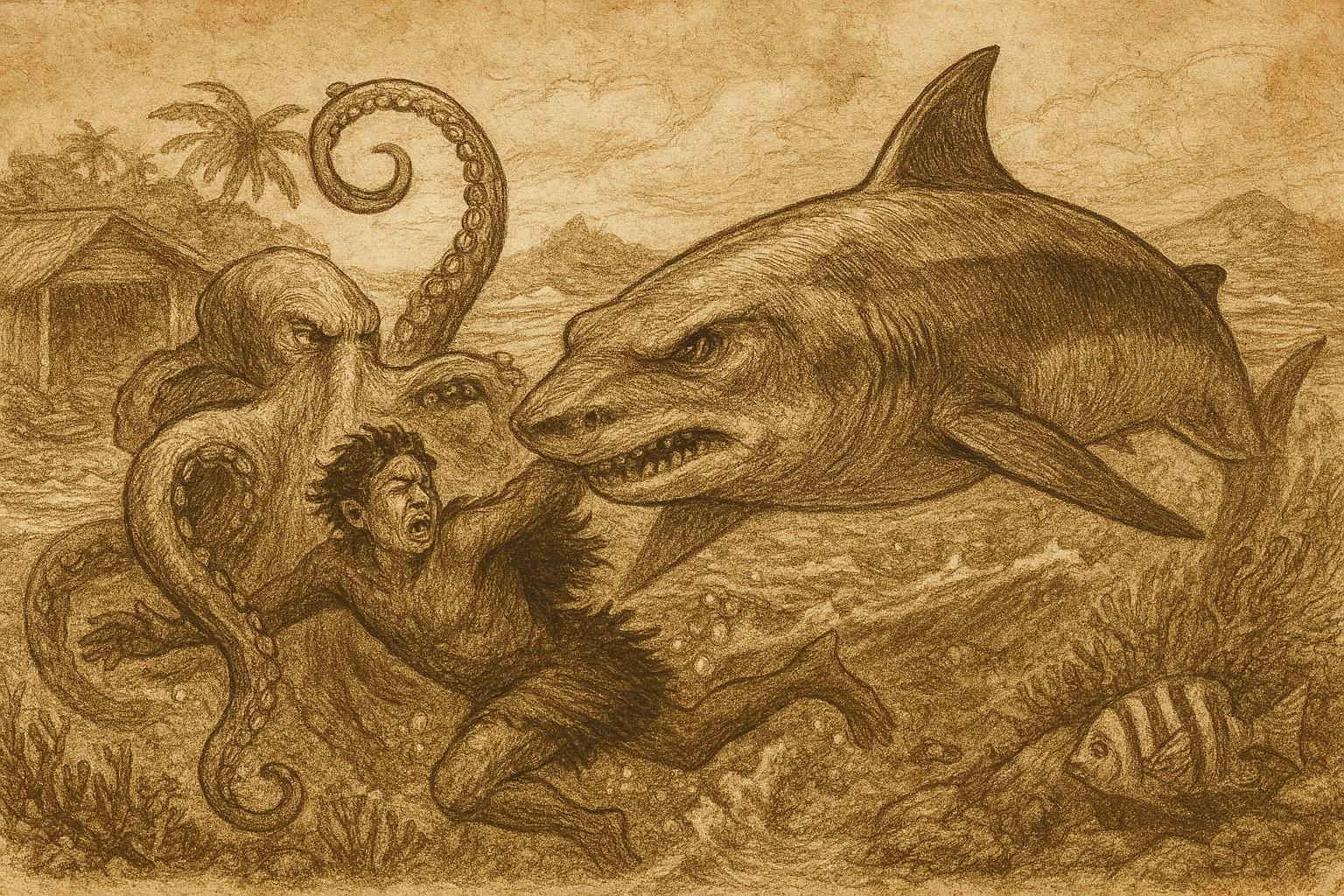
But the octopus goddess moved with speed and grace that Dakuwaqa had not anticipated. As he surged toward her, she flowed like liquid through the water, her eight arms spreading wide. Before Dakuwaqa could react, before his predator instincts could warn him of danger, she had wrapped those powerful tentacles around his body.
One arm circled his snout, clamping his jaws shut. Another wrapped around his gills, restricting the flow of water he needed to breathe. Two more coiled around his powerful tail, neutralizing the source of his speed and strength. The remaining four secured his body in a grip that tightened with every second, squeezing with force that would have crushed ordinary creatures into pulp.
Dakuwaqa thrashed and twisted, his body convulsing with the effort to break free, but the octopus goddess held him fast. Her grip was not the brutal crushing of overwhelming force; it was the inescapable embrace of perfect technique, each arm working in coordination with the others, tightening when he struggled, adjusting when he shifted, maintaining absolute control over his movements.
For the first time in his existence, Dakuwaqa experienced defeat. For the first time, he felt genuine fear. He could not move, could barely breathe, could do nothing but remain trapped in the octopus goddess’s embrace as she squeezed tighter and tighter. His vision began to darken at the edges, and he understood with sudden, terrible clarity that he was about to die.
In that moment of ultimate vulnerability, all of Dakuwaqa’s pride and arrogance evaporated like mist before the sun. He was not invincible. He was not the greatest force in the ocean. He was, in this moment, at the mercy of a being he had dismissed with contempt, and his life depended entirely on her choosing to show him grace he had never shown others.
Through the tentacle that covered his jaws, Dakuwaqa managed to emit a sound, a plea that carried all the desperation of someone who suddenly understands the value of life only when facing its end. He begged for mercy, his pride completely shattered, his confidence replaced by genuine humility born of terror and understanding.
The octopus goddess held him a moment longer, making sure the lesson had truly penetrated his consciousness, then gradually loosened her grip. As Dakuwaqa gasped and drew water through his gills once more, she spoke to him in a voice that carried the weight of ancient wisdom.
“Your violence and your hunger for conquest threaten the balance of the sea,” she said, her words flowing through the water like currents that could not be resisted. “You were given power to protect and maintain order, but you have used that power only to dominate and destroy. If you continue on this path, you will one day disturb the cosmic balance so completely that the ocean itself will turn against you, and even I will not be able to save you from the consequences.”
Dakuwaqa, still trembling from his near death experience, listened with an attention and humility he had never before displayed. The goddess continued, her tentacles still resting lightly on his body as a reminder of her power and his vulnerability.
“You must choose now who you will be. Will you continue as a conqueror, taking what you desire until you have destroyed the very waters you rule? Or will you transform yourself into what you were meant to be: a guardian, a protector, a force for balance rather than chaos?”
In that moment, Dakuwaqa made a choice that would define the rest of his existence. Humbled by defeat, educated by near death, and genuinely moved by the wisdom of the octopus goddess, he gave his solemn promise. He would abandon his campaigns of conquest. He would no longer seek to dominate every reef and bay. Instead, he would dedicate his great strength and power to protecting the people of Fiji, using his abilities not to conquer but to defend.
The octopus goddess released him fully then, and Dakuwaqa swam away from Kadavu’s shores, not in defeat but in transformation. The shark god who had approached those waters as a conqueror left them as something different: a guardian who had learned that true power lies not in dominating others but in protecting them.
From that day forward, Dakuwaqa’s nature changed profoundly. He no longer terrorized the waters seeking new territories to claim. Instead, he patrolled the seas around Fiji as a protector, watching over fishermen, guiding them away from dangers, and defending them from the very sharks that were his kin. When storms gathered on the horizon, Dakuwaqa would swim ahead of fishing boats, leading them to safe harbors. When dangerous creatures threatened villages, he would drive them away with the same fierce strength he once used for conquest.
The fishermen of Fiji came to revere him not with the fearful respect given to a tyrant but with the genuine gratitude offered to a protector. Before voyages, they would offer prayers to Dakuwaqa, asking for his blessing and protection. They believed, with reason, that he would defend them from the many dangers that lurked beneath the waves: unexpected storms, treacherous currents, aggressive sharks, and the thousand other perils that could claim a life at sea.
Stories spread across the islands of Dakuwaqa’s transformation, and he became a symbol of something profound: the possibility of change, the power of humility, and the understanding that defeat can be the doorway to wisdom. Children learned his tale as a lesson about pride and its consequences, about the importance of knowing one’s limitations, and about the greater glory that comes from protecting rather than conquering.
The octopus goddess remained in her cave near Kadavu, a quiet but powerful presence, her victory over Dakuwaqa becoming legendary throughout Fiji. She had not killed the shark god when she could have; instead, she had chosen transformation over destruction, redemption over revenge. In doing so, she had given Fiji not just a guardian but a living example of how even the proudest and most violent can change when they encounter something greater than themselves.
To this day, Fijian fishermen tell stories of Dakuwaqa as they prepare their nets and ready their boats. They speak of how the great shark god patrols the waters still, invisible but present, watching over those who venture onto his domain with respect and proper prayers. Some claim to have seen him: a massive shark of impossible size, moving through the depths with purpose and power, no longer a conqueror but a guardian, keeping the ancient promise made in a moment of defeat and transformation beneath the waves.
Click to read all Myths & Legends – timeless stories of creation, fate, and the divine across every culture and continent
The Moral Lesson
The legend of Dakuwaqa teaches us that unchecked pride and the hunger for domination inevitably lead to downfall, but defeat can become the catalyst for positive transformation. Dakuwaqa’s story shows us that true strength lies not in conquering others but in protecting them, and that the wise use of power creates more lasting legacy than violence and subjugation ever can.
Knowledge Check
Q1: Who was Dakuwaqa and what was his role in Fijian waters?
A: Dakuwaqa was the powerful shark god who ruled the seas around Fiji. He was a shark of supernatural size and strength, with absolute authority over ocean creatures. Despite his fearsome and hot tempered nature, he served important purposes: controlling ocean creatures to maintain balance and protecting fishermen who showed him proper respect. However, he also possessed an insatiable hunger for conquest and a need to prove his dominance over every reef and island.
Q2: What motivated Dakuwaqa to attack Kadavu?
A: Dakuwaqa was driven by his need to conquer and add Kadavu to his collection of dominated territories. The island was beautiful and rich with resources, making it a prize worthy of conquest. His arrogance had grown with each victory until he believed himself invincible, the greatest force in all the ocean. This pride and hunger for domination compelled him to claim Kadavu despite having already conquered island after island throughout Fiji.
Q3: Who defended Kadavu and how did she defeat Dakuwaqa?
A: The octopus goddess, ancient guardian of Kadavu’s waters, defended the island. Unlike Dakuwaqa who fought with hot tempered fury, she used calculated precision and perfect control. As Dakuwaqa charged, she wrapped her eight powerful tentacles around him: clamping his jaws shut, restricting his gills, immobilizing his tail, and securing his body in an inescapable grip. She demonstrated that technique and intelligence could overcome brute force, defeating the supposedly invincible shark god.
Q4: What warning did the octopus goddess give to Dakuwaqa?
A: The octopus goddess warned Dakuwaqa that his violence and hunger for conquest threatened the balance of the sea. She explained that he had been given power to protect and maintain order, but he had used it only to dominate and destroy. She cautioned that if he continued on this path, he would one day disturb the cosmic balance so completely that the ocean itself would turn against him, with consequences even she could not prevent.
Q5: How did Dakuwaqa change after his defeat?
A: Humbled by defeat and educated by his near death experience, Dakuwaqa transformed completely. He abandoned his campaigns of conquest and dedicated his strength to protecting the people of Fiji instead of dominating them. He began patrolling the seas as a guardian, watching over fishermen, guiding them away from dangers, leading them to safety during storms, and defending them from sharks and other threats. His transformation showed that even the proudest and most violent can change when confronted with truth about themselves.
Q6: What is the cultural significance of Dakuwaqa for Fijian fishermen today?
A: Dakuwaqa became a revered protector of Fijian fishermen rather than a feared tyrant. Before voyages, fishermen offer prayers to him, asking for his blessing and protection. They believe he defends them from storms, treacherous currents, aggressive sharks, and other ocean dangers. His story serves as a teaching tale about pride, humility, transformation, and the greater honor that comes from protecting rather than conquering. He represents the possibility of redemption and the wise use of power for service rather than domination.
Source: Adapted from Fiji Museum Archives collection “Dakuwaqa the Shark God”
Cultural Origin: Republic of Fiji, Melanesia, South Pacific