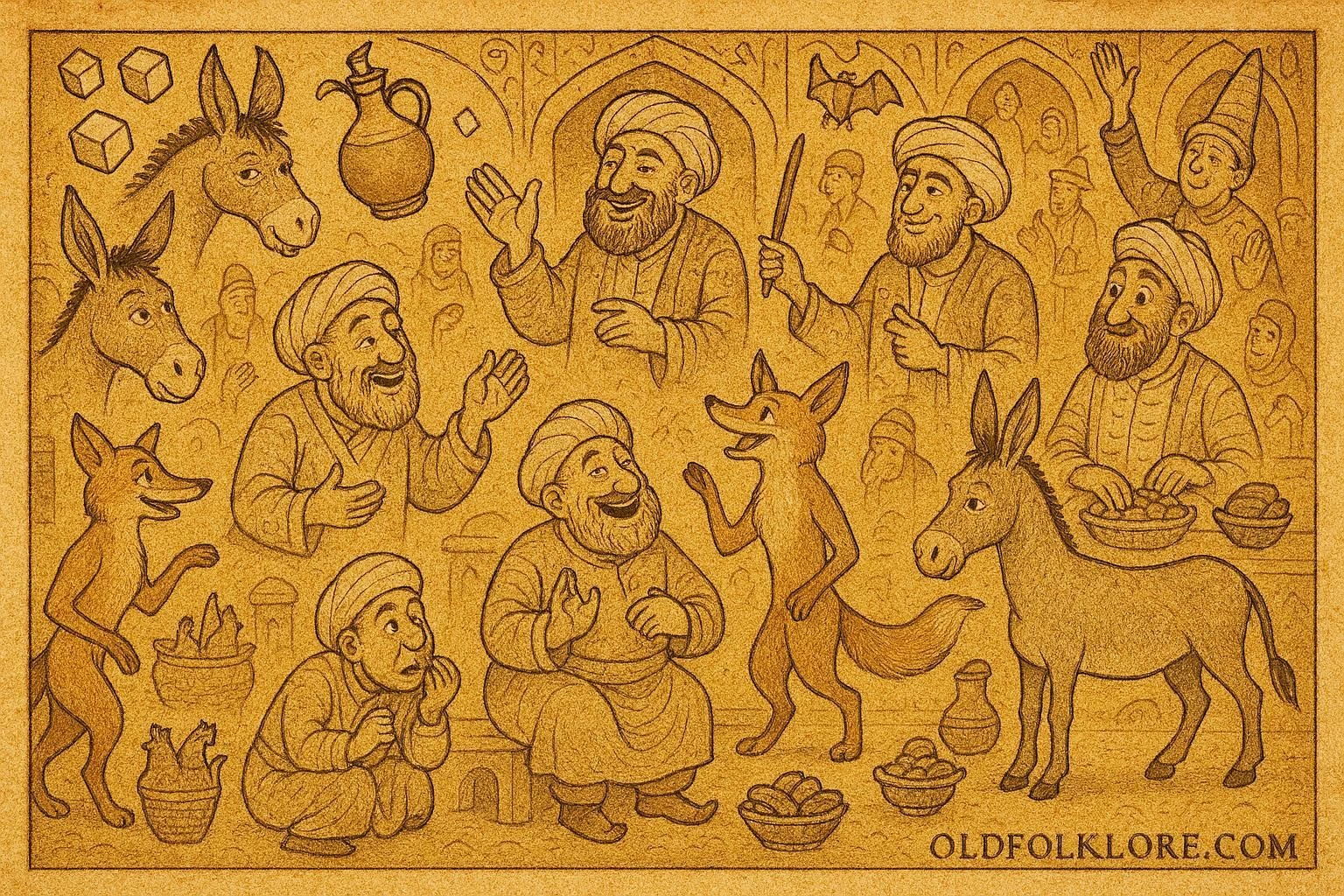
Persian culture has long celebrated the subtle art of wit, irony, and clever observation. From bustling bazaars to quiet tea houses, life is often viewed through a lens of humor, where a single phrase can reveal both joy and critique. Proverbs in Persian society are not merely lessons; they are tools of social insight, allowing people to navigate complex relationships, human folly, and the unpredictability of life with intelligence and subtlety. Humor is both shield and sword: it softens criticism, exposes hypocrisy, and allows communities to share wisdom in memorable, often amusing ways.
Persian proverbs often blend opposites, sweet and sour, sharp and gentle, serious and playful, reflecting the nuanced understanding that life is rarely one-dimensional. This duality is central to their charm: a saying can be comforting, cautionary, or teasing, depending on who listens. Through decades of urban storytelling, satire, and literary expression, these proverbs have become a mirror, reflecting not only human nature but also the society that cultivates and appreciates clever language.
Moreover, the Persian love of irony teaches patience and discernment. One learns to read between the lines, to laugh at one’s own mistakes, and to recognize absurdities in the world. The following collection contains 50 proverbs, each offering a morsel of wit or a twist of irony, revealing how the clever use of words shapes thought, behavior, and social understanding.
50 Persian Proverbs on Wit, Humor & Irony
- “A fool’s tongue runs faster than his mind.” – Speaking before thinking often leads to embarrassment.
- “He who has no sense laughs at everything.” – Not all laughter is clever; some reflect ignorance.
- “Even a wise man can fall into a trap of his own making.” – Intelligence doesn’t guarantee immunity to mistakes.
- “When the cat is away, the mice hold a feast.” – People exploit freedom when authority is absent.
- “A donkey carrying a load of gold is still a donkey.” – External appearances cannot change intrinsic nature.
- “The lips of a liar are never silent.” – Dishonesty often reveals itself through constant talking.
- “He who laughs last may have a crooked sense of humor.” – Timing in wit is crucial; irony matters.
- “A clever enemy is worth more than a foolish friend.” – Value intelligence, even if adversarial.
- “The mirror never lies, but people refuse to look.” – Truth is available, but perception is selective.
- “Don’t measure the fool by your ruler.” – One cannot judge ignorance by standards of wisdom.
- “A sharp tongue cuts deeper than a sword.” – Words can hurt more than physical harm.
- “Irony is the jewel of the subtle mind.” – Clever observations delight the discerning.
- “He who knows too much is often laughed at.” – Excess knowledge can appear ridiculous.
- “Even sugar becomes bitter if chewed wrongly.” – Context affects perception.
- “The joke is on those who take it seriously.” – Humor often relies on lighthearted interpretation.
- “A wise man changes his mind, a fool changes his coat.” – Adaptation versus superficial change.
- “When the fox preaches, beware the henhouse.” – Beware of cunning disguised as wisdom.
- “A man’s shadow follows his mischief.” – Wrongdoing eventually becomes apparent.
- “Laughter in the bazaar hides a secret complaint.” – Humor can conceal critique.
- “A tongue without thought is a mischief-maker.” – Speaking carelessly invites trouble.
- “Sweet words may hide bitter intentions.” – Flattery is not always sincere.
- “He who digs a pit may fall into it himself.” – Schemes often backfire.
- “Even a broken clock is right twice a day.” – Luck occasionally favors everyone.
- “The fool builds bridges to nowhere.” – Effort without wisdom is wasted.
- “A sarcastic smile can cut deeper than anger.” – Wit can be more piercing than aggression.
- “He who lives by the story will die by the rumor.” – Tales and gossip carry consequences.
- “A clever tongue can untie what force cannot loosen.” – Persuasion trumps violence.
- “The wise man dances to another’s tune, secretly leading the steps.” – Subtle influence is powerful.
- “Even the wind changes when the candle flickers.” – Small signals affect perception.
- “A fool’s echo is louder than a sage’s whisper.” – Ignorance often makes itself known.
- “The mirror cracks before the glass falls.” – Warning signs precede disaster.
- “He who rides two horses falls between them.” – Divided attention leads to failure.
- “A word once spoken cannot be swallowed.” – Speech has lasting impact.
- “Don’t teach a pig to sing; it wastes your time and annoys the pig.” – Some efforts are futile.
- “He who sows gossip reaps mistrust.” – Spreading rumors harms relationships.
- “The sly fox invites the crow to a feast, then forgets the bread.” – Deception can be subtle and amusing.
- “A clever servant makes the master look foolish.” – Intelligence can subvert hierarchy humorously.
- “Even a blind donkey can stumble upon treasure.” – Luck can favor the unwitting.
- “Irony is the language of the wise and the shield of the clever.” – Humor deflects criticism while teaching lessons.
- “The candle’s flame cannot argue with the wind.” – Some forces are beyond control.
- “The wise laugh at themselves first.” – Self-deprecating humor shows insight.
- “Even sugar sours in excess.” – Too much of anything can spoil it.
- “The thief thinks everyone steals.” – Projection reveals character.
- “A clever fool is still a fool, but funnier.” – Wit does not replace wisdom.
- “Don’t bite the hand that feeds irony.” – Accept playful criticism gracefully.
- “He who plants a thorn should not cry when pricked.” – Actions have consequences.
- “A joke poorly timed is a confession of folly.” – Timing is essential for humor.
- “Even a palace can have leaky walls.” – Appearances can be deceiving.
- “The wise use humor as a key, not a sword.” – Humor opens doors rather than cuts.
- “Laugh, and the world laughs with you; snicker, and it laughs at you.” – Public perception affects reception.
Learn the moral wisdom of ancient civilizations through proverbs that shaped cultural values
Author’s Note
Persian proverbs reveal a society that delights in intelligence, verbal dexterity, and subtle critique. Humor is not frivolous, it is a lens through which human behavior is examined, societal norms are questioned, and wisdom is transmitted. Sugar and vinegar coexist: sweetness to amuse, sharpness to instruct. Through these sayings, we see that life is best navigated with cleverness, observation, and the courage to smile at both folly and truth.
Knowledge Check
- Q: What role does irony play in Persian proverbs?
A: It highlights truth subtly, often with humor. - Q: Why are Persian sayings often dual in nature (sweet and sharp)?
A: To blend amusement with insight, teaching lessons playfully. - Q: What does “even a donkey carrying gold is still a donkey” mean?
A: External wealth or appearance cannot change inherent character. - Q: How is timing important in humor according to these proverbs?
A: Poor timing turns cleverness into folly. - Q: Why is self-deprecating humor valued?
A: It shows awareness, humility, and wisdom. - Q: How can wit serve as a social tool?
A: It allows critique, guidance, or persuasion without confrontation.