‘Aiaru is recorded in older Polynesian myth listings as one of the seven guardians of the world, each charged with watching a different dimension of existence, land, ocean, darkness, wind, spirit pathways, ancestors, and fate. Within this sacred septad, ‘Aiaru’s role is the most solemn and the most feared: she is the one who foresees death. Her presence is a reminder that mortality is woven into creation, not as a punishment, but as a necessary thread.
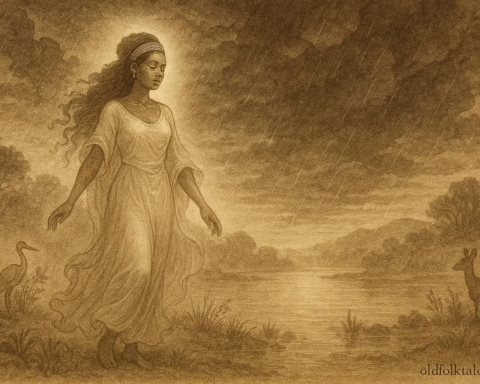
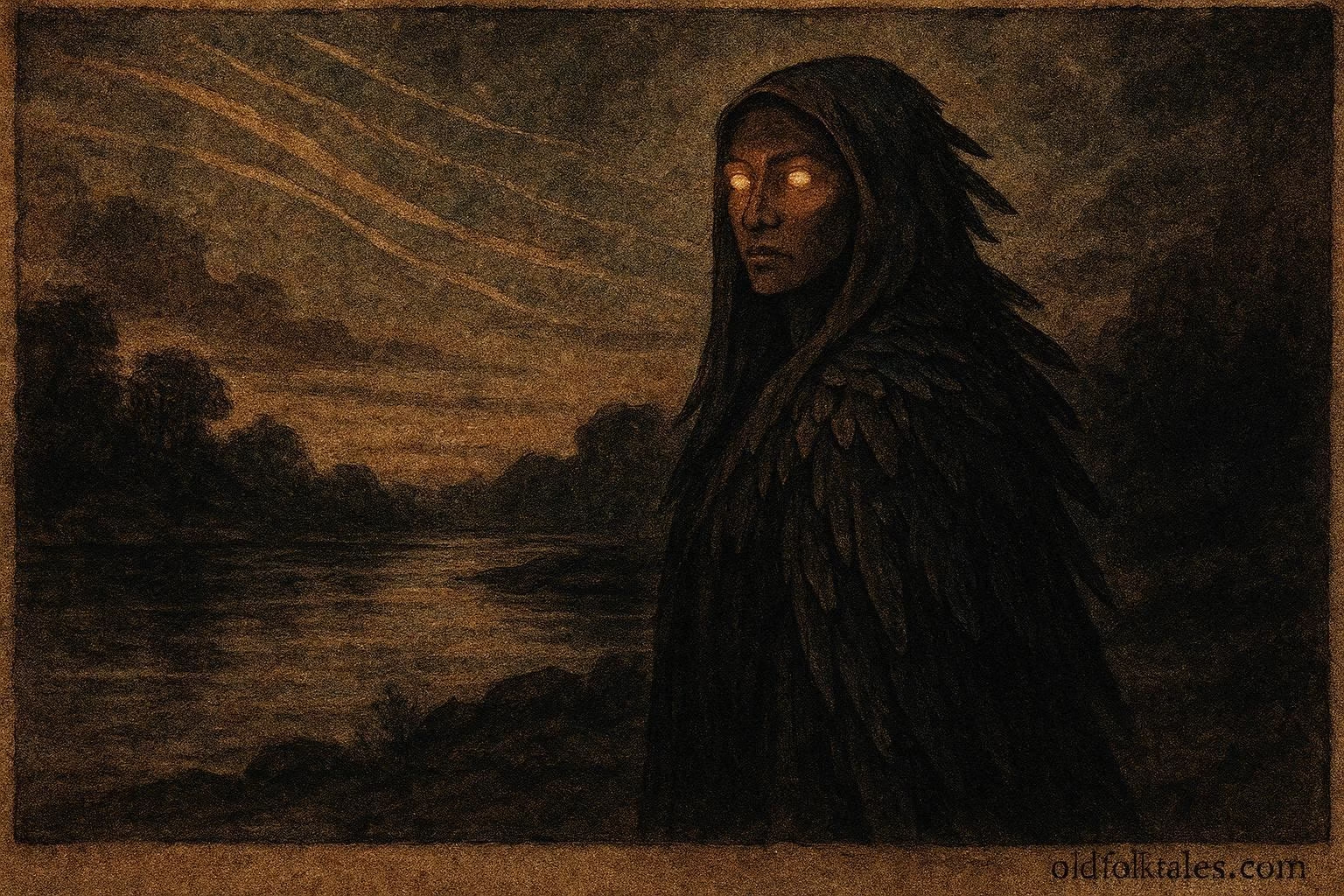
While not a universally attested figure across all Polynesian cultures, compendium sources describe ‘Aiaru with striking symbolic traits. She is neither monster nor goddess in the traditional sense but a cosmic sentinel, a being who sees across realms. Her appearance is often interpreted metaphorically: a tall, still figure cloaked in twilight, her skin reflecting the muted colors of dusk, blue-grey, soft violet, fading amber. Her eyes are described as “the last light before nightfall,” suggesting that she sees the moment the living step across the threshold into the spirit world.
A traditional motif attributes to her feathered adornments made of night birds or migratory birds, creatures known for their uncanny sensitivity to omens and shifts in the natural world. These feathers mark her as one who moves between realms, hearing the quiet messages that pass beneath the surface of reality.
Powers
As a guardian of fate and foreknowledge, ‘Aiaru possesses abilities associated with cosmological oversight:
- Prophecy of Death: Her primary mandate is to foresee the ending of life, whether through illness, misfortune, warfare, or natural passage.
• Spirit Vision: She perceives the pathways that spirits must travel after death, the routes taken across seas, mountains, and winds.
• Dream Sending: Some accounts claim she can enter dreams, offering cryptic warnings not as curses but as preparations.
• Silence Veils: She can mute the world around those near death, creating moments of strange quiet where the boundary between life and spirit thins.
• Presence at Thresholds: She may appear symbolically at the transition points, doorways, riverbanks, twilight hours, or the moment before dawn.
These abilities do not position her as a malevolent figure. Instead, she functions as a truth-bearer, a necessary agent in the balance between creation and departure.
Behavior
‘Aiaru is described as calm, watchful, and profoundly neutral. She does not take life, nor does she cause death. Rather, she witnesses and acknowledges it. She is the recorder of endings, the sentinel who ensures that each life follows the proper path toward the next realm.
Her behavior follows three major patterns:
- Observation Without Interference: She witnesses the stories of human lives without altering fate.
- Warning Through Signs: Her presence may manifest as a sudden shadow crossing the moon, the stilling of birds, or the unusual quieting of wind.
- Guiding in Transition: For those who die well, peacefully or with honor, she is believed to smooth the path into the ancestral world. For those who die in turmoil, she stands as a neutral escort, neither judging nor comforting.
Her neutrality makes her one of the most enigmatic guardians. She is feared because humans fear death, but she herself is not destructive. Instead, she is the embodiment of cosmic inevitability.
Myths & Beliefs Surrounding ‘Aiaru
In myth lists, ‘Aiaru appears alongside other guardians of elemental and spiritual realms. Her role is typically isolated from grand narratives, and yet, where she appears, she carries powerful thematic impact.
One story recounts that the first death in the world was not an accident but a transition taught by the guardians, with ‘Aiaru serving as the witness. When the primordial ancestor fell into entropic sleep and did not awaken, ‘Aiaru was the first to speak the truth: “Return home.” Her declaration established the cycle that governs all living things.
Another tradition says that ‘Aiaru walks the borders of villages during the change of seasons. When she is sensed, through an unseasonal cold breeze or a hush in bird song, it is interpreted not as doom, but as an invitation to prepare, reconcile, or strengthen one’s spirit.
There are also tales of priests or seers who sought her knowledge. They would journey to high cliffs or silent groves, remaining awake through the night, attempting to sense “the Guardian of the Last Light.” If ‘Aiaru chose to appear, it was never in a terrifying form; instead, she came as a moment of stillness, a realization, or a symbolic omen, such as a falling leaf or a fading star.
Unlike wrathful spirits or monstrous creatures, she does not devour, curse, or torment. She is simply the voice that acknowledges what must be.
Cultural Role & Symbolism
‘Aiaru represents one of the most universal concepts in Polynesian, and indeed human, cosmology: the inevitability of mortality. Her presence teaches several intertwined themes:
- Acceptance of Life’s Natural Cycle: In cultures where ancestors remain active in the spiritual world, death is not an ending but a continuation. ‘Aiaru’s role affirms this transition.
- Reverence for Twilight & Thresholds: As a guardian who stands between realms, she symbolizes liminality, dusk, dawn, doorways, river edges, and emotional crossroads.
- Honesty & Truth-Telling: Her name is connected with the idea that truth, even uncomfortable truth, is sacred.
- Preparation & Spiritual Readiness: Her myths encourage communities to live in a state of moral and relational completeness.
- The Quiet Power of Women in Cosmology: In a pantheon often dominated by elemental gods, ‘Aiaru embodies feminine spiritual authority, not through force but through wisdom and clarity.
Encounter dragons, spirits, and beasts that roamed the myths of every civilization
Author’s Note
‘Aiaru is a fascinating example of how mythological scholarship preserves figures who may not survive in mainstream narratives. Though she does not appear frequently in major island-specific oral traditions, her presence in myth compendia reflects cosmological structures recognizable across Oceania, guardians, thresholds, and the inevitability of mortality. She stands as a symbol of dignity in death and the sacredness of endings.
Knowledge Check
- What role does ‘Aiaru fulfill?
She is a guardian who foresees and acknowledges death. - Is she harmful?
No, she does not cause death; she witnesses it. - What natural symbol is associated with her?
Twilight, the moment between day and night. - How does she communicate warnings?
Through omens such as silence, shadows, or changes in wind. - Why is she feared?
Because she represents unavoidable truth, not because she is dangerous. - What cultural values does she reinforce?
Acceptance, honesty, spiritual readiness, and reverence for life cycles.
Source: Classical anthropological myth compendia (e.g., The Mythology of Oceania)
Origin: Polynesia, cosmological guardian traditions