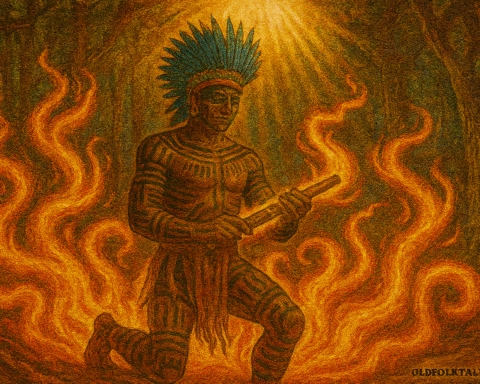
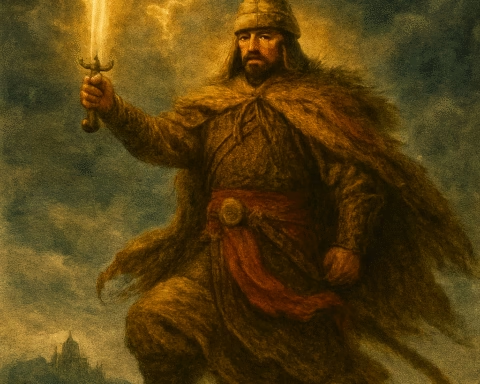
In the mist-drenched dawn beyond Alba’s rugged shores, a child called Connla was born beneath the cry of battle-ravens and the hush of enchanted winds. His mother, Aífe, warrior-mistress feared across the isles, held the infant to her breast as the sky gleamed with omens. For his father was Cú Chulainn, the Hound of Ulster, son of Lugh of the Long Arm, and through that divine line, the newborn inherited both mortal frailty and immortal fire.
Cú Chulainn, preparing to depart for Ériu, stood over the child one last time. His voice trembled not with fear, but prophecy.
“Connla, my son, you will walk a path of greatness. Keep these three geasa: never refuse single combat, never turn back from a challenge, and never reveal your name. And when at last you seek Ériu, come as a warrior, unrecognized, undefeated.”
With a kiss to Aífe and a final look at the infant whose fate he could not undo, the Hound crossed the sea, leaving destiny to sharpen its blade.
Connla grew swiftly, as heroes born of gods often do. In a handful of years he surpassed warriors twice his age. The spear flew from his hand like lightning uncoiling. His feet knew no weariness. His courage was boundless, and his judgment keen. Yet for all his might, he carried his father’s absence like a shadow stitched to his soul.
Aífe, though proud, watched with dread, for she remembered the pain in Cú Chulainn’s eyes, the way prophecy had coiled around their brief love. She knew the day would come when Connla’s greatness would demand a terrible price.
When the time arrived, Connla felt it not as a call but as a pulling in his blood. A whispering tide within him murmured of a land across the sea where honor waited to be proven. With a warrior’s calm, he took up his spear, set his small coracle upon the waves, and let fate carry him to Ériu.
The shores of Ulster glimmered pale beneath the sun when Connla arrived, alone, silent, marked only by the aura of a hero who could not hide what he was. Word reached Conchobar’s court that a mysterious youth had landed, refusing all questions, accepting all challengers. The Red Branch stirred; the omen felt close and cold.
Cú Chulainn, hearing of the stranger, rose at once, for he sensed what others did not: an echo of himself, a rhythm he had known long ago in Alba. But he did not dare speak the thought forming like smoke in his mind.
First came Conall Cernach, proud and fierce. Connla bested him gently, with no malice, as though fighting a beloved elder. Then Lóegaire came, and the youth humbled him as well, his skill beyond mortal measure. Warriors whispered that no human child could possess such mastery.
At last, Cú Chulainn stepped forward.
He stood before the boy, heart pounding with a fear he had felt only once, when the Morrígan had whispered doom into his ear. “Tell me your name,” he demanded, voice trembling ever so slightly.
Connla bowed, respectful yet unyielding. “It is my geis not to.”
The words struck Cú Chulainn like a spear-point. Three geasa, he remembered. Three binding vows. His soul froze.
Yet to preserve Ulster’s honor, he could not retreat. Bound by destiny, bound by pride, bound by sorrow he did not yet know how to name, the Hound of Ulster raised his spear.
The duel began like thunder made flesh. Connla moved with a grace that split the air. Cú Chulainn struck with fury born of grief unspoken. Spear rang upon spear, feet blurred upon sand, the very sea holding its breath.
Three times Connla landed blows that could have ended any mortal warrior. Three times he pulled them, sparing the older man, something in him resisting a kill he felt would tear the world in two.
But Cú Chulainn, driven by the mounting certainty of who this youth must be, unleashed the gae bolga, the monstrous spear-technique taught only once in a lifetime, meant never to be turned aside.
The weapon burst into Connla’s flesh with the fury of the Otherworld.
The boy stumbled, fell to his knees, and at last spoke the name he had kept sacred:
“I am Connla… son of Cú Chulainn… and of Aífe of Alba.”
Silence swept the battlefield. Cú Chulainn’s spear slid from his grasp. He knelt, gathering his dying son into his arms, and the cries that tore from him pierced the heavens. For no hero in Ériu, not even he, the Hound, could outrun fate.
Connla smiled despite his wound. “Father… I sought not victory. Only to be worthy of you.”
And then he was still.
The sea breeze carried his spirit westward, to the isles of the blessed, where doomed heroes find peace. Cú Chulainn remained kneeling over the body long after the sun dipped beneath the waves, a man shattered, a god-blooded warrior facing a truth too heavy: greatness without mercy is a blade that cuts its wielder deepest.
From that day onward, the warriors of Ulster told Connla’s tale not as a tragedy alone, but as a symbol, the price of pride, the weight of prophecy, and the terrible nobility of a hero who kept his vows even unto doom.
AUTHOR’S NOTE
Connla stands among Ireland’s most poignant mythic figures, a hero defined not by triumph but by honor. His story echoes the Ulster Cycle’s greatest moral truth: destiny spares no warrior, and a hero’s greatness can become their undoing. Yet Connla’s legacy endures as a symbol of loyalty, courage, and the tragic cost of unbreakable vows.
KNOWLEDGE CHECK (6 QUESTIONS)
-
What are the three geasa Cú Chulainn gives to Connla?
-
Why does Connla refuse to reveal his name upon reaching Ulster?
-
Which warriors does Connla face before dueling Cú Chulainn?
-
What ultimate weapon-technique does Cú Chulainn use in the battle?
-
What realization strikes Cú Chulainn during the duel?
-
What broader symbolic message does Connla’s death convey?
CULTURAL ORIGIN: Irish mythology, specifically the Ulster Cycle, one of the four great cycles of early Irish literature.
SOURCE: Aided Óenfhir Aífe (“The Tragic Death of Aífe’s Only Son”), an early Irish tale preserved in medieval manuscripts of the Ulster Cycle.