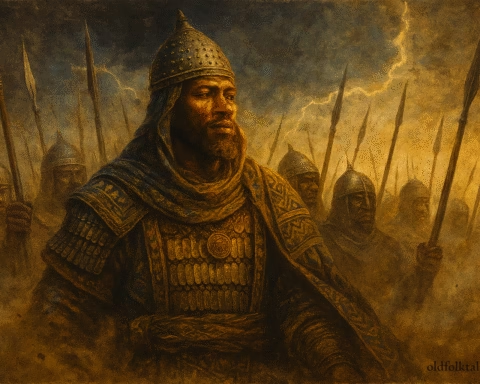
In the age when the world was young and shadowed with wonder, there was born a king whose destiny was woven from the threads of both earth and heaven. Dietrich von Bern, son of the noble Theodoric and descendant of divine blood, emerged into the halls of men with a visage of stern majesty and eyes alight with foresight. It was said that the gods themselves had kissed his brow at birth, imparting strength beyond mortal measure, wisdom to temper valor, and a spirit that would confront the darkness that haunted the land.
The kingdom of Bern, though fair and fertile, lay at the edge of a world in turmoil, where the mountains breathed smoke and the forests whispered secrets older than kings. Giants, whose shadows blotted the sun, roamed the highlands; dragons, coiled in treasure-hoarded caverns, roused storms with their fury; and the underworld, a realm of silent, watchful power, stirred in jealous anticipation of human pride. Dietrich, though young, knew the mantle of heroism demanded deeds that sang through the ages.
It began with the Giant Wars, a series of epic confrontations that tested the limits of courage and honor. The first challenge emerged when the sky itself darkened with the wingbeats of Fafnir-like dragons, their scales glinting like molten iron. Villages fell beneath their fire, and despair gripped the hearts of men. Dietrich, mounted upon his steed Schemming, whose hooves rang like thunder on stone, rode into the tempest. His sword, Balmung, forged with runes of protection and ancestral power, cleaved the air with a voice of justice. The dragons, sensing a mortal who bore the favor of gods, recoiled, yet one alone, the mightiest, rose against him with eyes burning as if the sun had fallen to earth. A duel ensued upon a mountain precipice, lightning flashing in accompaniment to steel and claw. Dietrich’s strength, tempered with reason, overcame brute fury, and he sent the dragon plummeting into the chasm, its roar echoing like a lament through the ages.
Yet the victory was but a prelude. From the depths of the northern forests arose the giants, towering beings of stone-like sinew and unyielding pride. Their leader, a colossus known as Hreidmar, demanded tribute, claiming dominion over the realm of men. Dietrich, though warned of the futility of mortal defiance, accepted the challenge, for the courage of kings is not measured by avoidance of danger but by the steadfastness to protect their people. Across the fields of frost and through ancient ruins, he battled, each clash a symphony of power and resolve. The giants’ hands could rend earth and crush walls, yet Dietrich’s cunning turned their might against itself. He lured them into a gorge, collapsing stone and root upon their heads, binding their rage with ingenuity and bravery.
Amid these earthly trials, the underworld stirred. Shadows lengthened, whispers coiled around the minds of men, and spirits of envy and greed sought to unseat the rightful king. Dietrich descended into caverns where daylight never penetrated, seeking the source of this creeping corruption. There, amid rivers of mist and jagged crystal, he faced an entity of sorrow and malice, a wraith claiming dominion over fear itself. The battle was not of steel alone but of heart and conscience. Dietrich’s mind and spirit were tested; visions of betrayal, despair, and endless war haunted him. Yet he drew upon the divine legacy coursing through his veins, finding courage in mercy, strength in justice, and victory in the resolve to remain true to honor. The wraith, unable to comprehend such light, dissolved into the shadows, leaving the hero cleansed of doubt and the world freer of darkness.
Dietrich’s triumphs carried deeper resonance than mere conquest. The dragons, the giants, the underworld, they were not merely foes but symbols of chaos, of the fears and desires that test all rulers and all men. Through facing them, Dietrich showed that true kingship requires courage tempered with wisdom, power guided by conscience, and might balanced by morality. His deeds became legend, teaching that heroism is measured not solely by victory but by the preservation of order and the defense of the weak.
When he returned to Bern, the people celebrated not merely a victorious warrior but a king whose moral and spiritual strength affirmed the bond between heaven and earth. Tales of Dietrich’s Giant Wars spread across valleys and rivers, told by bards beside hearth and hall, carrying the resonance of hope, warning, and inspiration. And though the giants still slumbered in distant lands, the dragons in hidden caves, and the underworld ever vigilant, humanity knew that there existed one whose courage could challenge even the shadowed might of chaos.
Author’s Note
Dietrich von Bern’s legacy endures as a bridge between mortal endeavor and divine providence. His story, drawn from the Thidrekssaga, reveals a hero who embodies the balance of strength, wisdom, and ethical fortitude. In the Germanic heroic imagination, Dietrich represents the ideal that true leadership confronts both external threats and internal moral dilemmas. His victories over dragons, giants, and underworld forces are symbolic victories over fear, chaos, and injustice, leaving a timeless mark on the imagination of Northern Europe.
Knowledge Check
-
What divine or semi-divine element is associated with Dietrich’s birth?
-
Name Dietrich’s legendary sword used to battle the dragons.
-
Who was the giant leader that challenged Dietrich in the Giant Wars?
-
Describe the symbolic significance of Dietrich’s descent into the underworld.
-
How does Dietrich’s approach to heroism combine both strength and morality?
-
What lesson about leadership can be drawn from Dietrich’s confrontations with dragons, giants, and the underworld?
Cultural Origin
Germanic heroic tradition, medieval Northern Europe
Source
Thidrekssaga (13th century)