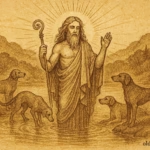

Yakushi Nyorai, known as the Medicine Buddha, embodies compassion, healing, and spiritual restoration. He is revered across Japan and East Asia as a protector against disease, physical and spiritual suffering, and misfortune. Often depicted seated in serene meditation, Yakushi Nyorai holds a medicine jar in his left hand, symbolizing remedies for illness, while his right hand forms the abhaya mudra, the gesture of granting protection and fearlessness.
Temples dedicated to Yakushi Nyorai, known as Yakushi-dera, are sacred centers of prayer, ritual healing, and community health. Devotees offer incense, prayers, and symbolic medicines to invoke his restorative power. Sometimes, he is venerated alongside local Shinto deities of health, creating syncretic practices that blend Buddhist and indigenous beliefs. His worship emphasizes not only physical wellness but moral and spiritual equilibrium, reflecting the Mahayana Buddhist ideal of alleviating suffering for all beings.
Yakushi Nyorai is considered a guide for both monks and laypersons, demonstrating that healing is a sacred duty and a moral act. His presence represents hope, perseverance, and the interconnectedness of body, mind, and spirit.
Mythic Story
Long ago, during the reign of Emperor Shōmu, the land of Japan was beset by illness, famine, and misfortune. Plague swept through villages, and sorrow weighed upon families as countless lives succumbed to sickness. The people prayed fervently to the divine, seeking relief and protection. Among the celestial guardians, Yakushi Nyorai, the Medicine Buddha, turned his gaze upon the suffering, moved by compassion for all beings.
In one revered account, Yakushi Nyorai descended from his heavenly palace, radiant in golden light that shimmered like sunlight upon calm waters. His eyes, serene yet penetrating, saw the deep wounds of human suffering, the fevered child, the ailing elder, the desperate mother. The medicine jar he carried glowed with a sacred elixir, holding the divine power to cure both physical maladies and spiritual afflictions.
He first appeared to a humble monk meditating by a mountain stream, instructing him in the sacred mantra of healing. “Recite these words with faith,” Yakushi Nyorai intoned, “and the sick shall find relief; the wounded heart shall be restored.” The monk obeyed, sharing the mantra with villagers and travelers alike, and soon the air was filled with prayers and chants. With each utterance, the sick regained strength, their bodies warming with vitality, their spirits lifted from despair.
Yet the Medicine Buddha’s work was not only in curing physical illness. A cruel demon, the Lord of Plague, had been spreading disease and panic across the lands. Yakushi Nyorai confronted this malignant spirit atop the sacred Mount Hiei. With his right hand raised in the abhaya mudra, he exuded a protective aura, and the very presence of his calm, unwavering compassion weakened the demon’s power. The medicine jar in his left hand radiated purifying light, enveloping the demon in warmth and mercy.
As the demon shrank beneath the Buddha’s radiant energy, villagers and monks observed a miraculous transformation. The demon’s malevolence was not destroyed by violence but transmuted by the Medicine Buddha’s boundless compassion. It fled the human realm, leaving behind fertile land, clean water, and renewed vitality. Yakushi Nyorai had shown that healing is not merely the absence of illness but the restoration of harmony between body, mind, and spirit.
After this celestial intervention, Yakushi Nyorai continued to walk among the people in spirit, inspiring temples, rituals, and daily acts of care. Devotees would offer flowers, incense, and symbolic medicines in the temple courtyards, believing that these offerings, combined with heartfelt prayers, could extend his divine healing presence into homes and communities. Festivals honoring Yakushi Nyorai became annual occasions for collective gratitude, reinforcing social cohesion and spiritual mindfulness.
Legends also describe his ability to heal not only humans but the natural world. Trees, rivers, and animals restored their vitality when his blessings passed over the land, underscoring the interconnectedness of all life. By teaching the people to care for one another, Yakushi Nyorai demonstrated that healing is both a spiritual and communal endeavor, reflecting the Mahayana ideal of relieving suffering for all sentient beings.
Through centuries, Yakushi Nyorai’s influence endured. He became the patron of doctors, midwives, and caretakers; his sacred mantras were inscribed on scrolls and statues, ensuring that his presence remained a guiding force in times of hardship. His myth conveys that true healing requires compassion, vigilance, and faith, and that divine intervention often works hand-in-hand with human dedication.
Discover the gods, goddesses, and divine spirits who ruled the heavens and shaped human fate
Author’s Note
Yakushi Nyorai’s myth illuminates the essential connection between compassion and healing. His divine presence reminds us that alleviating suffering is a sacred act, encompassing body, mind, and spirit. By inspiring rituals, ethical care, and communal responsibility, Yakushi Nyorai teaches that mercy and vigilance can transform misfortune into restoration, and that hope is a bridge between the human and divine.
Knowledge Check
Q1: What object does Yakushi Nyorai hold, and what does it symbolize?
A: A medicine jar, symbolizing remedies for physical and spiritual illness.
Q2: Which gesture does he commonly display with his right hand?
A: The abhaya mudra, granting protection and fearlessness.
Q3: During which period was Yakushi Nyorai introduced to Japan?
A: 7th-8th century CE, via Mahayana Buddhism.
Q4: What role does Yakushi Nyorai serve in temples?
A: He is venerated for healing, protection from disease, and spiritual guidance.
Q5: How does Yakushi Nyorai defeat the Lord of Plague in myths?
A: Through compassion and purifying light, transforming the demon rather than destroying it violently.
Q6: What broader lesson does Yakushi Nyorai teach?
A: Healing requires compassion, vigilance, and communal care, linking human effort with divine grace.
Source: Yakushi Nyorai cult and temple records, Japan.
Source Origin: Japan, Mahayana Buddhism, 7th-8th century CE