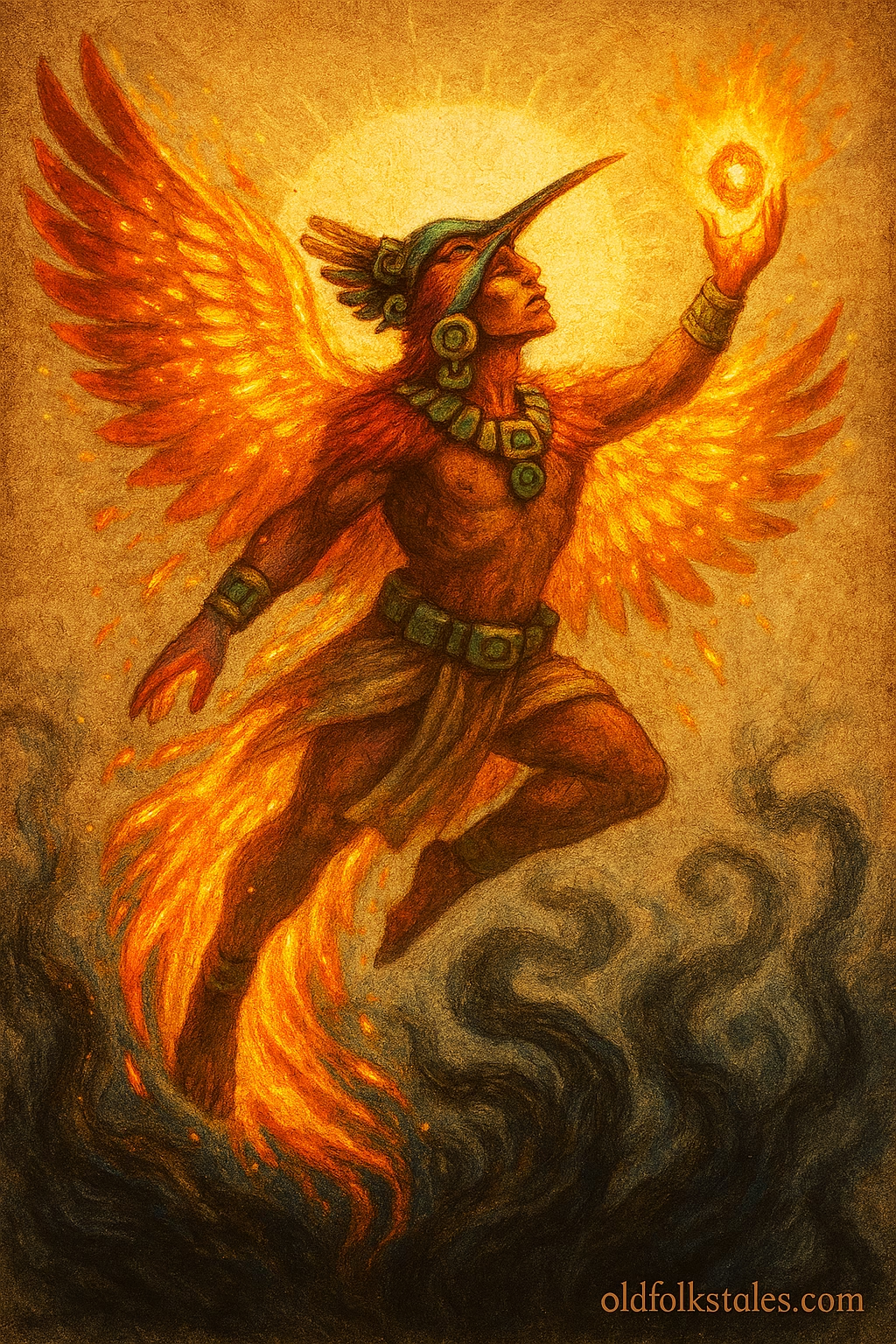
Before the maize sprouted and before humankind learned to call the sky by name, the First Father Itzamna gazed upon the still-dark earth. The lands were rich but sleeping, untouched by the warmth of fire or the rhythm of cultivated life. So Itzamna shaped a hero of dawn-light and hummingbird-wings, a being swift enough to move between worlds and bright enough to carry divine knowledge. Thus was born the Hummingbird-Prophet, half deity, half mortal promise, feathered in iridescence, heart lit with the spark of celestial fire.
He grew under the tutelage of Itzamna in the Celestial Court, learning the language of stars, the secrets of carving terraces into mountain slopes, the proper way maize spirits should be honored. Yet despite his beauty and grace, sorrow stirred in him. Below, the human clans lived huddled in cold darkness, frightened by prowling night-creatures and tricked by underworld spirits who kept the fire for themselves. The Hummingbird-Prophet watched as people scratched the soil without knowledge, harvesting little, offering meager thanks.
“Father,” the prophet said, wings shimmering like shards of morning, “give me leave to descend. Let me awaken them.”
Itzamna looked long upon his creation, knowing the path before him would cross shadows no light could guarantee victory over. “If you descend,” the god warned, “you must face the Lords of Xibalba, who hoard the fire. You will not return untouched.”
The Prophet bowed. “Still, I descend.”
And so he fell from the sky like a beam of bright pollen, landing among the bewildered Maya clans. They gathered around his glow, awe-struck as he spoke in both divine resonance and human gentleness. He taught them to shape fields into milpas, to sing to the maize before planting, to observe the dance of seasons. He showed them how to watch the hummingbird, whose hovering mirrored the patient attention required for cultivation.
But still the nights were cold.
Fire, the spirits of Xibalba guarded. And the people shivered.
Thus the Hummingbird-Prophet journeyed to the Mouth of the Earth, where the cavern yawned like a blackened jaw. He folded his dawn-light close, dimming himself so the underworld sentries would not see him blaze. Through nine perilous layers he traveled, through rooms of quaking earth, through chambers where obsidian knives whispered promises of despair, through corridors where echoes of old fears tried to bind his wings. At every turn the Lords of Xibalba tested him.
“Why do you descend, little bird?” they asked in voices like shifting bones. “What gift can you give mortals that we should surrender our flame?”
He answered, “A future that does not crawl in darkness.”
They mocked him. “A future must be earned.”
Thus they challenged him to trials.
In the House of Blades, he danced so swiftly that the knives could not taste his feathers.
In the House of Cold, where frost spirits clung like jealous hands, he wrapped his heart in the memory of Itzamna’s sun.
In the House of Jaguars, he sang a dawn-song so piercing the beasts were lulled, dreaming of early light.
But no test cut as deeply as the House of Mirrors.
There, reflections formed from crystal walls, each one a possible self: a tyrant with fire-power clenched in his grasp, a god who abandoned mortals for celestial ease, a warrior burning villages that displeased him. The Prophet staggered. In every reflection he saw that fire, once stolen, could corrupt. To give fire meant offering humans a power that could scorch fields, raze homes, or be wielded by the cruel.
Doubt clouded his wings.
Was he truly serving Itzamna’s will? Or only his own longing to be adored by mortals? The reflections whispered, “You will fall as we did. Leave the fire. Let humans fend for themselves.”
The Hummingbird-Prophet shut his eyes and steadied his heart. He remembered the shivering children he had seen, the barren fields, the prayers made in hunger. He remembered that knowledge, like maize, must be tended with care, not hoarded through fear.
With a cry sharp enough to shatter illusions, he beat his wings, scattering the false selves. Light returned to him.
At last he reached the Chamber of Fire, where the flame was guarded by a serpent-spirit coiled around a basin of molten radiance. Its eyes glowed like dying stars.
“Why should I let you take the spark?” it hissed. “Fire is power. Power breaks the weak.”
“Fire is life,” the Prophet replied, “when given with wisdom.”
The serpent struck, but the Hummingbird-Prophet wove around it, darting with supernatural swiftness. He plucked a single ember, holding it close to his heart, where it fused with his divine light. The serpent roared as his wings blazed brighter than the torches of Xibalba, and the Prophet ascended through the cavern, pursued by curses and shadows.
He burst into the mortal world as a streak of dawn-fire. The people gathered, trembling. He opened his hands; the ember sparked, danced, and became the first hearth-fire. Villagers cried out in gratitude, warming their faces, cooking their first true meals, feeling protection against the night.
But the Prophet did not remain unchanged.
His once-iridescent feathers were scorched at the tips, his glow dimmed by the shadows he had passed through. He had seen how fragile the balance was, light and shadow intertwined. So he became not a ruler but a wandering teacher, guiding the people in the right use of fire, ensuring that knowledge and power grew together.
In time, he vanished into the forests, becoming one with the hummingbird spirits. To this day, when a hummingbird hovers suddenly at dawn, elders say it is the Prophet checking that fire is still used with gratitude, not arrogance.
AUTHOR’S NOTE
The Hummingbird-Prophet stands as a Maya symbol of balance, between worlds, between power and humility, between divine gift and human responsibility. His story reflects enduring Maya values: respect for maize, harmony with nature, and the understanding that every gift carries moral weight.
KNOWLEDGE CHECK
-
Who created the Hummingbird-Prophet, and why?
-
What did the Prophet teach humans before seeking fire?
-
Name two trials he faced in Xibalba.
-
What moral struggle did he confront in the House of Mirrors?
-
How did he finally obtain the fire?
-
What symbolic purpose does his scorched feathers serve?
CULTURAL ORIGIN: Maya civilization; Mesoamerica (particularly Yucatán, Chiapas, and Guatemala highlands).
SOURCE: Inspired by Maya cosmology, glyphic traditions, and commentary on the Popol Vuh (Tedlock, 1985).