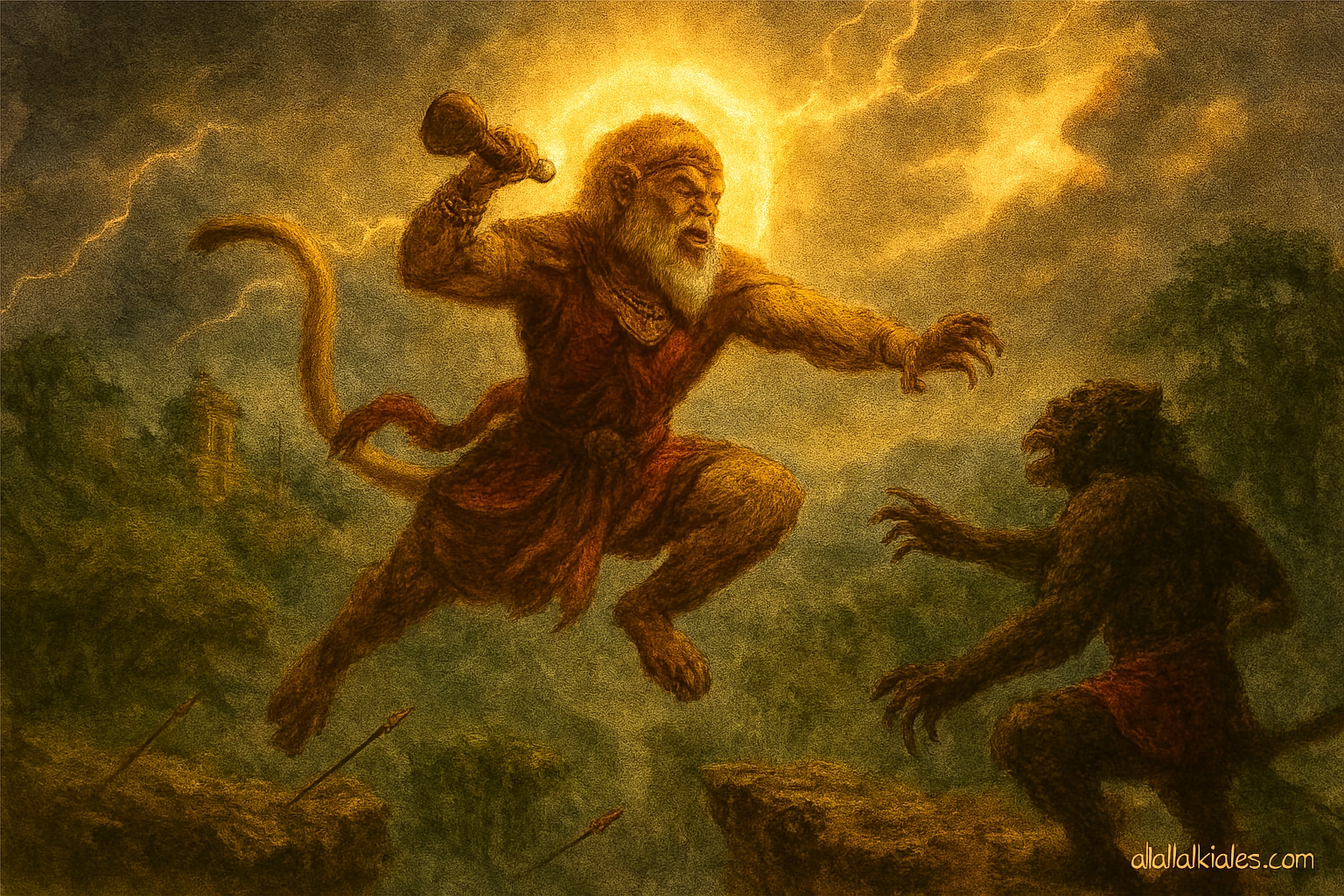
In an age when mountains still whispered their secrets and forests held the footprints of gods, the kingdom of Kishkindha rose like a citadel of ancient stone. At its heart stood Vali, the Monkey King, born not of mortal lineage, but of the celestial breath of Indra himself. Thunder shaped his bones, lightning fired his blood, and the divine vigor of the heavens coursed through every sinew of his being. From his first roar at birth, the world understood that a champion of cosmic purpose had arrived.
Vali’s youth was a tapestry of triumphs. He leapt across chasms where eagles dared not fly and wrestled crocodiles beneath the black waters of forest lakes. But more than physical might, he possessed a fierce loyalty, unyielding as the roots of the oldest fig trees. To his brother Sugriva, he was a shield. To his people, he was the mountain against which all storms broke. Yet even heroes shaped in heaven must someday walk the razor path between duty and destiny.
The greatest challenge of Vali’s life began as whispers, rumors of a demon who stalked the southern forests, a monstrous terror named Mayavi. His hunger for destruction was so immense that even the wind feared to pass through the trees he haunted. One night, as the moon stood pale and trembling, Mayavi approached the gates of Kishkindha and bellowed a challenge to Vali. No king born of Indra would retreat. With a cry that shook the earth, Vali charged forward, Sugriva beside him, both driven by the fire of brotherhood.
Mayavi fled into a dark cavern, its entrance gaping like the mouth of the underworld. Vali ordered Sugriva to remain outside while he pursued the demon alone. Days passed. Then weeks. Blood-curdling screams echoed from the cavern, and at last a torrent of blood spilled out onto the stones. Sugriva, believing his brother dead, sealed the cavern in terror and sorrow. But Vali had not fallen. Emerging victorious and weary after a titanic battle, he returned to find the entrance closed and his kingdom in Sugriva’s hands.
From this moment, Vali’s greatest moral struggle ignited. Betrayal, real or imagined, burns hotter than any demon’s breath. In his wrath, Vali confronted Sugriva, unable to understand the fear and grief that had driven his brother’s desperate choice. Their bond shattered like a sacred vessel. Vali cast Sugriva into exile and claimed his brother’s wife, believing the laws of kingship permitted such judgment. Yet beneath his thunderous command lay a heart clouded by wounded pride, not malice.
Kishkindha prospered under Vali’s reign, but destiny had begun its silent work. Far to the north, Rama, exiled prince of Ayodhya and earthly incarnation of Vishnu, sought allies in his quest to rescue Sita from the demon king Ravana. Sugriva, trembling yet resolute, pledged his service to Rama in exchange for protection and justice against his mighty brother. Rama agreed, recognizing that Vali, for all his greatness, had allowed righteousness to slip from his grasp.
The confrontation unfolded in the trembling light of dawn. Vali stood radiant, his aura blazing like a golden storm, his strength multiplied a hundredfold by a divine boon. When he met Sugriva in combat, the forest quaked, branches snapping beneath the force of their blows. But Rama watched from concealment, as agreed. And when Sugriva faltered under Vali’s overwhelming power, Rama loosed the arrow that would alter the fate of Kishkindha forever.
The shaft flew with the certainty of cosmic decree, striking Vali in the heart. Stunned more by the justice behind the strike than by the wound itself, Vali fell against the roots of an ancient tree. The world seemed to hush. Birds stilled in mid-flight. The wind bowed low.
“Why,” Vali asked, his voice dimming like the last rumble of thunder, “does a righteous prince strike from the shadows?”
Rama stepped forth, carrying the calm of oceans in his gaze. He spoke of dharma, of order, duty, and the misuse of kingly power. He told Vali that a ruler’s strength must serve balance, not vengeance; protection, not pride. Hearing this, Vali’s anger dissolved. In its place rose clarity, like sunlight breaking through a storm.
“If my fall restores righteousness,” Vali murmured, “then let my passing be a doorway to peace.” With final breath, he entrusted his son Angada to Rama’s care, ensuring a lineage rooted not in bitterness, but reborn in justice.
Thus ended the life of Vali, the thunder-souled king. But the echoes of his truth, strength guided by duty, would shake the world long after his body returned to the forest. Trees whispered his name. Storms carried his roar. And warriors of every age remembered that even the mighty must bow before the eternal law of dharma.
AUTHOR’S NOTE
Vali’s story is one of celestial power, human flaw, and ultimate illumination. His journey shows that greatness without wisdom can wander from its purpose, yet redemption lies in understanding one’s missteps. His legacy endures as a reminder that even divine strength must serve justice, compassion, and universal harmony.
KNOWLEDGE CHECK
-
What divine origin grants Vali his immense power?
-
Which demon challenges Vali and leads him into the fateful cavern?
-
What misunderstanding causes the rift between Vali and Sugriva?
-
Why does Sugriva seek Rama’s help?
-
What justification does Rama give for striking Vali?
-
What symbolic legacy does Vali leave through his final words?
CULTURAL ORIGIN: Vali’s tale originates from ancient Hindu mythology, specifically within the Ramayana, one of India’s foundational epics. It reflects values of dharma, kingship, duty, and the consequences of moral imbalance.
SOURCE: Valmiki’s Ramayana, Book IV: Kishkindha Kanda, classical Sanskrit literature (c. 500 BCE–100 BCE).