
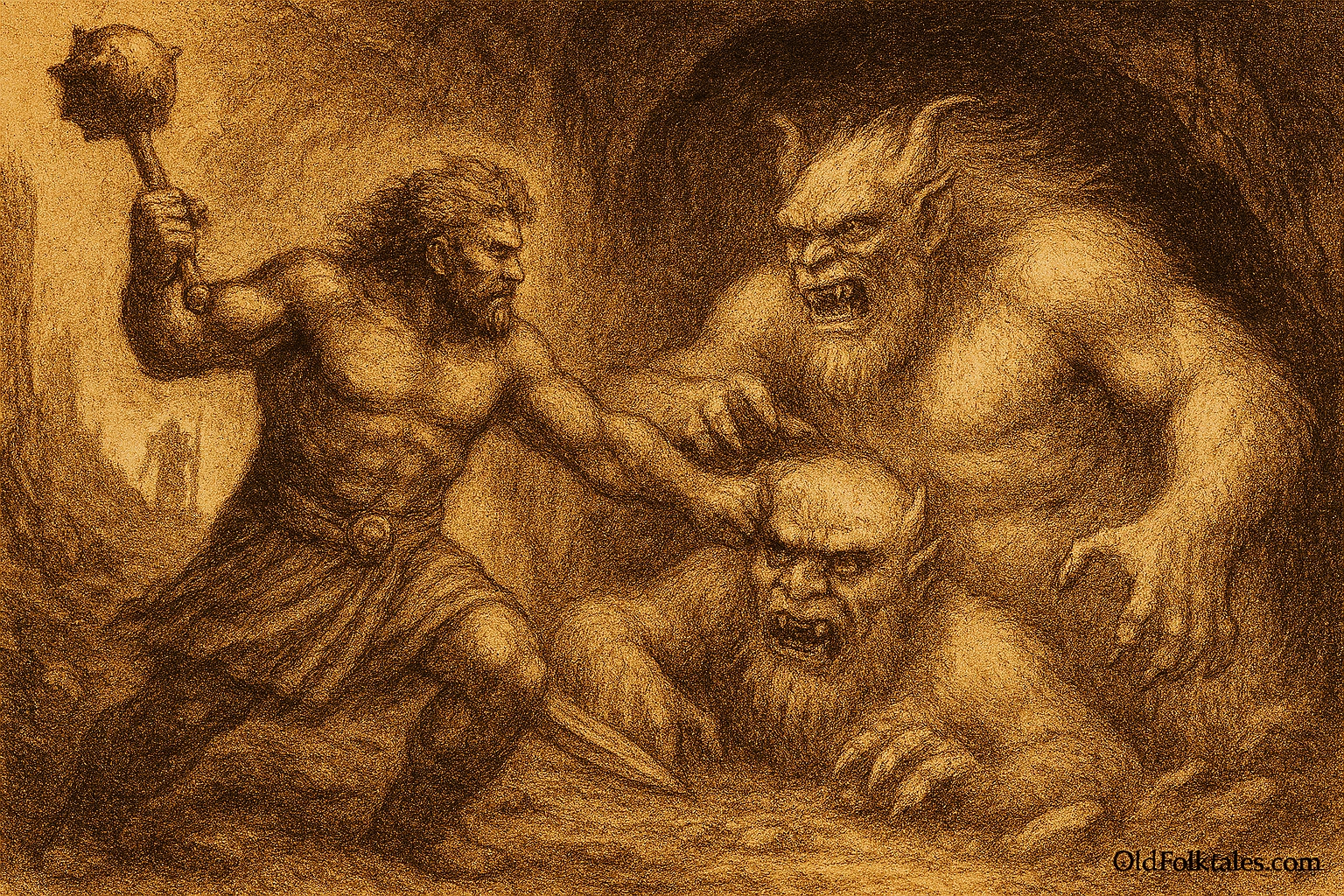
In the ancient days when the world was still young, and the boundary between earth and magic remained thin, there lived a hero whose name would echo through the mountains and valleys of Persia for countless generations. His name was Rustam, and his strength was legendary a warrior whose courage burned as bright as the sun that rose over the peaks of Mazandaran.
In those times, King Kai Kāvus ruled the Persian lands with wisdom and authority. But the king possessed a fatal flaw: pride. His ambition grew so great that he believed he could conquer even the magical realm of Mazandaran, a place where demons dwelled among twisted forests and ancient evil held dominion. Against all counsel, the king marched his army into that cursed land, seeking glory beyond mortal reach.
Click to read all Myths & Legends – timeless stories of creation, fate, and the divine across every culture and continent
The demons of Mazandaran did not take kindly to this intrusion. Led by the terrible White Demon, the Div-e Sefid, they unleashed their dark magic upon the Persian forces. The king’s soldiers fell into enchanted sleep, unable to lift their swords or cry out for help. And King Kai Kāvus himself suffered the cruelest fate drops of demon blood fell into his eyes, stealing his sight and plunging him into eternal darkness. The proud king who had sought to conquer the unconquerable now sat helpless and blind, a prisoner in the demon’s realm.
Word of this disaster reached the ears of Rustam, the mightiest warrior in all of Persia. He stood tall as a cypress tree, his shoulders broad enough to carry the weight of kingdoms. His faithful companion was Rakhsh, a magnificent rose-colored stallion whose speed and intelligence were matched only by his loyalty. When Rustam heard of his king’s plight, he did not hesitate. He saddled Rakhsh, took up his great mace and sword, and set forth on the perilous journey to Mazandaran.
The path before him wound through seven deadly valleys, each one designed to break the spirit and body of any mortal who dared to traverse them. The first valley stretched endlessly, a wasteland of scorching heat where water vanished like dreams upon waking. Rustam’s throat burned with thirst, but he pressed onward, trusting in Rakhsh to guide him to hidden springs.
In the second valley, lions prowled in the shadows, their eyes glowing with hunger. A massive beast attacked while Rustam slept, but Rakhsh fought valiantly, his hooves striking like hammers until the lion lay defeated. Rustam awoke to find his faithful horse standing guard, blood staining his perfect coat.
The third valley brought a dragon, ancient and terrible, with scales like black iron and breath that reeked of sulfur. It rose from the darkness, coiling and hissing, its jaws wide enough to swallow horses whole. Rustam drew his sword, the blade singing as it left its sheath. The battle raged for hours, warrior and monster locked in deadly combat, until finally Rustam’s blade found the dragon’s heart. The beast fell with a sound like thunder, and the hero continued onward.
Through valleys of enchantment and illusion, past demons who whispered madness and sorceresses who tried to bind him with spells, Rustam journeyed deeper into Mazandaran. Each trial tested him in different ways his strength, his wisdom, his resolve. But the thought of his blinded king trapped in darkness drove him forward, step after determined step.
At last, after crossing all seven valleys, Rustam arrived at the demon’s stronghold. The land around it was poisoned and dead, the very ground cracked and bleeding darkness. And there, in a cavern that yawned like the mouth of hell itself, dwelled the White Demon the Div-e Sefid.
The demon was monstrous beyond imagination. His skin was pale as death, his body massive as a mountain. His eyes burned with malevolent intelligence, and his voice rumbled like an avalanche. When he saw Rustam approach, he laughed, a sound that shook the very stones.
“Another mortal comes to die,” the White Demon bellowed. “I have blinded your king and destroyed your army. What can one man do against me?”
“I am Rustam,” the hero replied, his voice steady as steel. “And I have come to end your reign of terror.”
The battle that followed was like nothing the world had witnessed before. Rustam and the White Demon clashed with the fury of storms. The demon wielded dark magic, hurling boulders and summoning fire. But Rustam was protected by righteousness and his own indomitable will. His mace struck like lightning, his sword cut through shadow and flesh alike.
For three days and three nights they fought, neither yielding, neither falling. The earth trembled beneath their struggle. Mountains cracked. Rivers changed their course. Finally, with one mighty blow from his mace, Rustam struck the demon’s head and sent him crashing to the ground.
But the demon was not yet dead. With his last strength, Rustam seized the White Demon and tore open his chest. He pulled out the monster’s still-beating heart, black and pulsing with evil. The demon let out one final terrible scream before his body dissolved into smoke and shadow.
Rustam did not rest. He carried the demon’s heart to where King Kai Kāvus sat in darkness, surrounded by his sleeping army. Following the ancient knowledge passed down through generations, Rustam squeezed the heart, letting three drops of blood fall into the king’s sightless eyes.
Immediately, the darkness lifted. King Kai Kāvus blinked, and light flooded back into his vision. He could see once more the face of his loyal champion, the sky above, the world he had thought lost forever. The enchantments broke like chains snapping. His soldiers awoke from their cursed sleep, stretching and reaching for their weapons, confused but alive.
The king embraced Rustam with tears of gratitude flowing down his face. “You have saved not just my sight,” he said, “but my kingdom and my soul. I was blind in more ways than one blind to my pride, blind to my limitations. You have shown me that true strength lies not in conquest, but in courage used for righteous purpose.”
Rustam and King Kai Kāvus returned home in triumph, the hero’s legend growing with every retelling. The tale of the seven valleys and the White Demon became immortal, passed from generation to generation, a reminder that even in the darkest places, courage and loyalty can bring light.
The Moral Lesson
The legend of Rustam and the White Demon teaches us that pride leads to downfall, while humility and courage lead to victory. King Kai Kāvus’s ambition blinded him both literally and figuratively, showing how arrogance can make us vulnerable to forces we cannot control. Rustam represents the virtues of loyalty, perseverance, and selfless service willing to face impossible odds not for glory but to help those in need. The tale reminds us that true heroism lies not in seeking power over others, but in having the courage to confront evil and the wisdom to know when battles must be fought.
Knowledge Check
Q1: Who is Rustam in Tajik and Persian epic tradition?
A1: Rustam is the greatest hero in Persian and Tajik epic tradition, a legendary warrior of immense strength and courage who serves as the champion of Persia, featured prominently in Ferdowsi’s Shahnameh.
Q2: Why did King Kai Kāvus lose his sight in the legend?
A2: King Kai Kāvus lost his sight because his pride led him to invade the magical realm of Mazandaran against all advice, and the White Demon punished his arrogance by dropping demon blood into his eyes, causing blindness.
Q3: What challenges did Rustam face on his journey to save the king?
A3: Rustam faced seven deadly valleys filled with trials including scorching deserts, attacking lions, a massive dragon, demons, sorceresses, and various magical traps and illusions before reaching the White Demon’s stronghold.
Q4: How did Rustam restore King Kai Kāvus’s sight?
A4: After defeating the White Demon, Rustam tore out the demon’s heart and squeezed it, letting three drops of blood fall into the king’s eyes, which immediately restored his vision and broke all enchantments.
Q5: What does the White Demon (Div-e Sefid) symbolize in this Persian epic?
A5: The White Demon symbolizes the forces of evil, chaos, and darkness that must be overcome through courage and righteousness. He also represents the consequences of human pride and the supernatural dangers of overreaching ambition.
Q6: What is the cultural significance of this legend in Tajikistan?
A6: This legend from Ferdowsi’s Shahnameh is a cornerstone of Tajik cultural heritage, representing Persian literary tradition and values. It exemplifies the timeless themes of heroism, loyalty, and the triumph of good over evil that define Tajik national identity.
Source: Adapted from Ferdowsi’s Shahnameh (The Book of Kings)
Cultural Origin: Persian/Tajik Epic Tradition, Tajikistan and Greater Persian Cultural Sphere






