
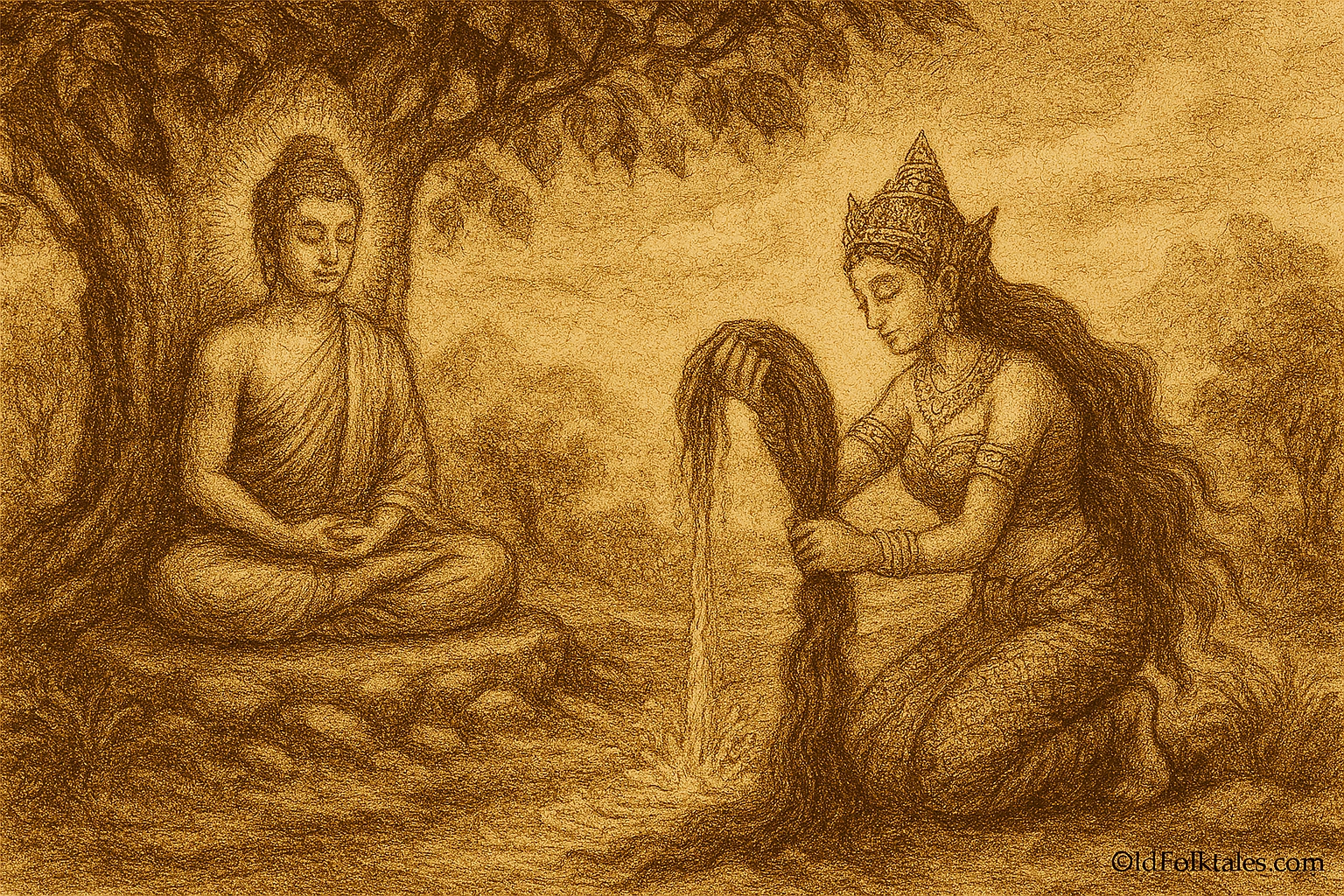
Beneath the spreading branches of the sacred Bodhi tree, as twilight painted the sky in shades of gold and crimson, sat Prince Siddhartha. He had wandered for years seeking the answer to human suffering, and now, after forty-nine days of deep meditation, he stood at the threshold of perfect enlightenment. The air around him shimmered with spiritual energy, and all of nature seemed to hold its breath, waiting for the moment when a mortal would become the Buddha, the Awakened One.
But there were forces in the universe that did not wish to see this transformation come to pass.
From the shadows of the spirit realm emerged Mara, the demon of desire, delusion, and death. His form was terrible to behold, shifting between beauty and horror, his eyes burning with jealousy and rage. Mara ruled over the cycle of suffering, and if Siddhartha achieved enlightenment, his dominion would be broken. Humans would have a path to freedom from the endless wheel of birth, death, and rebirth.
Click to read all Myths & Legends – timeless stories of creation, fate, and the divine across every culture and continent
Mara would not allow it.
The demon approached with honeyed words at first, his voice smooth as silk. “Why do you sit here beneath this tree, starving yourself, abandoning the pleasures of life? You were a prince, Siddhartha. You could return to your palace, to soft beds and sweet music, to your wife and child. Why torture yourself with this meaningless quest?”
But Siddhartha remained unmoved, his eyes closed, his breath steady as the tide. His mind was clear as still water, reflecting truth without distortion.
Seeing that temptation would not work, Mara’s face twisted with fury. He summoned his three daughters Tanha, Arati, and Raga each embodying aspects of craving, discontent, and passion. They danced before the meditating prince, their movements hypnotic, their voices singing songs designed to pierce even the most disciplined heart. They wove illusions of pleasure and comfort, trying to pull Siddhartha away from his sacred purpose.
Still, he did not move. His meditation deepened, drawing him closer to the ultimate truth.
Mara’s rage exploded like a storm. If seduction would not work, then he would use force. He raised his arms and called forth his armies legions of demons and hungry ghosts, creatures of nightmare and shadow. They came howling from every direction, brandishing weapons of fear and doubt. They hurled arrows of anxiety, spears of despair, and chains of attachment. The very air grew thick with their presence, and the earth trembled beneath their march.
But every weapon that flew toward Siddhartha transformed before it could touch him. Arrows became flowers that fell softly at his feet. Spears turned to lotus petals drifting on gentle winds. The demons’ shouts of hatred dissolved into the whisper of leaves.
Mara stood before the meditating prince, his form towering and terrible, casting shadows that seemed to swallow the stars themselves. “By what right do you claim this enlightenment?” the demon roared. “I have armies to witness my power! Who will testify for you? Who will bear witness to your worthiness?”
This was the crucial moment. Mara’s challenge struck at the heart of Siddhartha’s journey. Who could verify the countless lifetimes of merit, the endless acts of compassion and sacrifice that had prepared him for this moment? His followers had fled in fear. The gods watched from afar but dared not intervene in this cosmic battle. He sat alone beneath the tree, with no one to speak on his behalf.
Except the earth itself.
With perfect calm, Prince Siddhartha extended his right hand downward, his fingers touching the ground in what would become known as the earth-touching gesture, the bhumisparsha mudra. It was not a gesture of aggression or defense, but a simple, quiet act a call to the oldest witness of all.
“The earth knows,” he said, his voice clear and unshakeable. “Let the earth bear witness.”
At that touch, the ground beneath the Bodhi tree began to tremble. Not with violence, but with recognition. Deep within the soil, in the very bones of the world, something ancient stirred. The earth remembered every step Siddhartha had taken in this life and countless lives before. It remembered every seed he had planted, every creature he had helped, every drop of water he had given to the thirsty, every moment of kindness that had fallen like rain upon its surface.
And then she rose.
Phra Mae Thorani, the Earth Mother, emerged from the ground like dawn breaking over mountains. Her form was magnificent a goddess whose beauty reflected the fertility and strength of the living world. Her skin glowed like burnished bronze, her eyes held the depth of ancient forests, and her hair flowed down her back, thick and dark as the richest soil, impossibly long, reaching down past her waist, past her knees, cascading like a river of night.
She faced Mara and his armies with the serene power of one who has witnessed the birth and death of countless ages. “I am the witness,” Phra Mae Thorani declared, her voice resonating like thunder across still water. “I have held this being through every lifetime. His merit is beyond counting, his compassion deeper than my deepest caverns, his sacrifice greater than my highest peaks.”
Mara laughed mockingly, though his confidence had begun to waver. “Words! Show me proof, Earth Mother! Show me evidence of these claims!”
Phra Mae Thorani smiled, ancient and knowing. She gathered her impossibly long hair in both hands, the strands winding around her fingers like living things. Her hair had absorbed every libation, every offering of water that Siddhartha had poured upon the earth throughout his countless lifetimes acts of generosity, moments of renunciation, gifts given freely without expectation of return. Each good deed, each sacrifice, had seeped into the ground and been held safe in her keeping.
Now, with steady hands, she wrung her hair.
Water poured forth not a trickle, not a stream, but a mighty flood. It gushed from her hair like monsoon rains, like rivers breaking their banks, like oceans upending themselves upon the land. The water was crystal clear and carried within it the weight of infinite merit, the accumulated evidence of countless compassionate acts.
The flood roared toward Mara’s armies with unstoppable force. Demons shrieked and scattered, their forms dissolving like smoke in the torrent. Mara himself stumbled backward, his power breaking against the truth that Phra Mae Thorani had unleashed. His daughters vanished. His weapons shattered. His throne of pride crumbled and was swept away in the sacred waters.
The flood subsided as quickly as it had risen, leaving the ground clean and peaceful. Mara and his armies were gone, washed away by the evidence of truth. The night grew quiet again, broken only by the gentle rustle of the Bodhi tree’s leaves.
Phra Mae Thorani bowed to Prince Siddhartha and descended back into the earth, returning to her eternal vigil. The prince, now free from all obstruction, deepened his meditation. As the morning star rose in the eastern sky, he achieved perfect enlightenment, becoming the Buddha, the Awakened One who would teach the path to liberation for all beings.
From that moment forward, Phra Mae Thorani has been honored throughout Thailand as the faithful witness, the mother who protects truth, and the embodiment of the earth’s boundless capacity to remember and testify to goodness. Her image appears in temples and homes, her story is told to children, and her gesture wringing water from her hair has become a sacred symbol of the truth that cannot be denied, the merit that cannot be erased, and the protection that the earth itself offers to those who walk the path of righteousness.
The Moral Lesson
The legend of Phra Mae Thorani teaches us that the earth itself bears witness to our actions, both good and bad. Every act of kindness, every moment of compassion, every sacrifice we make is remembered and will testify on our behalf when we need it most. The story reminds us that truth needs no army to defend it, it simply is, as solid and undeniable as the ground beneath our feet. Phra Mae Thorani’s intervention shows that when we align ourselves with righteousness and truth, the very forces of nature will rise to protect us. Finally, it demonstrates that the greatest power lies not in violence or intimidation, but in the accumulated weight of virtuous living.
Knowledge Check
Q1: Who is Phra Mae Thorani in Thai Buddhist tradition?
A1: Phra Mae Thorani is the Earth Mother goddess in Thai Buddhist tradition, the personification of the earth who serves as the eternal witness to all actions and protector of truth and righteousness.
Q2: Why did Mara try to stop Prince Siddhartha from achieving enlightenment?
A2: Mara, the demon of desire and delusion, tried to stop Siddhartha because the prince’s enlightenment would break Mara’s dominion over the cycle of suffering and provide humanity with a path to liberation from endless rebirth.
Q3: What is the significance of the earth-touching gesture (bhumisparsha mudra)?
A3: The earth-touching gesture, where Buddha touched the ground with his right hand, was a call to the earth to bear witness to his merit and worthiness for enlightenment, summoning Phra Mae Thorani to testify on his behalf.
Q4: How did Phra Mae Thorani defeat Mara’s armies?
A4: Phra Mae Thorani wrung her long hair, releasing a massive flood of water that had accumulated from all of Buddha’s virtuous acts and offerings throughout countless lifetimes, washing away Mara’s demon armies with the force of accumulated merit.
Q5: What does the water from Phra Mae Thorani’s hair symbolize?
A5: The water symbolizes the accumulated merit and evidence of countless compassionate acts, libations, and virtuous deeds that Buddha performed throughout his lifetimes proof of his worthiness that the earth had faithfully preserved.
Q6: What is the cultural significance of Phra Mae Thorani in Thailand today?
A6: Phra Mae Thorani remains a revered figure in Thai Buddhist culture, appearing in temple art and sculptures throughout Thailand. She represents the earth’s protection of truth, the importance of witnessed virtue, and the connection between Buddhist spirituality and the natural world.
Source: Adapted from Thai Buddhist canonical art and literature
Cultural Origin: Thai Buddhist Tradition, Thailand






