In the harsh and beautiful land of Turkmenistan, where the desert winds whisper ancient secrets and the mountains stand eternal witness to the passage of time, there lived a man whose name would become synonymous with justice itself. But the story of Gorogly begins not with triumph, but with tragedy a darkness so profound that it would forge a hero unlike any the world had seen.
Long ago, in a time when tyrants ruled without mercy and the poor suffered in silence, there lived a noble man who dared to speak truth to power. He was a voice for the voiceless, a defender of the weak, and for this, the cruel ruler of the land hated him. The tyrant’s heart was black as midnight, his cruelty boundless as the desert. He could not tolerate anyone who challenged his authority or questioned his injustice.
Click to read all Myths & Legends – timeless stories of creation, fate, and the divine across every culture and continent
One terrible day, the tyrant’s soldiers came for this righteous man. They seized him, and despite his wife’s pleas and tears, they executed him for the crime of refusing to bow before wickedness. His pregnant wife was left alone, her heart shattered, her future destroyed. In her grief, she felt as though she too had died, as though the world itself had ended with her husband’s last breath.
The woman’s sorrow was so deep that it affected her unborn child. When her time came to give birth, something extraordinary and terrible happened. The labor was long and agonizing, and when it finally ended, the woman herself passed away, her strength spent, her spirit broken by loss. The midwives who attended her made a horrifying discovery the child had been born inside what appeared to be a coffin, a wooden vessel that had somehow formed around him in the womb, as if his mother’s grief had created a protective shell around her son.
The midwives were terrified. They believed this was a terrible omen, a cursed child who would bring only misfortune. They discussed abandoning the infant, leaving him to die in the wilderness where his dark fate could not touch the living. But one old woman among them, wiser than the rest, stopped them.
“No,” she said firmly, her voice carrying the weight of years. “This child has survived what should have killed him. He was born surrounded by death, yet he lives. This is not a curse this is a sign. This boy is marked by destiny for something great.”
They opened the strange coffin-cradle and found inside a baby boy, alive and crying lustily, his eyes bright and fierce even in those first moments. They named him Gorogly, which means “Son of the Grave,” for he was a child born from death itself, a living miracle wrapped in tragedy.
The old woman took the boy and raised him as her own. From his earliest days, it was clear that Gorogly was no ordinary child. He grew faster and stronger than other children, his limbs thick with muscle, his voice deep and commanding even in youth. By the time he was ten years old, he had the strength of three grown men. By fifteen, he could lift horses and bend iron bars with his bare hands.
But it was not just physical power that set Gorogly apart. His mind was sharp as any blade, his heart burned with an unquenchable fire for justice, and his tongue could shape words into poetry that made grown men weep or roar with courage. He learned the stories of his father’s murder, of the tyrant who had destroyed his family, and a sacred purpose took root in his soul like a tree whose roots reach down to touch the very heart of the earth.
“I was born in a coffin,” Gorogly would say, his voice resonating like thunder across the steppes, “but I will not let others die in chains. I was born from injustice, and I will spend my life fighting it.”
As he grew to manhood, Gorogly became a champion of the oppressed. Wherever tyranny raised its ugly head, wherever the powerful crushed the weak, wherever injustice held sway, there you would find Gorogly. He gathered around him a band of forty brave companions, warriors who shared his vision of a world where justice prevailed and the innocent were protected.
His fame spread across the land like wildfire. When corrupt officials extorted money from poor farmers, Gorogly appeared to right the wrong. When bandits terrorized villages, he rode down upon them like divine retribution. When armies of tyrants marched to conquer peaceful peoples, Gorogly stood in their path, his sword flashing like lightning, his battle cry shaking the heavens.
But Gorogly was not merely a warrior he was a poet and a sage. Before battles, he would recite verses that stirred the souls of his companions, filling them with courage that knew no bounds. After victories, he would compose songs that celebrated not his own glory but the triumph of justice and the dignity of common people. His poetry was passed from village to village, sung by shepherds and farmers, memorized by children and elders alike.
The tyrant who had killed Gorogly’s father still ruled, grown even more cruel with age. When he heard of this hero who was rallying the people, inspiring rebellion through strength and song, he knew that his old enemy had returned in the form of this remarkable son. He sent army after army to destroy Gorogly, but each one fell before the hero’s might and cunning.
One legendary battle lasted for seven days and seven nights. The tyrant’s forces surrounded Gorogly and his companions on a rocky mountain, believing they had finally trapped the great hero. But Gorogly turned the mountain itself into a fortress. During the day, he fought with such ferocity that the enemy soldiers broke and fled in terror. During the night, he recited poetry and songs that echoed across the valleys, reminding his people why they fought and what they fought for.
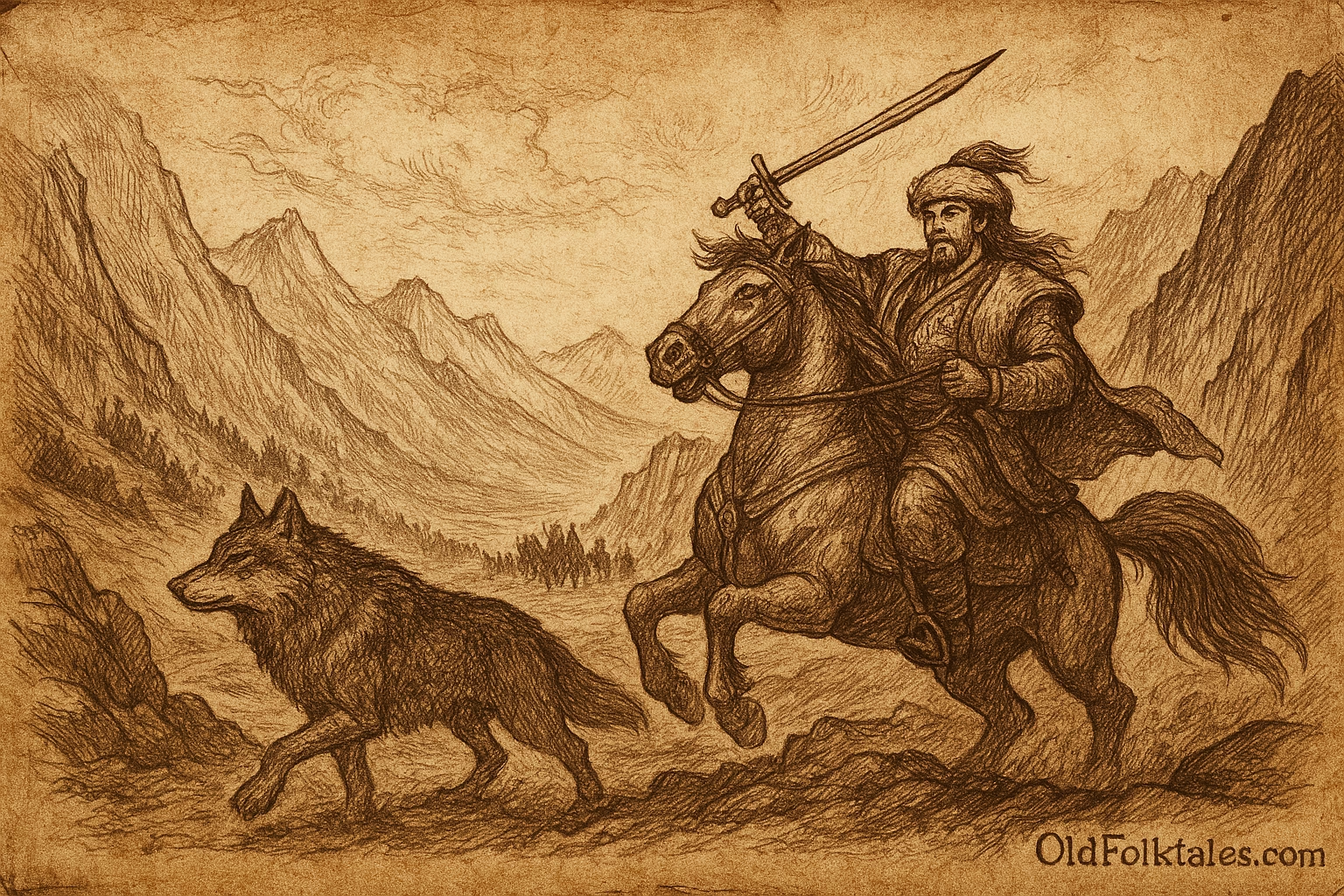
On the seventh day, as the sun rose blood-red over the battlefield, Gorogly rode down from the mountain alone. His companions had begged him to let them fight beside him, but he refused to risk their lives. With his great sword singing in his hand and his horse thundering beneath him, he charged into the enemy army like a storm descending from the peaks.
The battle that followed became the stuff of legend. Gorogly fought with the strength of ten men, with the courage of a hundred, with the righteous fury of a nation that had suffered too long under oppression. When it was over, the tyrant’s army had scattered to the winds, and the cruel ruler himself had fled his throne, never to return.
But Gorogly did not claim the throne for himself. He had no desire for crowns or palaces. His mission was not to rule but to liberate, not to command but to inspire. He continued his wanderings, appearing wherever he was needed, defending the defenseless, speaking for the voiceless, and reciting poetry that kept alive the dream of a world built on justice rather than power.
The tales of Gorogly’s adventures became countless, passed down through generations in the oral tradition of the Turkmen people. There were stories of his battles against demons and dragons, his encounters with wise sages and beautiful maidens, his clever tricks that outwitted villains, and his profound verses that captured the soul of a nation. Each storyteller added their own flourishes, but the core remained the same Gorogly, the hero born in a coffin, who rose from tragedy to become a symbol of hope.
Even today, the epic of Gorogly lives in the hearts of the Turkmen people and beyond. His songs are still sung, his stories still told, his name still invoked when courage is needed. He remains a reminder that heroes can emerge from the darkest circumstances, that justice can triumph over tyranny, and that poetry and strength together can change the world.
The Moral Lesson
The epic of Gorogly teaches us that the circumstances of our birth do not determine our destiny. Though born literally in a coffin, surrounded by death and injustice, Gorogly transformed his tragic origins into a source of strength and purpose. The story reminds us that true heroism combines physical courage with moral conviction and intellectual wisdom Gorogly was warrior, poet, and champion of justice all at once. It demonstrates that fighting for the oppressed and speaking truth to power are the highest callings, and that one person of extraordinary conviction can inspire entire nations. Finally, the legend shows us that heroes are remembered not for seeking power for themselves, but for using their gifts to lift others from suffering.
Knowledge Check
Q1: What is the miraculous origin of Gorogly in Turkmen legend?
A1: Gorogly was born inside a coffin-like vessel after his father was murdered by a tyrant and his mother died during childbirth. This extraordinary birth, surrounded by death, marked him as a child of destiny with supernatural strength and purpose.
Q2: What made Gorogly different from other legendary warriors?
A2: Unlike many warriors, Gorogly combined physical strength and combat prowess with poetry and wisdom. He recited verses before battles to inspire courage, composed songs celebrating justice, and used his intellect as much as his sword to defeat enemies.
Q3: What was Gorogly’s primary mission throughout his life?
A3: Gorogly’s mission was to defend the oppressed, fight against tyranny and injustice, and give voice to the voiceless. He dedicated his life to protecting common people from corrupt officials, bandits, and cruel rulers rather than seeking power for himself.
Q4: How did Gorogly’s tragic origins shape his life’s purpose?
A4: Born from his father’s murder and his mother’s death, Gorogly transformed his tragic beginning into a sacred purpose—ensuring that others would not suffer the injustice that destroyed his family. His origins gave him deep empathy for the suffering of others.
Q5: What is the significance of Gorogly refusing to take the throne after defeating the tyrant?
A5: Gorogly’s refusal to claim power demonstrates that his heroism was not about personal ambition but genuine commitment to justice. He understood that true leadership means liberating people, not ruling over them, and continued his mission of defending the weak.
Q6: Why is the Gorogly epic important to Turkmen cultural heritage?
A6: The Gorogly epic is recognized by UNESCO as Intangible Cultural Heritage and represents core Turkmen values of justice, courage, and resistance to oppression. Passed orally for centuries, it embodies national identity and the triumph of righteousness over tyranny.
Source: Adapted from the traditional oral epic cycle of Gorogly (Koroğlu/Goroglu)
Cultural Origin: Turkmen People, Turkmenistan (shared heritage across Turkic regions)