
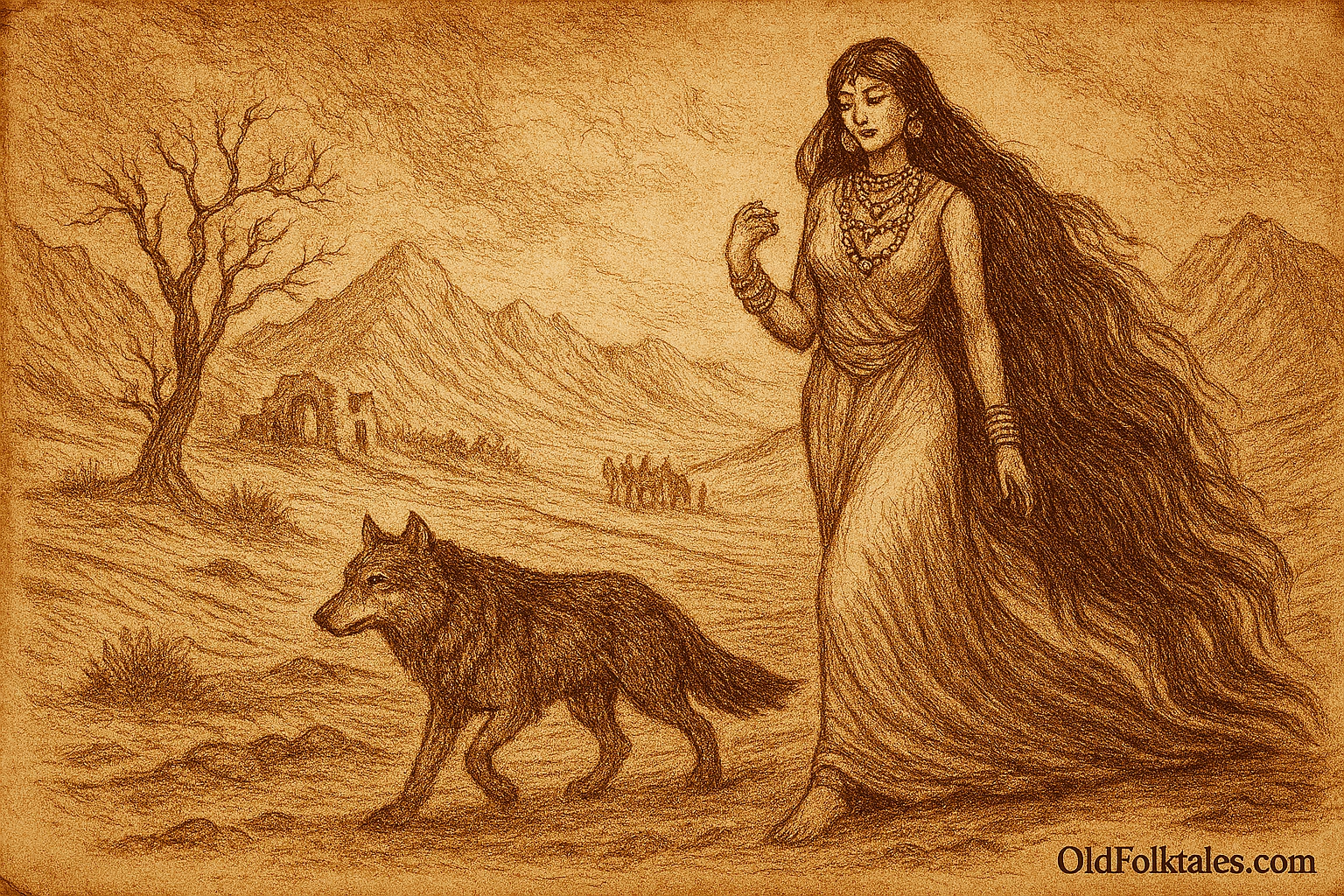
In the vast emptiness of the Arabian desert, where the sand stretches endlessly under a burning sun and the night brings both relief and danger, there exists a legend whispered around campfires and spoken in hushed tones when darkness falls. It is the tale of Umm Al Duwais, a spirit both beautiful and terrible, whose presence haunts the lonely places where wind sculpts dunes into ever-changing mountains and the horizon shimmers with mirages.
The desert has always been a place of extremes scorching heat and freezing nights, abundant life hidden beneath apparent barrenness, beauty that can kill and danger that can save. In such a landscape, it is no wonder that stories grow of beings who embody these contradictions, creatures who are neither fully human nor entirely spirit, who exist in the liminal spaces between the known and the unknown.
Click to read all Myths & Legends – timeless stories of creation, fate, and the divine across every culture and continent
Umm Al Duwais is such a being.
According to the ancient tales passed down through generations of Bedouin families and coastal communities across the Emirates, she appears most often in the loneliest hours, just after sunset, when the light turns golden and shadows grow long, or in the dead of night, when travelers find themselves far from the safety of their camps. She manifests in desolate places: abandoned wells, remote crossroads in the desert, stretches of beach where the sea whispers secrets to the sand, or ruins of old settlements half-buried by time and weather.
To those who first glimpse her, Umm Al Duwais appears as the most beautiful woman imaginable. Her form is perfect, her movements graceful as water flowing over stones. Her skin glows with ethereal radiance in the moonlight. Most striking of all is her hair impossibly long, cascading down her back like a dark waterfall, reaching past her knees to sweep the sand behind her. The hair moves as if alive, stirred by winds that no one else can feel.
She adorns herself with golden jewelry that catches every gleam of light bracelets that jingle softly as she moves, necklaces that rest against her throat, rings that glitter on her fingers. The gold is old and ornate, worked in patterns that seem both familiar and strange, as if crafted by hands that knew secrets lost to modern times. The sound of her jewelry is hypnotic, a soft chiming that draws the ear and the attention.
But it is her perfume that truly ensnares those who encounter her. The scent reaches travelers before they see her, carried on the desert breeze intoxicating, alluring, unlike any earthly fragrance. It speaks of exotic flowers that bloom only in hidden oases, of spices from distant lands, of promises and pleasures just out of reach. Men who catch that scent find their thoughts growing hazy, their judgment clouded, their feet moving toward its source without conscious decision.
The stories tell of travelers always men, and usually men who are married or committed to others who encounter this vision of beauty in the desert’s emptiness. She appears before them as if by accident, a woman alone and seemingly vulnerable, lost or in need of help. She speaks with a voice like honey, her words carefully chosen to appeal to vanity or desire or the urge to play the hero. Her smile is knowing, her eyes full of promises.
“I am alone,” she might say, her voice carrying perfectly in the desert silence. “Will you help me? Will you accompany me? Come, walk with me just a little way.”
And the man, forgetting his wife waiting at home, forgetting his duties and his honor, forgetting everything except the overwhelming desire that has seized him, follows. The perfume grows stronger. The jewelry chimes softly. Her laughter is like music, and he walks deeper into the desert, drawn by beauty and desire, his conscience silenced by enchantment.
But the desert is a place of truth, where illusions eventually fall away and reality reveals itself with merciless clarity.
As the man follows Umm Al Duwais farther from safety, farther from witness, farther from the possibility of rescue, she begins to change. It happens gradually at first so subtle that the enchanted victim might not notice immediately. Her movements become slightly more predatory. Her laughter takes on an edge that raises the hairs on the back of his neck. The perfume that was so alluring begins to smell wrong, tainted with something else beneath the sweetness decay, perhaps, or sulfur, or ancient earth disturbed.
And then she turns to face him fully.
In that moment, the illusion shatters like glass. The beautiful woman’s face transforms into something from nightmare her features twist and contort, her beautiful eyes become red as blood or black as wells, her smile stretches impossibly wide to reveal teeth like daggers. Her hands, which had seemed so delicate, extend into claws long, curved, sharp as any blade, capable of tearing flesh from bone.
Her hair, that glorious cascade that had seemed so alluring, begins to writhe like living serpents. Her golden jewelry, which had chimed so prettily, now clatters and clangs with a sound like chains. And from her throat comes a laugh that is no longer musical but horrible a sound that freezes the blood and turns the legs to water.
Some versions of the tale say that Umm Al Duwais speaks to her victim in this moment, her voice now like grinding stones: “You followed beauty and forgot honor. You pursued desire and abandoned duty. You chose betrayal over faithfulness. Now you will understand the price of moral weakness.”
What happens next varies in the telling. Some stories say she simply vanishes, leaving the man lost and terrified in the desert, forced to wander until dawn finds him if it finds him at all broken in spirit and often in mind. Others say she pursues him, her claws scraping on stone, her terrible laughter echoing across the dunes, driving him to madness or worse. The darkest versions whisper that she claims such men entirely, and they are never seen again, becoming warnings marked only by bones half-buried in shifting sand.
But the consistent thread through all versions is this: Umm Al Duwais is not merely a predator hunting random victims. She is a force of moral reckoning, a spirit who punishes specifically those who betray their commitments, who abandon honor for momentary pleasure, who prove weak when strength is required. Faithful men who refuse her lures find she vanishes harmlessly. Those who resist temptation despite her beauty discover they can walk away unharmed. But those who give in to weakness, who choose betrayal, who let desire overwhelm duty these are the ones who face her true nature.
The legend serves as a powerful cautionary tale throughout the Emirates and across the Arabian Gulf. Mothers tell it to sons growing into manhood, emphasizing the importance of faithfulness and moral strength. Elders share it around fires, reminding listeners that beauty can deceive and that true character is revealed in moments of temptation. The story persists because it speaks to timeless truths about loyalty, honor, and the consequences of moral failure.
Even today, in an age of cities and technology, when the desert is crossed by highways and the old ways seem distant, people still speak of Umm Al Duwais. Drivers claim to see her on lonely roads at night. Travelers in remote areas report catching that distinctive perfume on the wind. And always, the story remains the same beautiful enchantress, terrible truth, and the high price paid by those who betray their better selves.
The desert keeps its secrets, and Umm Al Duwais remains one of them a reminder that in the lonely places, we face not just external dangers but the truth of our own character, and that sometimes the most dangerous monsters are the ones we invite by our own moral weakness.
The Moral Lesson
The legend of Umm Al Duwais serves as a powerful moral teaching about faithfulness, honor, and the importance of resisting temptation. The spirit specifically targets those who betray commitments or abandon moral principles for momentary pleasure, making her a supernatural enforcer of ethical behavior. The tale reminds us that what appears beautiful and desirable may hide terrible consequences, and that true character is revealed when we face temptation in isolation. It emphasizes that infidelity and moral weakness carry devastating consequences, while those who remain faithful and honorable even when no one is watching will find protection. Ultimately, the story teaches that the greatest dangers often come not from external forces but from our own choices when our integrity is tested.
Knowledge Check
Q1: Who is Umm Al Duwais in Emirati folklore?
A1: Umm Al Duwais is a desert spirit from United Arab Emirates folklore who appears as a beautiful woman with long hair and golden jewelry but transforms into a terrifying demon to punish men who demonstrate infidelity or moral weakness.
Q2: How does Umm Al Duwais lure her victims?
A2: She lures victims through her extraordinary beauty, long cascading hair, golden jewelry that creates hypnotic sounds, and most powerfully, an intoxicating perfume that clouds judgment and draws men to follow her into the desert.
Q3: What is the significance of her transformation from beauty to horror?
A3: The transformation symbolizes how temptation initially appears beautiful and desirable but reveals its true destructive nature once we succumb to it. It represents the unveiling of truth what seemed alluring becomes terrifying when moral boundaries are crossed.
Q4: Who specifically does Umm Al Duwais target and why?
A4: Umm Al Duwais specifically targets men who are married or committed to others but who follow her despite their obligations. She punishes infidelity, betrayal of trust, and moral weakness, while those who resist temptation remain unharmed.
Q5: What happens to men who encounter Umm Al Duwais?
A5: According to various versions, men who follow her may be driven mad, left lost and broken in the desert, pursued by her terrifying true form, or disappear entirely. Those who resist her lures and remain faithful are able to walk away safely.
Q6: What is the cultural significance of this legend in the UAE?
A6: The Umm Al Duwais legend serves as a moral cautionary tale emphasizing the importance of faithfulness, honor, and resisting temptation. It is used to teach values across generations and remains part of Gulf folklore traditions preserved by UAE cultural institutions.
Source: Adapted from the UAE Folklore Collection maintained by the Ministry of Culture and Youth, and “Emirati Folktales and Legends” documented by the Saif Ghobash Cultural Centre, Abu Dhabi.
Cultural Origin: Emirati and Arabian Gulf Folklore, United Arab Emirates






